Web Edition
Growth Readiness + Operational Capacity
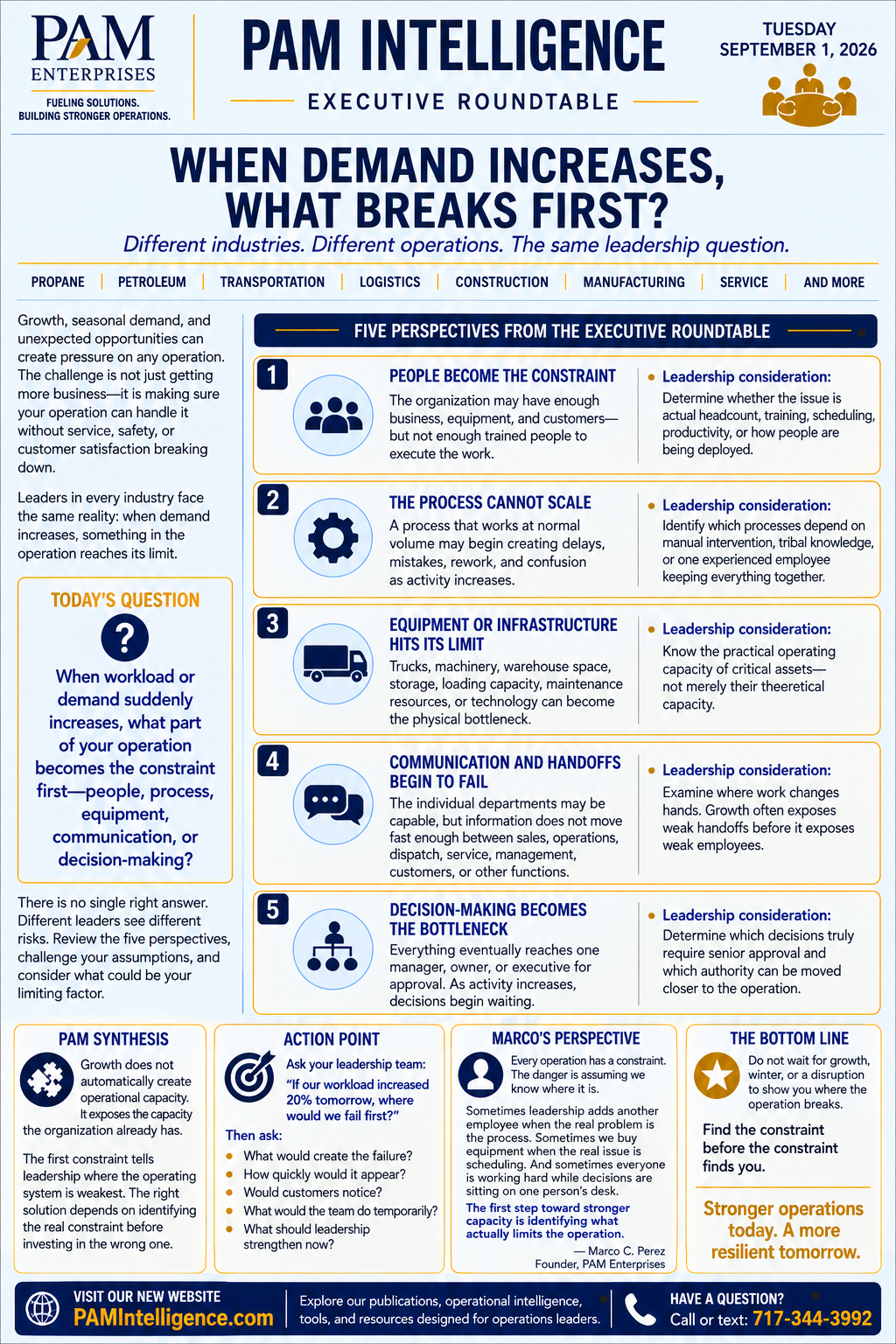
View Designed Edition1 original publication pageToday’s Question
Growth, seasonal demand, and unexpected opportunities can create pressure on any operation. The challenge is not just getting more business—it is making sure your operation can handle it without service, safety, or customer satisfaction breaking down.
Leaders in every industry face the same reality: when demand increases, something in the operation reaches its limit.
When workload or demand suddenly increases, what part of your operation becomes the constraint first—people, process, equipment, communication, or decision-making?
There is no single right answer. Different leaders see different risks. Review the five perspectives, challenge your assumptions, and consider what could be your limiting factor.
Five Perspectives From the Executive Roundtable
1. PEOPLE BECOME THE CONSTRAINT
The organization may have enough business, equipment, and customers—but not enough trained people to execute the work.
Leadership consideration
- Determine whether the issue is actual headcount, training, scheduling, productivity, or how people are being deployed.
2. THE PROCESS CANNOT SCALE
A process that works at normal volume may begin creating delays, mistakes, rework, and confusion as activity increases.
Leadership consideration
- Identify which processes depend on manual intervention, tribal knowledge, or one experienced employee keeping everything together.
3. EQUIPMENT OR INFRASTRUCTURE HITS ITS LIMIT
Trucks, machinery, warehouse space, storage, loading capacity, maintenance resources, or technology can become the physical bottleneck.
Leadership consideration
- Know the practical operating capacity of critical assets—not merely their theoretical capacity.
4. COMMUNICATION AND HANDOFFS BEGIN TO FAIL
The individual departments may be capable, but information does not move fast enough between sales, operations, dispatch, service, management, customers, or other functions.
Leadership consideration
- Examine where work changes hands. Growth often exposes weak handoffs before it exposes weak employees.
5. DECISION-MAKING BECOMES THE BOTTLENECK
Everything eventually reaches one manager, owner, or executive for approval. As activity increases, decisions begin waiting.
Leadership consideration
- Determine which decisions truly require senior approval and which authority can be moved closer to the operation.