Web Edition
The national supply number is not the whole operating picture.
View Designed Edition2 original publication pagesExecutive Summary
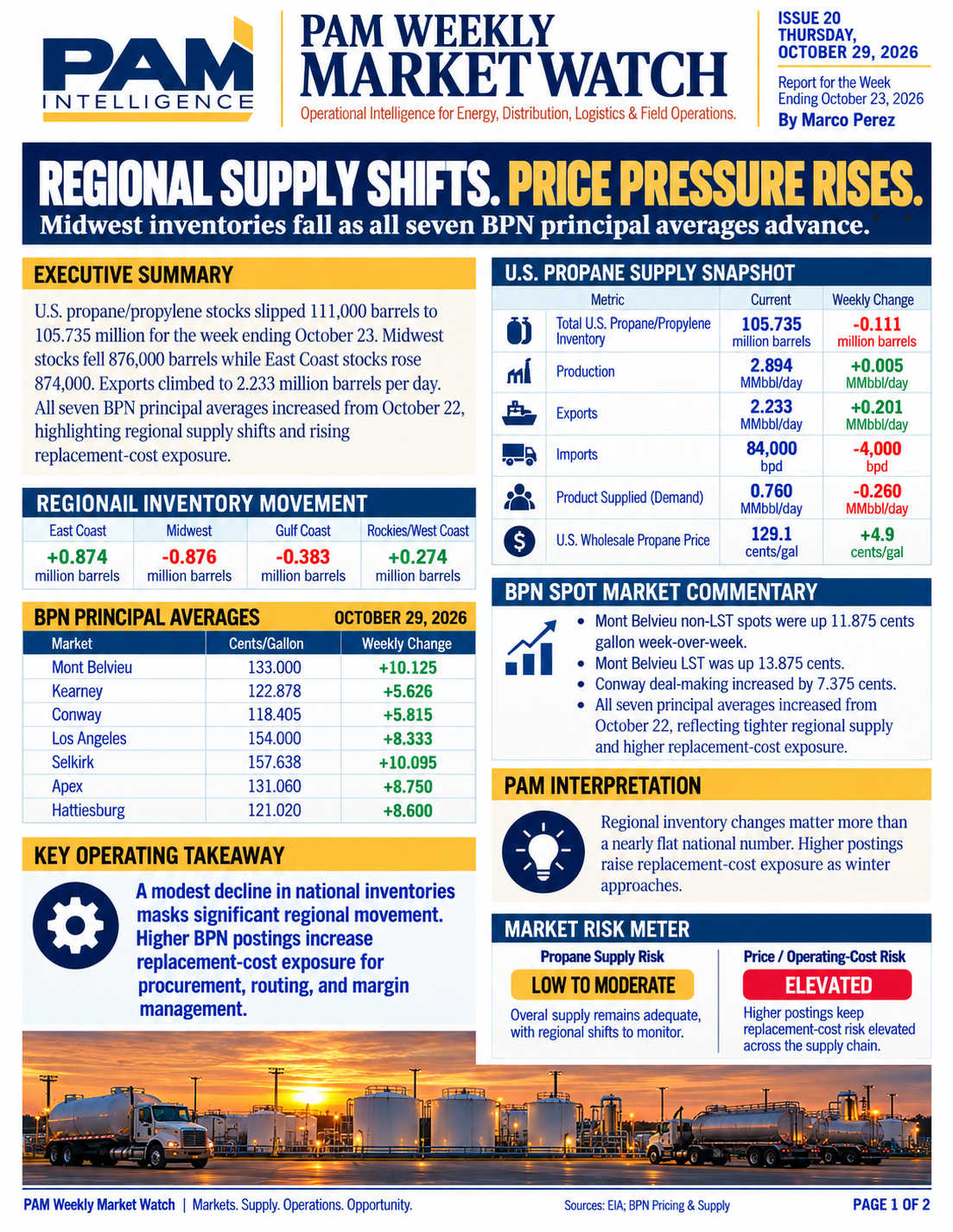
U.S. propane/propylene stocks slipped 111,000 barrels to 105.735 million for the week ending October 23. Midwest stocks fell 876,000 barrels while East Coast stocks rose 874,000. Exports climbed to 2.233 million barrels per day. All seven BPN principal averages increased from October 22, highlighting regional supply shifts and rising replacement-cost exposure.
U.S. Propane Supply Snapshot
| Metric | Current | Weekly change |
|---|---|---|
| Total U.S. propane/propylene inventory | 105.735 million barrels | −0.111 million barrels |
| Production | 2.894 MMbbl/day | +0.005 MMbbl/day |
| Exports | 2.233 MMbbl/day | +0.201 MMbbl/day |
| Imports | 84,000 bpd | −4,000 bpd |
| Product supplied (demand) | 0.760 MMbbl/day | −0.260 MMbbl/day |
| U.S. wholesale propane price | 129.1 cents/gallon | +4.9 cents/gallon |
Regional Inventory Movement
- East Coast: +0.874 million barrels
- Midwest: −0.876 million barrels
- Gulf Coast: −0.383 million barrels
- Rockies/West Coast: +0.274 million barrels
BPN Principal Averages — October 29, 2026
| Market | Cents/gallon | Weekly change |
|---|---|---|
| Mont Belvieu | 133.000 | +10.125 |
| Kearney | 122.878 | +5.626 |
| Conway | 118.405 | +5.815 |
| Los Angeles | 154.000 | +8.333 |
| Selkirk | 157.638 | +10.095 |
| Apex | 131.060 | +8.750 |
| Hattiesburg | 121.020 | +8.600 |
BPN Spot Market Commentary
- Mont Belvieu non-LST spots were up 11.875 cents per gallon week over week.
- Mont Belvieu LST was up 13.875 cents.
- Conway deal-making increased by 7.375 cents.
- All seven principal averages increased from October 22.
PAM interpretation: Regional inventory changes matter more than a nearly flat national number. Higher postings raise replacement-cost exposure as winter approaches.
Diesel & Fleet Operations
| Region | Price | Weekly change |
|---|---|---|
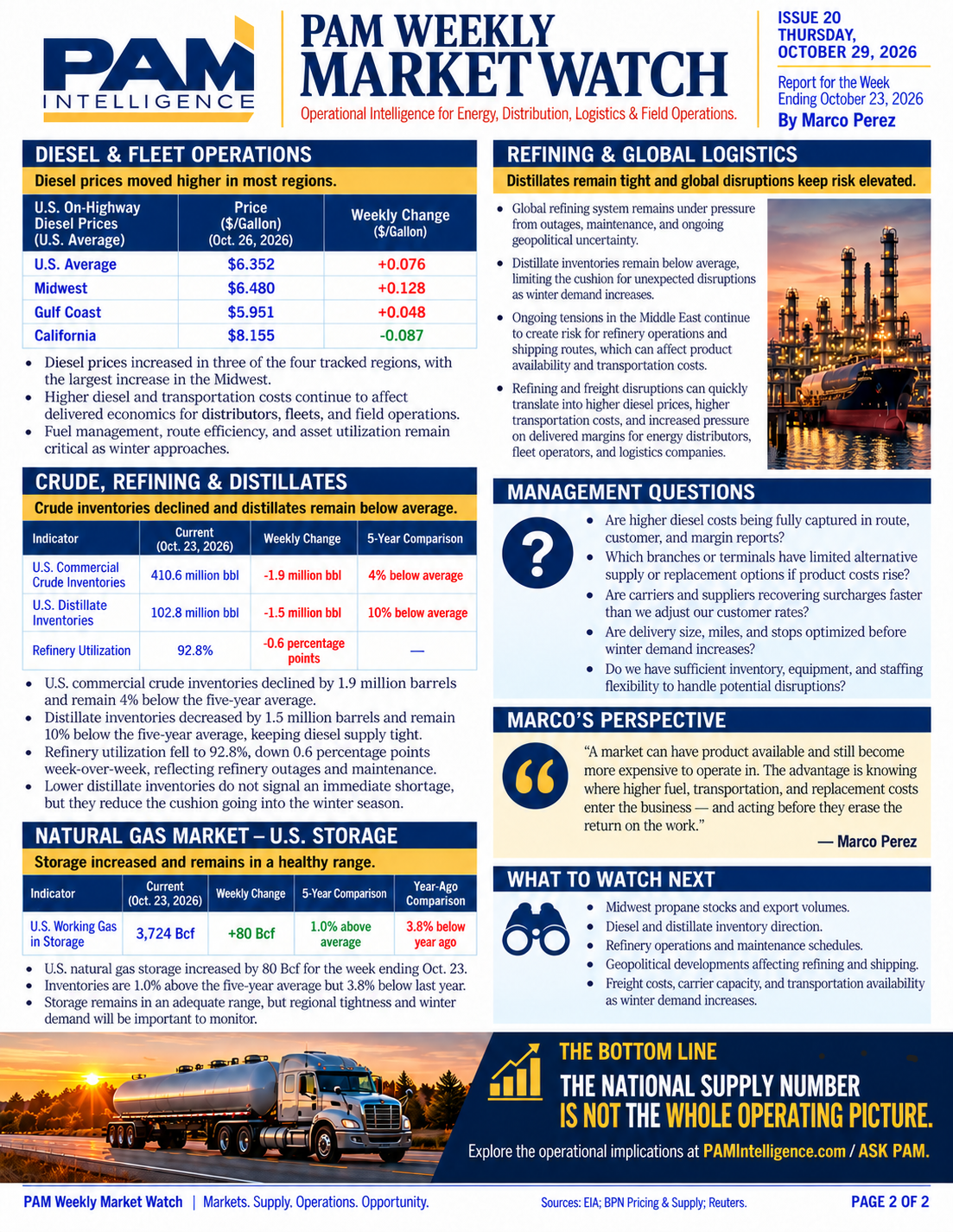
| U.S. average | $6.352 | +$0.076 |
| Midwest | $6.480 | +$0.128 |
| Gulf Coast | $5.951 | +$0.048 |
| California | $8.155 | −$0.087 |
Diesel increased in three of the four tracked regions, with the largest increase in the Midwest. Fuel management, route efficiency, and asset utilization remained critical.
Crude, Refining & Distillates
| Indicator | Current | Weekly change | Five-year comparison |
|---|---|---|---|
| U.S. commercial crude inventories | 410.6 million barrels | −1.9 million barrels | 4% below average |
| U.S. distillate inventories | 102.8 million barrels | −1.5 million barrels | 10% below average |
| Refinery utilization | 92.8% | −0.6 percentage points | — |
Lower distillate inventories did not signal an immediate shortage, but they reduced the cushion going into winter.
Natural Gas Market — U.S. Storage
| Indicator | Current | Weekly change | Five-year comparison | Year-ago comparison |
|---|---|---|---|---|
| U.S. working gas in storage | 3,724 Bcf | +80 Bcf | 1.0% above average | 3.8% below year ago |
Storage remained in an adequate range, but regional tightness and winter demand remained important to monitor.
Refining & Global Logistics
- Global refining remained under pressure from outages, maintenance, and geopolitical uncertainty.
- Distillate inventories remained below average, limiting the cushion for unexpected disruptions as winter demand increased.
- Middle East tensions continued to create risk for refinery operations, shipping routes, product availability, and transportation costs.
- Refining and freight disruptions can translate into higher diesel prices and delivered-margin pressure.
Management Questions
- Are higher diesel costs being fully captured in route, customer, and margin reports?
- Which branches or terminals have limited alternative supply or replacement options if product costs rise?
- Are carriers and suppliers recovering surcharges faster than customer rates are adjusted?
- Are delivery size, miles, and stops optimized before winter demand increases?
- Is there sufficient inventory, equipment, and staffing flexibility to handle potential disruptions?
What to Watch Next
- Midwest propane stocks and export volumes
- Diesel and distillate inventory direction
- Refinery operations and maintenance schedules
- Geopolitical developments affecting refining and shipping
- Freight costs, carrier capacity, and transportation availability
Marco’s Perspective: “A market can have product available and still become more expensive to operate in. The advantage is knowing where higher fuel, transportation, and replacement costs enter the business—and acting before they erase the return on the work.”