Web Edition
Leadership may understand where the company is going. Employees often experience only the turn.
View Designed Edition 4 original publication pagesWhen Normal Becomes the Problem
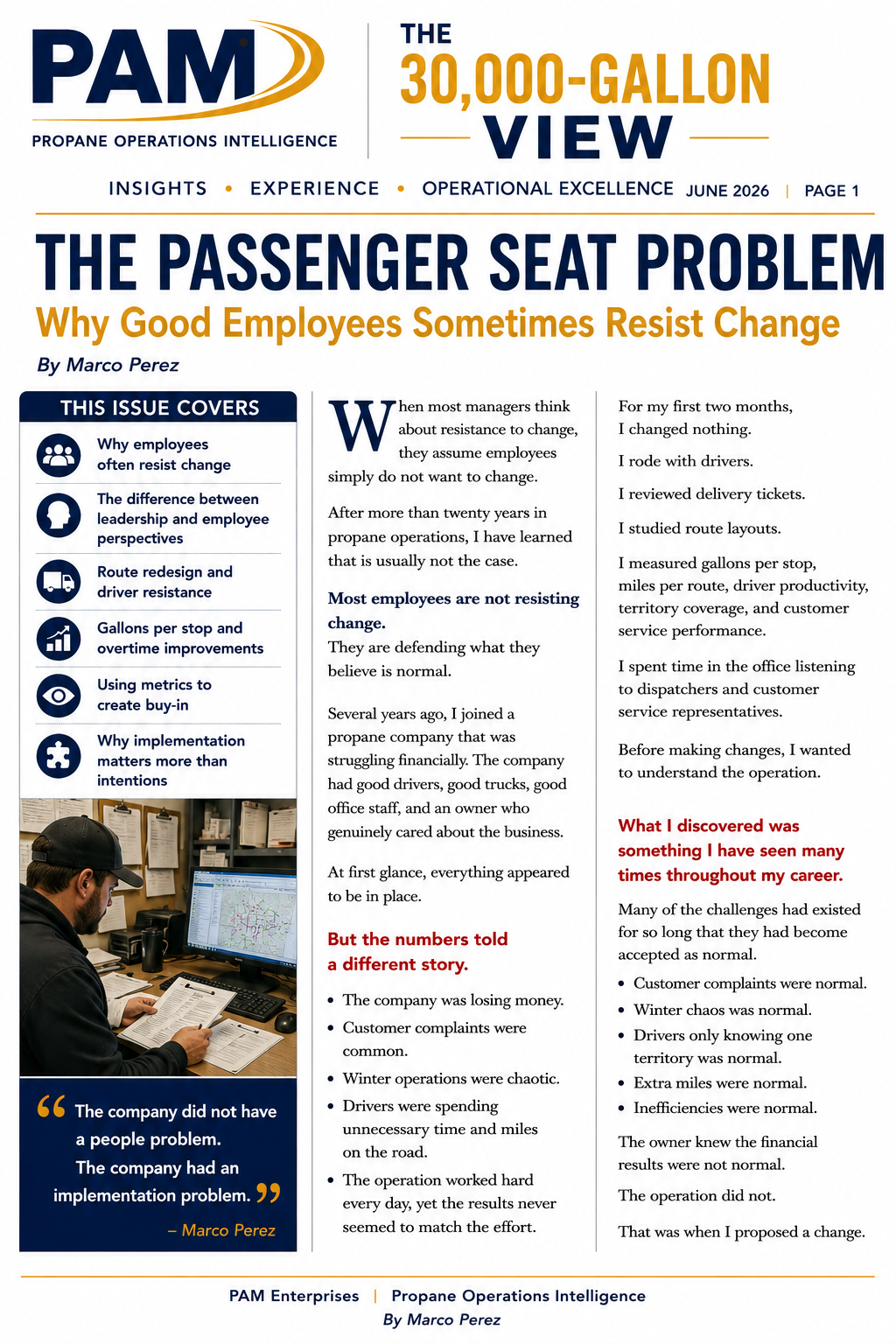
When managers think about resistance to change, they often assume employees simply do not want to change. After more than twenty years in propane operations, I have learned that is usually not the case. Most employees are not resisting change. They are defending what they believe is normal.
Several years ago, I joined a propane company that was struggling financially. The company had good drivers, good trucks, good office staff, and an owner who genuinely cared about the business. At first glance, everything appeared to be in place.
But the numbers told a different story.
- The company was losing money.
- Customer complaints were common.
- Winter operations were chaotic.
- Drivers were spending unnecessary time and miles on the road.
The operation worked hard every day, yet the results never seemed to match the effort.
For my first two months, I changed nothing. I rode with drivers. I reviewed delivery tickets. I studied route layouts. I measured gallons per stop, miles per route, driver productivity, territory coverage, and customer service performance. I spent time in the office listening to dispatchers and customer service representatives.
Before making changes, I wanted to understand the operation.
What I discovered was something I have seen many times throughout my career. Many of the challenges had existed for so long that they had become accepted as normal.
Customer complaints were normal. Winter chaos was normal. Drivers only knowing one territory was normal. Extra miles were normal. Inefficiencies were normal.
The owner knew the financial results were not normal. The operation did not.
That was when I proposed a change.
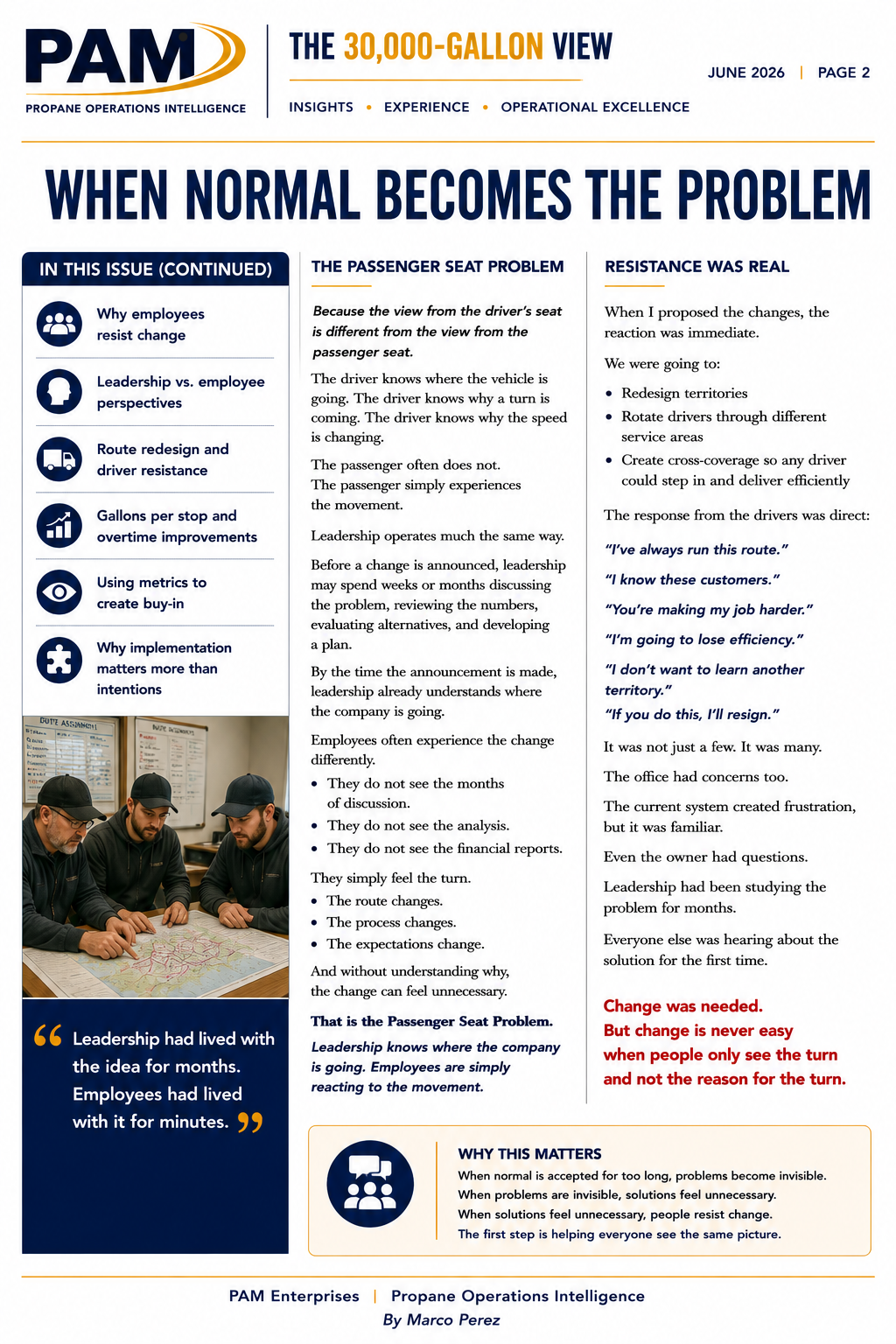
The Passenger Seat Problem
The view from the driver’s seat is different from the view from the passenger seat. The driver knows where the vehicle is going, why a turn is coming, and why speed is changing. The passenger simply experiences the movement.
Leadership operates much the same way. Before a change is announced, leadership may spend weeks or months discussing the problem, reviewing the numbers, evaluating alternatives, and developing a plan. By the time the announcement is made, leadership already understands where the company is going.
Employees often experience the change differently.
- They do not see the months of discussion.
- They do not see the analysis.
- They do not see the financial reports.
- They simply feel the turn.
- The route changes.
- The process changes.
- The expectations change.
And without understanding why, the change can feel unnecessary.
That is the Passenger Seat Problem. Leadership knows where the company is going. Employees are simply reacting to the movement.
Leadership had lived with the idea for months. Employees had lived with it for minutes.
Resistance Was Real
When I proposed the changes, the reaction was immediate. We were going to:
- Redesign territories
- Rotate drivers through different service areas
- Create cross-coverage so any driver could step in and deliver efficiently
The response from the drivers was direct: “I’ve always run this route.” “I know these customers.” “You’re making my job harder.” “I’m going to lose efficiency.” “I don’t want to learn another territory.” “If you do this, I’ll resign.”
It was not just a few. It was many.
The office had concerns too. The current system created frustration, but it was familiar. Even the owner had questions.
Leadership had been studying the problem for months. Everyone else was hearing about the solution for the first time.
Change was needed. But change is never easy when people only see the turn and not the reason for the turn.
Why This Matters
When normal is accepted for too long, problems become invisible. When problems are invisible, solutions feel unnecessary. When solutions feel unnecessary, people resist change.
The first step is helping everyone see the same picture.
From Opinion to Results
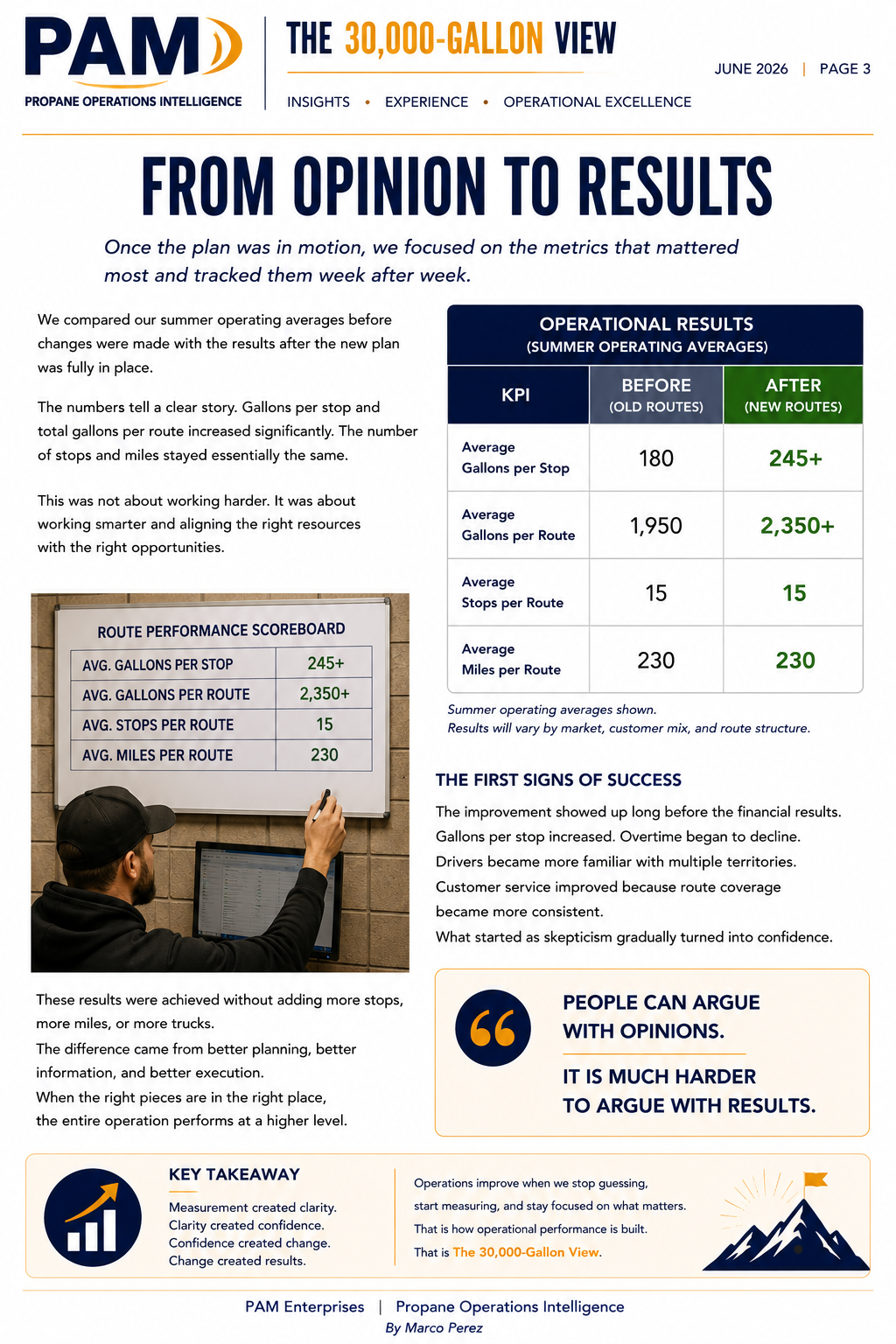
Once the plan was in motion, we focused on the metrics that mattered most and tracked them week after week. We compared our summer operating averages before changes were made with the results after the new plan was fully in place.
The numbers tell a clear story. Gallons per stop and total gallons per route increased significantly. The number of stops and miles stayed essentially the same. This was not about working harder. It was about working smarter and aligning the right resources with the right opportunities.
- Average gallons per stop: 180 before; 245+ after
- Average gallons per route: 1,950 before; 2,350+ after
- Average stops per route: 15 before and after
- Average miles per route: 230 before and after
These results were achieved without adding more stops, more miles, or more trucks. The difference came from better planning, better information, and better execution.
Summer operating averages shown. Results will vary by market, customer mix, and route structure.
The First Signs of Success
- Gallons per stop increased.
- Overtime began to decline.
- Drivers became familiar with multiple territories.
- Customer service improved because route coverage became more consistent.
What started as skepticism gradually turned into confidence. People can argue with opinions. It is much harder to argue with results.
When the right pieces are in the right place, the entire operation performs at a higher level.
Putting the Pieces in the Right Place
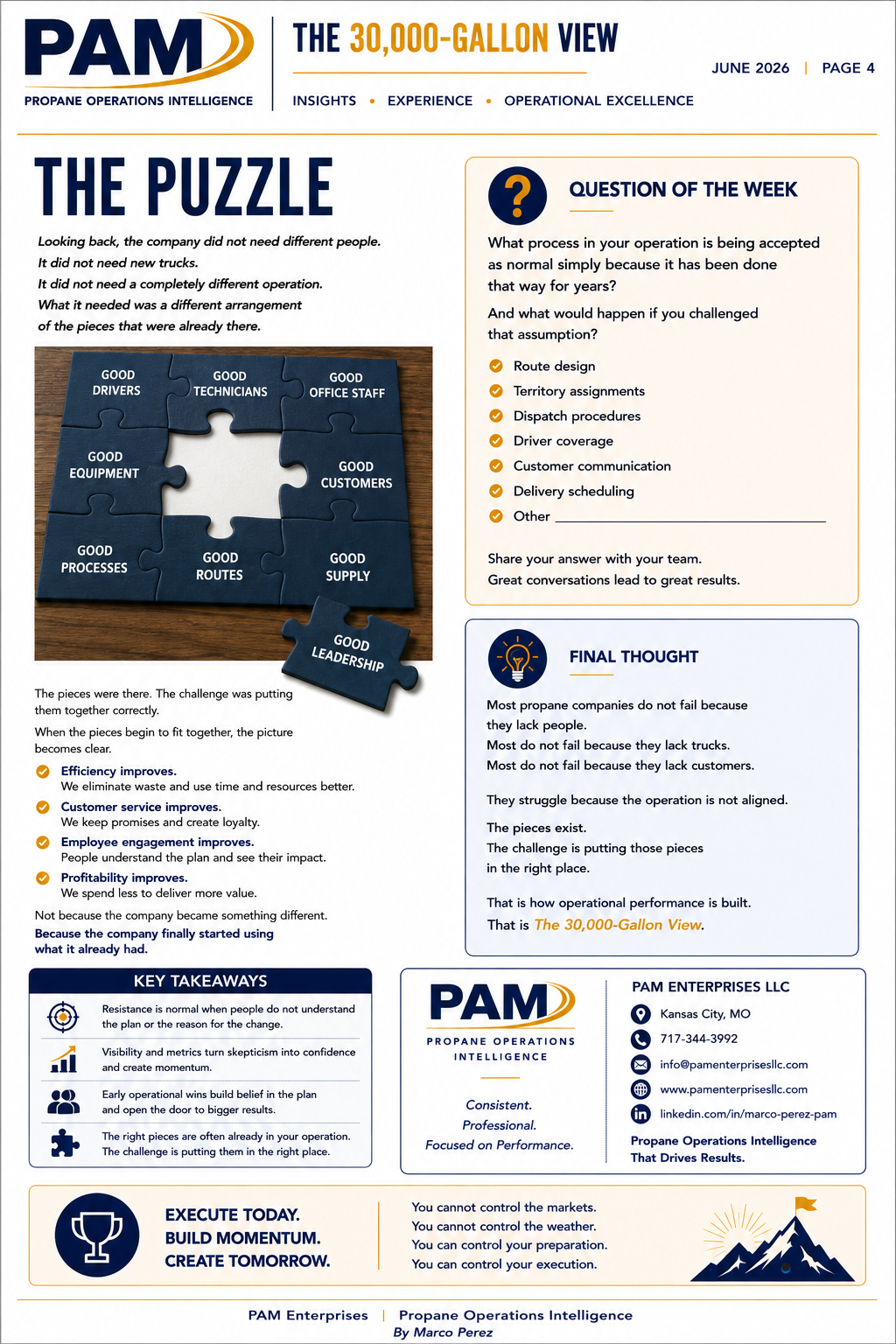
Looking back, the company did not need different people. It did not need new trucks. It did not need a completely different operation.
What it needed was a different arrangement of the pieces that were already there.
- Good drivers
- Good equipment
- Good processes
- Good technicians
- Good routes
- Good office staff
- Good customers
- Good supply
- Good leadership
The pieces were there. The challenge was putting them together correctly.
When the pieces begin to fit together, the picture becomes clear.
- Efficiency improves. We eliminate waste and use time and resources better.
- Customer service improves. We keep promises and create loyalty.
- Employee engagement improves. People understand the plan and see their impact.
- Profitability improves. We spend less to deliver more value.
Not because the company became something different. Because the company finally started using what it already had.
Key Takeaways
- Resistance is normal when people do not understand the plan or reason for change.
- Data and metrics turn skepticism into confidence and create momentum.
- Early operational wins build belief in the plan and open the door to bigger results.
- The right pieces are often already in the operation. The challenge is putting them in the right place.