Web Edition
The goal of centralization should be to improve local decisions, not replace them.
View Designed Edition4 original publication pagesWhy Centralization Appeals to Leaders
Most centralization efforts begin with good intentions. Organizations grow. Branches multiply. Managers develop different habits. Processes begin to vary from location to location. Leadership naturally begins searching for consistency.
The goal is understandable. Customers should receive a similar experience regardless of location. Safety standards should be consistent. Reporting should be accurate. Resources should be shared. Best practices should be available to everyone.
Centralization promises to solve many of those challenges. In many cases, it does. Some organizations improve dramatically after introducing centralized systems, standards, and oversight.
The question is not whether centralization works. The question is where centralization stops and local ownership begins.
The Difference Between Information and Decisions
One of the most common leadership mistakes occurs when organizations confuse centralized information with centralized decision-making. These are not the same thing.
- Centralized information provides visibility.
- Centralized decision-making transfers authority.
Visibility can strengthen an organization. Removing authority from people closest to the customer can weaken it. The strongest organizations learn to balance both. They create standards without eliminating judgment. They improve consistency without eliminating accountability. They centralize information while keeping ownership close to the work.
When Standardization Meets Reality
Systems can be designed for efficiency. But they cannot be designed with local knowledge.
The first place the gap between centralized decisions and local knowledge showed up was in routing. The central team had the data, software, and algorithms. From their desks, they could see every ticket, address, gallon, time window, and mile. On paper, the routes looked efficient. In the field, they were not.
The Limits of Data
No matter how advanced the routing software was, it could not see what a branch manager sees every day: road construction, narrow streets, seasonal traffic, customers who need extra time, or the drivers' individual strengths, limitations, and experience.
The system saw data. The managers saw reality.
Pressure to Push More
Once the centralized routing team believed the routes were efficient, the next step was to push more tickets: more stops, more gallons, more miles. The assumption was simple: if the software could do it, the drivers could do it.
When managers pushed back, the response was predictable: “You’re resisting change.” “You just want to go back to the old way.” “Trust the system.” But the issue was never about going back. It was about telling the truth. Field feedback was treated as friction.
The Cost of Getting Routes Wrong
- Drivers were behind all day and routes were unrealistic.
- Customers were frustrated and deliveries were late.
- Emergency calls and overtime increased.
- Gallons per hour dropped while travel time increased.
- Best customers started leaving.
The system looked efficient. The business became less effective.
Key Takeaway“The best system fails when it ignores what the people closest to the work already know.”
The Feedback Loop That Broke
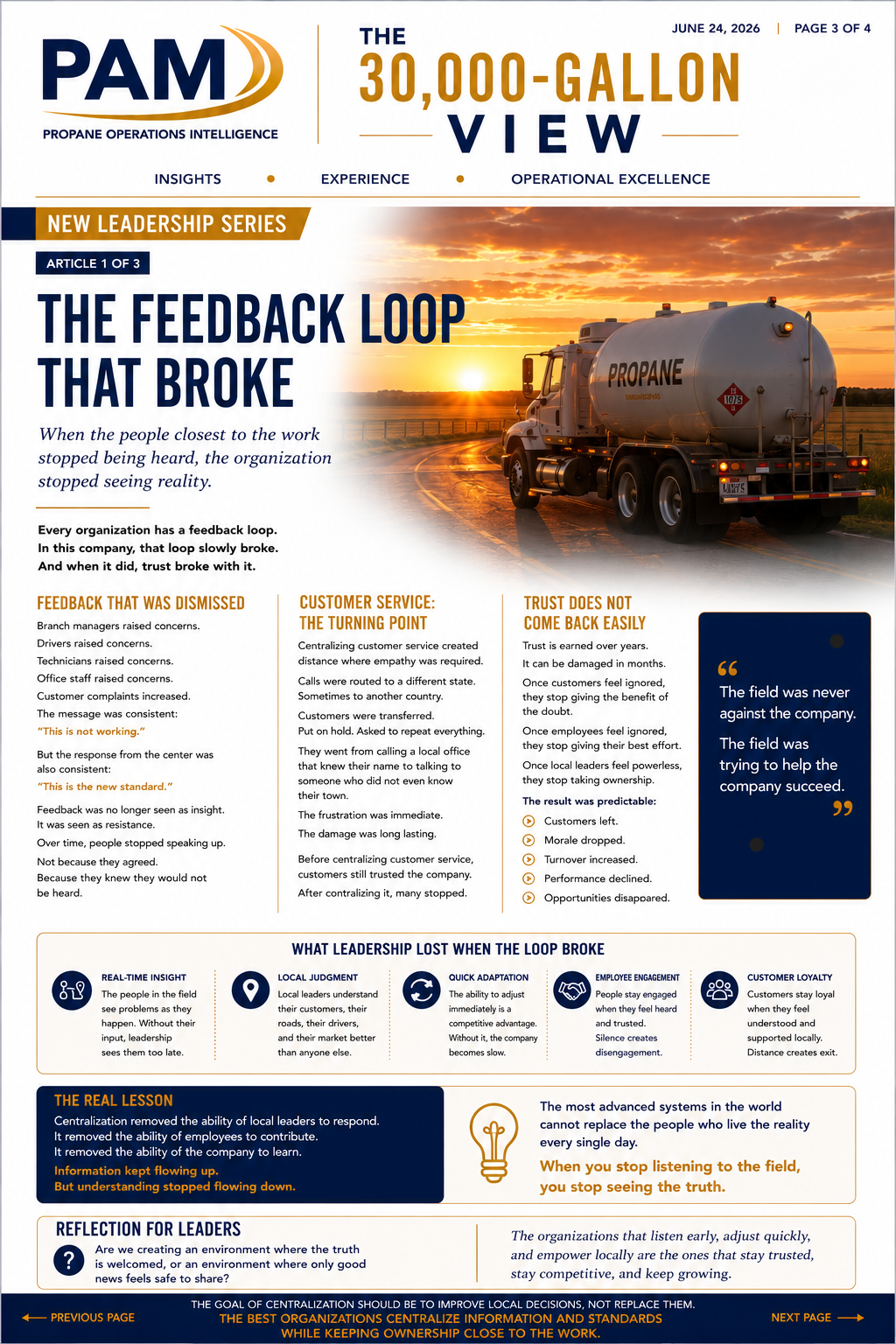
When the people closest to the work stopped being heard, the organization stopped seeing reality.
Every organization has a feedback loop. In this company, that loop slowly broke. And when it did, trust broke with it.
Feedback That Was Dismissed
Branch managers, drivers, technicians, and office staff raised concerns. Customer complaints increased. The message was consistent: “This is not working.” But the response from the center was also consistent: “This is the new standard.”
Feedback was no longer seen as insight. It was seen as resistance. Over time, people stopped speaking up—not because they agreed, but because they knew they would not be heard.
Customer Service: The Turning Point
Centralizing customer service created distance where empathy was required. Calls were routed to a different state, sometimes another country. Customers were transferred, put on hold, and asked to repeat everything. They went from calling a local office that knew their name to talking to someone who did not even know their town.
Trust Does Not Come Back Easily
Trust is earned over years. It can be damaged in months. Once customers feel ignored, they stop giving the benefit of the doubt. Once employees feel ignored, they stop giving their best effort. Once local leaders feel powerless, they stop taking ownership.
- Customers left.
- Morale dropped.
- Turnover increased.
- Performance declined.
- Opportunities disappeared.
The Balance That Builds Strong Companies
Centralize information. Empower local decisions. Unite the company.
Centralization is not the enemy. Poorly designed centralization is. When information flows up and judgment stays local, organizations become both consistent and effective.
Information Should Travel Up
Every branch should use the same information. Every location should measure performance the same way. Every leader should look at the same scorecard. Every customer record should be available throughout the organization. Information becomes a common language across the company.
Decisions Should Travel Down
The person closest to the customer should retain the ability to act. The person closest to the route should retain the ability to adjust. The person closest to the operation should retain the ability to respond.
Information should be centralized. Judgment should remain local. That is the balance that creates strength.
Before You Centralize, Ask
- Are we centralizing information or decisions?
- Are we increasing visibility or reducing ownership?
- Are we helping local leaders succeed or replacing their judgment?
- Are we listening to feedback or defending a process?
- Will this improve results in the field or only look good on paper?
What Strong Companies Do
Centralize information, standards, reporting, and visibility. Then decentralize decision-making. Trust local leaders. Empower local teams. Measure results, not activity. Listen to the field. Adjust with purpose.