Web Edition
The work between the work is real labor. Finding and reducing it can recover capacity, lower operating cost, and make execution easier.
View Designed Edition4 original publication pagesThe Work Between the Work
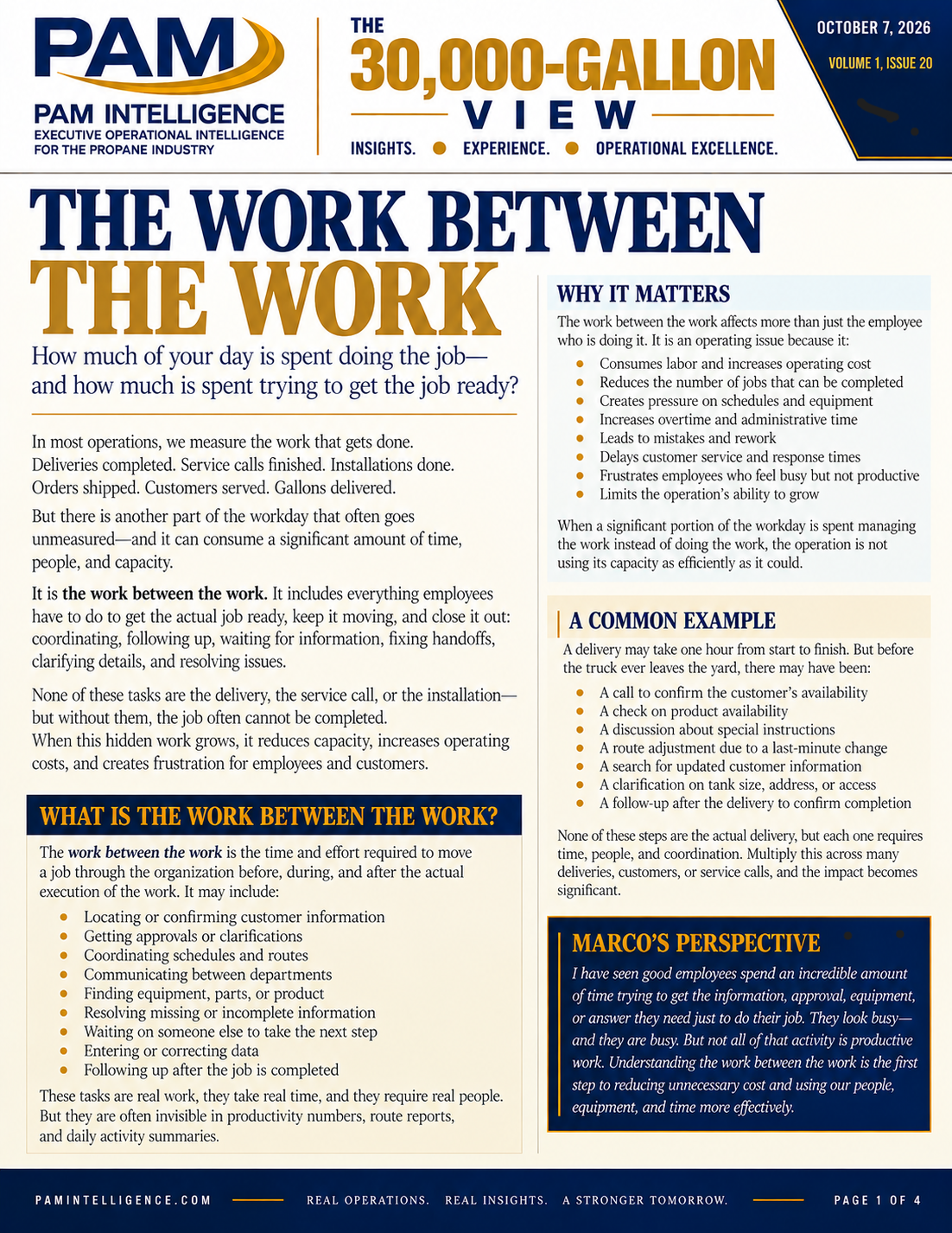
In most operations, we measure the work that gets done. Deliveries completed. Service calls finished. Installations done. Orders shipped. Customers served. Gallons delivered.
But there is another part of the workday that often goes unmeasured—and it can consume a significant amount of time, people, and capacity.
It is the work between the work. It includes everything employees have to do to get the actual job ready, keep it moving, and close it out: coordinating, following up, waiting for information, fixing handoffs, clarifying details, and resolving issues.
None of these tasks are the delivery, the service call, or the installation—but without them, the job often cannot be completed. When this hidden work grows, it reduces capacity, increases operating costs, and creates frustration for employees and customers.
What Is the Work Between the Work?
The work between the work is the time and effort required to move a job through the organization before, during, and after the actual execution of the work. It may include:
- Locating or confirming customer information
- Getting approvals or clarifications
- Coordinating schedules and routes
- Communicating between departments
- Finding equipment, parts, or product
- Resolving missing or incomplete information
- Waiting on someone else to take the next step
- Entering or correcting data
- Following up after the job is completed
These tasks are real work, they take real time, and they require real people. But they are often invisible in productivity numbers, route reports, and daily activity summaries.
Why It Matters
The work between the work affects more than just the employee who is doing it. It is an operating issue because it:
- Consumes labor and increases operating cost
- Reduces the number of jobs that can be completed
- Creates pressure on schedules and equipment
- Increases overtime and administrative time
- Leads to mistakes and rework
- Delays customer service and response times
- Frustrates employees who feel busy but not productive
- Limits the operation’s ability to grow
When a significant portion of the workday is spent managing the work instead of doing the work, the operation is not using its capacity as efficiently as it could.
A Common Example
A delivery may take one hour from start to finish. But before the truck ever leaves the yard, there may have been:
- A call to confirm the customer’s availability
- A check on product availability
- A discussion about special instructions
- A route adjustment due to a last-minute change
- A search for updated customer information
- A clarification on tank size, address, or access
- A follow-up after the delivery to confirm completion
None of these steps are the actual delivery, but each one requires time, people, and coordination. Multiply this across many deliveries, customers, or service calls, and the impact becomes significant.
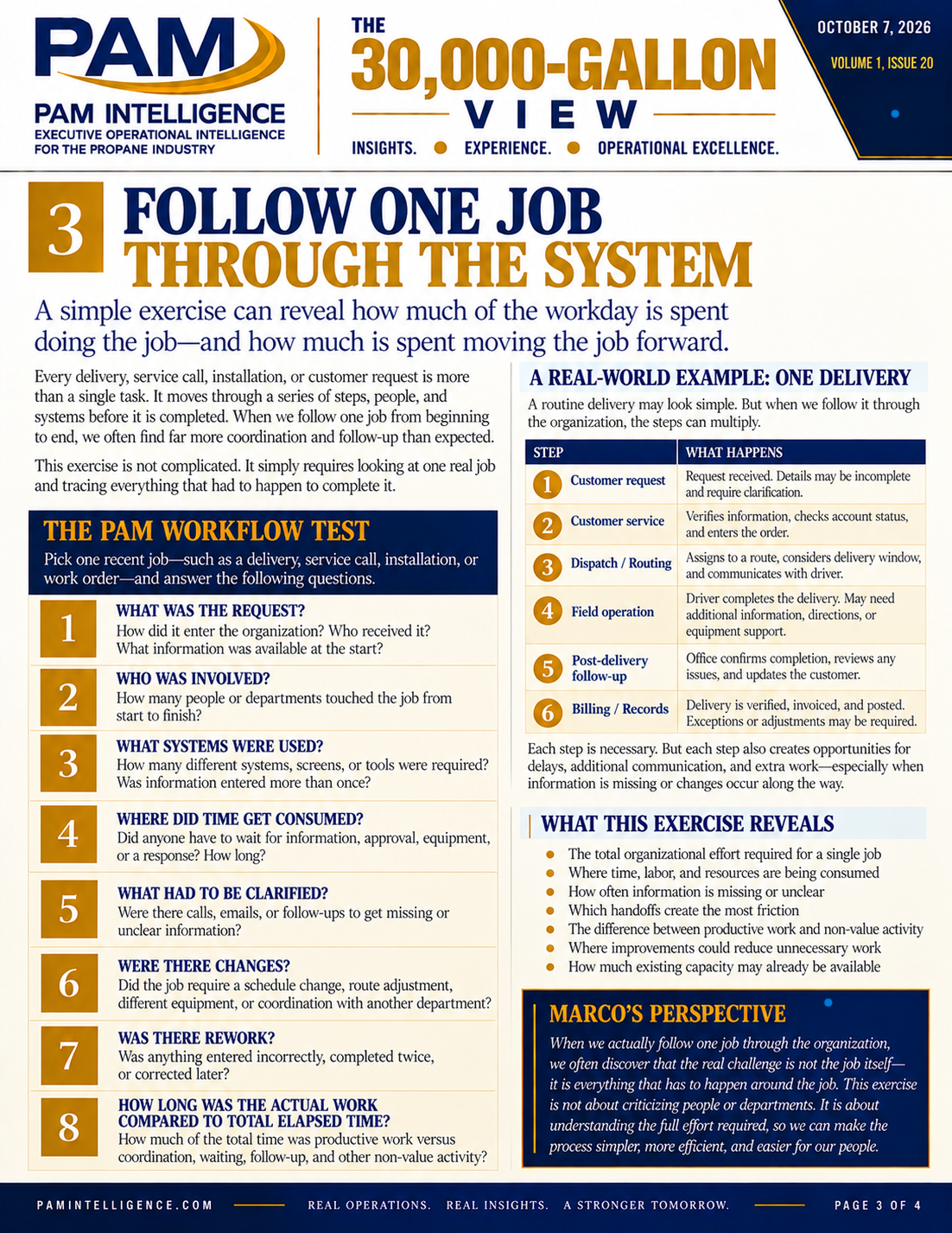
Follow One Job Through the System
A simple exercise can reveal how much of the workday is spent doing the job—and how much is spent moving the job forward.
Every delivery, service call, installation, or customer request is more than a single task. It moves through a series of steps, people, and systems before it is completed. When we follow one job from beginning to end, we often find far more coordination and follow-up than expected.
This exercise is not complicated. It simply requires looking at one real job and tracking everything that had to happen to complete it.
The PAM Workflow Test
Pick one recent job—such as a delivery, service call, installation, or work order—and answer the following questions.
- What Was the Request? How did it enter the organization? Who received it? What information was available at the start?
- Who Was Involved? How many people or departments touched the job from start to finish?
- What Systems Were Used? How many different systems, screens, or tools were required? Was information entered more than once?
- Where Did Time Get Consumed? Did anyone have to wait for information, approval, equipment, or a response? How long?
- What Had to Be Clarified? Were there calls, emails, or follow-ups to get missing or unclear information?
- Were There Changes? Did the job require a schedule change, route adjustment, different equipment, or coordination with another department?
- Was There Rework? Was anything entered incorrectly, completed twice, or corrected later?
- How Long Was the Actual Work Compared to Total Elapsed Time? How much of the total time was productive work versus coordination, waiting, follow-up, and other non-value activity?
A Real-World Example: One Delivery
A routine delivery may look simple. But when we follow it through the organization, the steps can multiply.
| Step | What Happens |
|---|---|
| 1 · Customer request | Request received. Details may be incomplete and require clarification. |
| 2 · Customer service | Verifies information, checks account status, and enters the order. |
| 3 · Dispatch / Routing | Assigns to a route, considers delivery window, and communicates with driver. |
| 4 · Field operation | Driver completes the delivery. May need additional information, directions, or equipment support. |
| 5 · Post-delivery follow-up | Office confirms completion, reviews any issues, and updates the customer. |
| 6 · Billing / Records | Delivery is verified, invoiced, and posted. Exceptions or adjustments may be required. |
Each step is necessary. But each step also creates opportunities for delays, additional communication, and extra work—especially when information is missing or changes occur along the way.
What This Exercise Reveals
- The total organizational effort required for a single job
- Where time, labor, and resources are being consumed
- How often information is missing or unclear
- Which handoffs create the most friction
- The difference between productive work and non-value activity
- Where improvements could reduce unnecessary work
- How much existing capacity may already be available
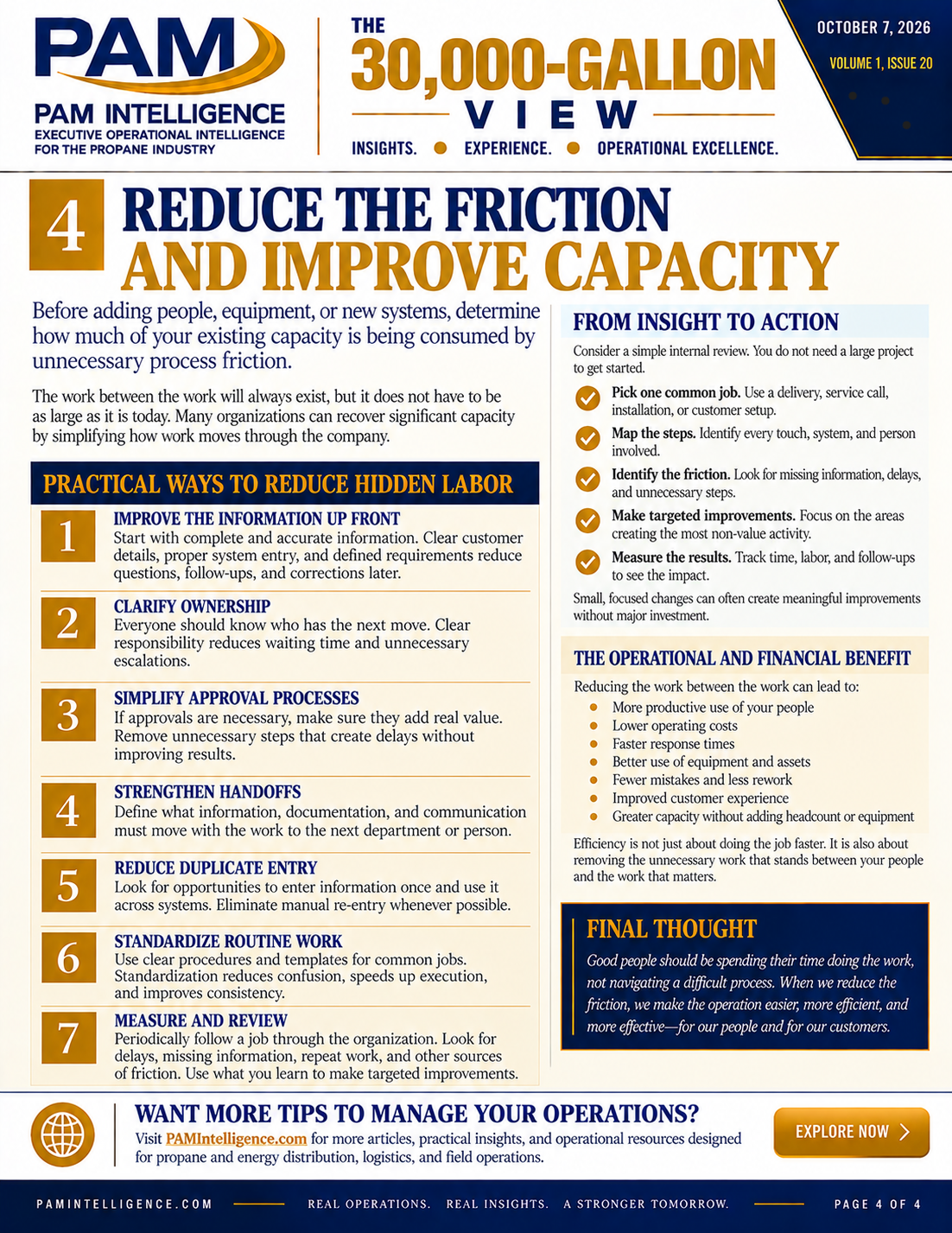
Reduce the Friction and Improve Capacity
Before adding people, equipment, or new systems, determine how much of your existing capacity is being consumed by unnecessary process friction.
The work between the work will always exist, but it does not have to be as large as it is today. Many organizations can recover significant capacity by simplifying how work moves through the company.
Practical Ways to Reduce Hidden Labor
- Improve the Information Up Front. Start with complete and accurate information. Clear customer details, proper system entry, and defined requirements reduce questions, follow-ups, and corrections later.
- Clarify Ownership. Everyone should know who has the next move. Clear responsibility reduces waiting time and unnecessary escalations.
- Simplify Approval Processes. If approvals are necessary, make sure they add real value. Remove unnecessary steps that create delays without improving results.
- Strengthen Handoffs. Define what information, documentation, and communication must move with the work to the next department or person.
- Reduce Duplicate Entry. Look for opportunities to enter information once and use it across systems. Eliminate manual re-entry whenever possible.
- Standardize Routine Work. Use clear procedures and templates for common jobs. Standardization reduces confusion, speeds up execution, and improves consistency.
- Measure and Review. Periodically follow a job through the organization. Look for delays, missing information, repeat work, and other sources of friction. Use what you learn to make targeted improvements.
From Insight to Action
Consider a simple internal review. You do not need a large project to get started.
- Pick one common job. Use a delivery, service call, installation, or customer setup.
- Map the steps. Identify every touch, system, and person involved.
- Identify the friction. Look for missing information, delays, and unnecessary steps.
- Make targeted improvements. Focus on the areas creating the most non-value activity.
- Measure the results. Track time, labor, and follow-ups to see the impact.
Small, focused changes can often create meaningful improvements without major investment.
The Operational and Financial Benefit
Reducing the work between the work can lead to:
- More productive use of your people
- Lower operating costs
- Faster response times
- Better use of equipment and assets
- Fewer mistakes and less rework
- Improved customer experience
- Greater capacity without adding headcount or equipment
Efficiency is not just about doing the job faster. It is also about removing the unnecessary work that stands between your people and the work that matters.