Web Edition
When we only look at the surface, we treat the symptom. When we look deeper, we solve the problem.
View Designed Edition4 original publication pagesWhy Symptoms Get Mistaken for Problems
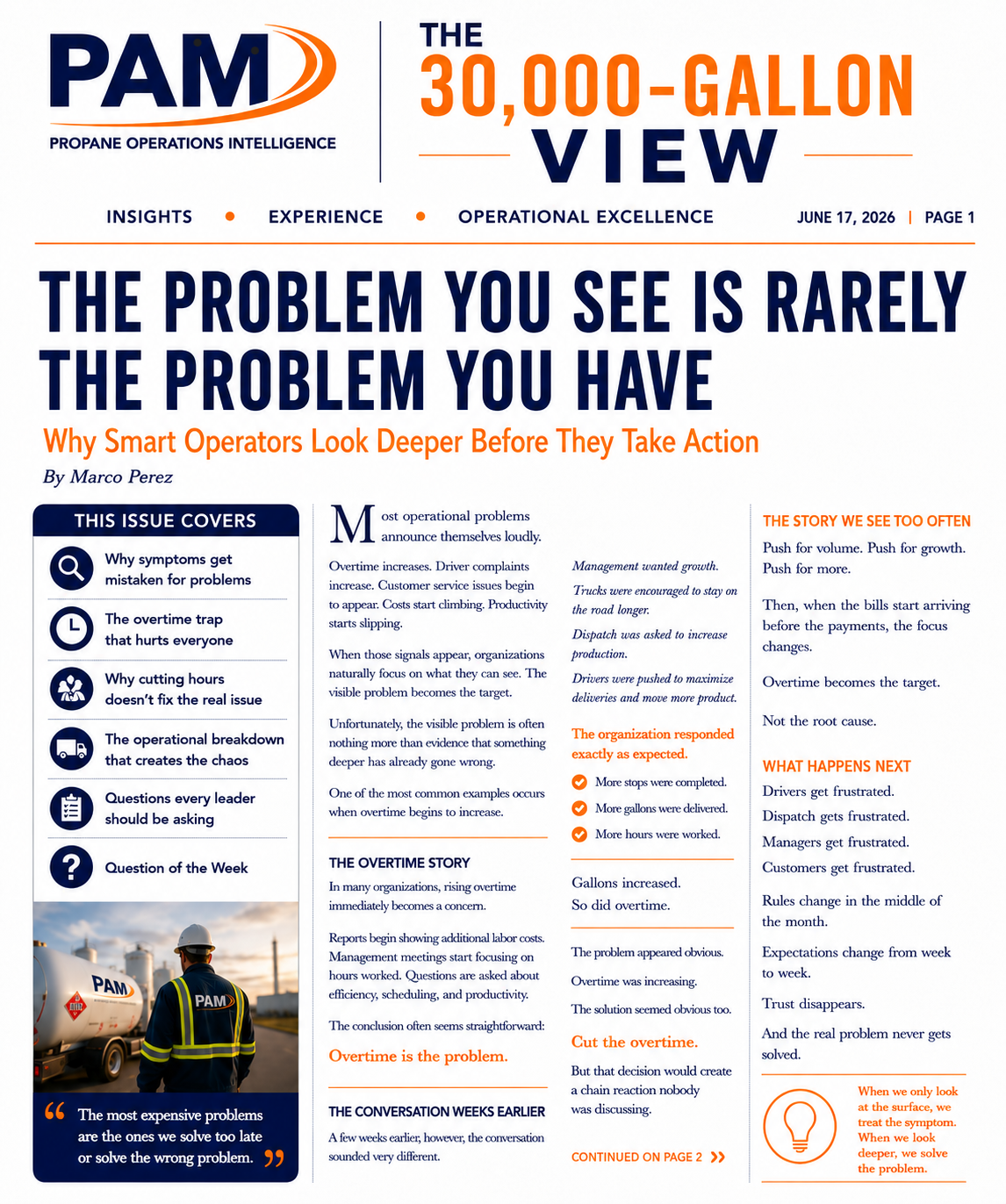
Most operational problems announce themselves loudly. Overtime increases. Driver complaints increase. Customer service issues begin to appear. Costs start climbing. Productivity starts slipping.
When those signals appear, organizations naturally focus on what they can see. The visible problem becomes the target. Unfortunately, the visible problem is often nothing more than evidence that something deeper has already gone wrong.
The Overtime Story
In many organizations, rising overtime immediately becomes a concern. Reports show additional labor costs. Meetings focus on hours worked. Questions are asked about efficiency, scheduling, and productivity. The conclusion seems straightforward: overtime is the problem.
A few weeks earlier, however, management wanted growth. Trucks were encouraged to stay on the road longer. Dispatch was asked to increase production. Drivers were pushed to maximize deliveries and move more product. The organization responded exactly as expected: more stops, more gallons, and more hours.
Gallons increased. So did overtime. The problem appeared obvious. The solution seemed obvious too: cut the overtime. But that decision would create a chain reaction nobody was discussing.
The story we see too often is a push for volume, growth, and more. Then, when bills arrive before payments, the focus changes. Overtime becomes the target—not the root cause. Rules change in the middle of the month. Expectations change from week to week. Trust disappears. The real problem never gets solved.
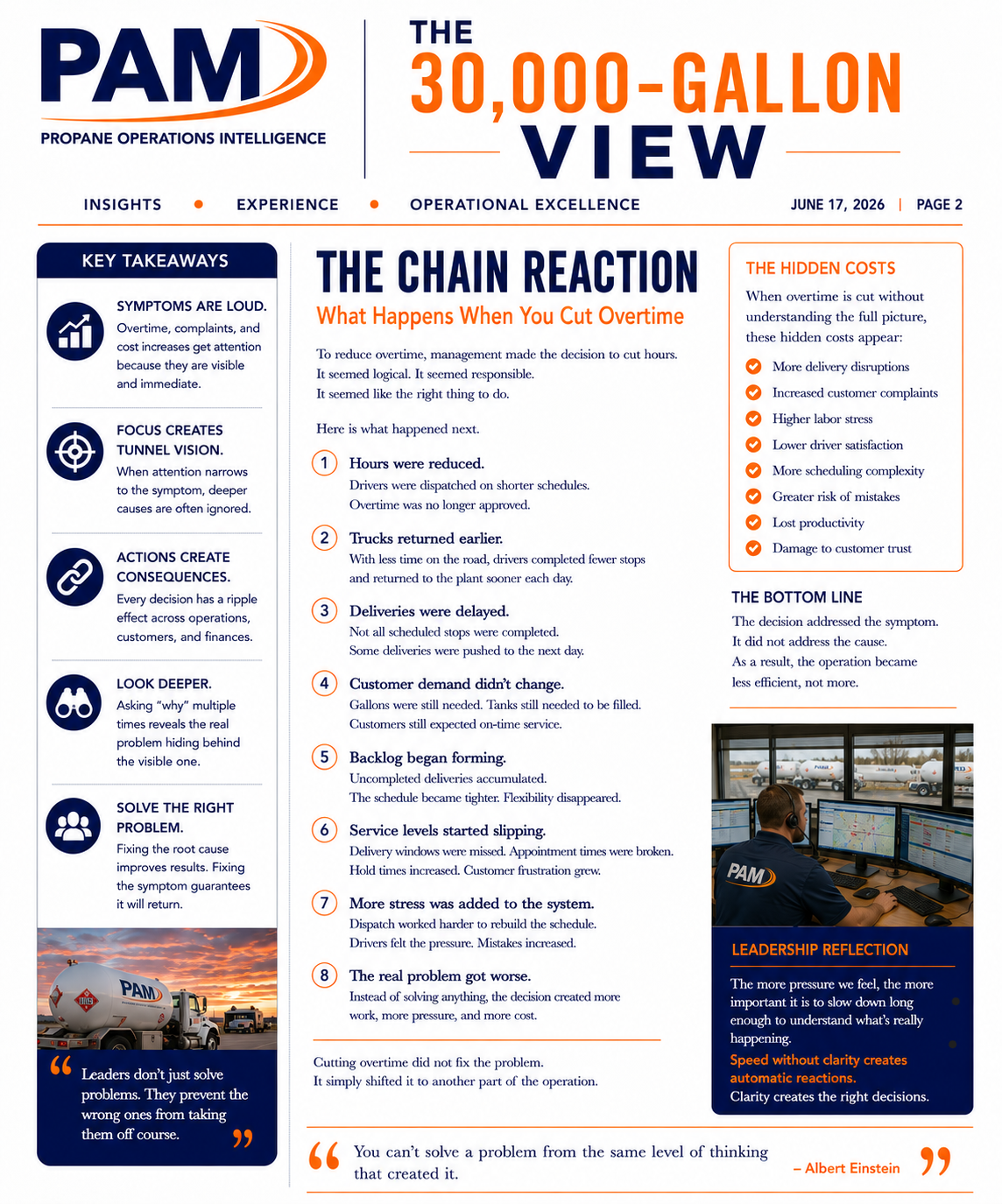
The Chain Reaction
What happens when you cut overtime.
To reduce overtime, management made the decision to cut hours. It seemed logical, responsible, and like the right thing to do. Here is what happened next.
- Hours were reduced. Drivers were dispatched on shorter schedules. Overtime was no longer approved.
- Trucks returned earlier. With less time on the road, drivers completed fewer stops and returned sooner.
- Deliveries were delayed. Not all scheduled stops were completed. Some deliveries were pushed to the next day.
- Customer demand didn’t change. Gallons were still needed. Tanks still needed to be filled. Customers still expected on-time service.
- Backlog began forming. Uncompleted deliveries accumulated. The schedule became tighter. Flexibility disappeared.
- Service levels started slipping. Delivery windows were missed. Appointment times were broken. Hold times and customer frustration grew.
- More stress was added to the system. Dispatch worked harder to rebuild the schedule. Drivers felt the pressure. Mistakes increased.
- The real problem got worse. Instead of solving anything, the decision created more work, more pressure, and more cost.
Cutting overtime did not fix the problem. It simply shifted it to another part of the operation.
The Hidden Costs
- More delivery disruptions
- Increased customer complaints
- Higher labor stress
- Lower driver satisfaction
- More scheduling complexity
- Greater risk of mistakes
- Lost productivity
- Damage to customer trust
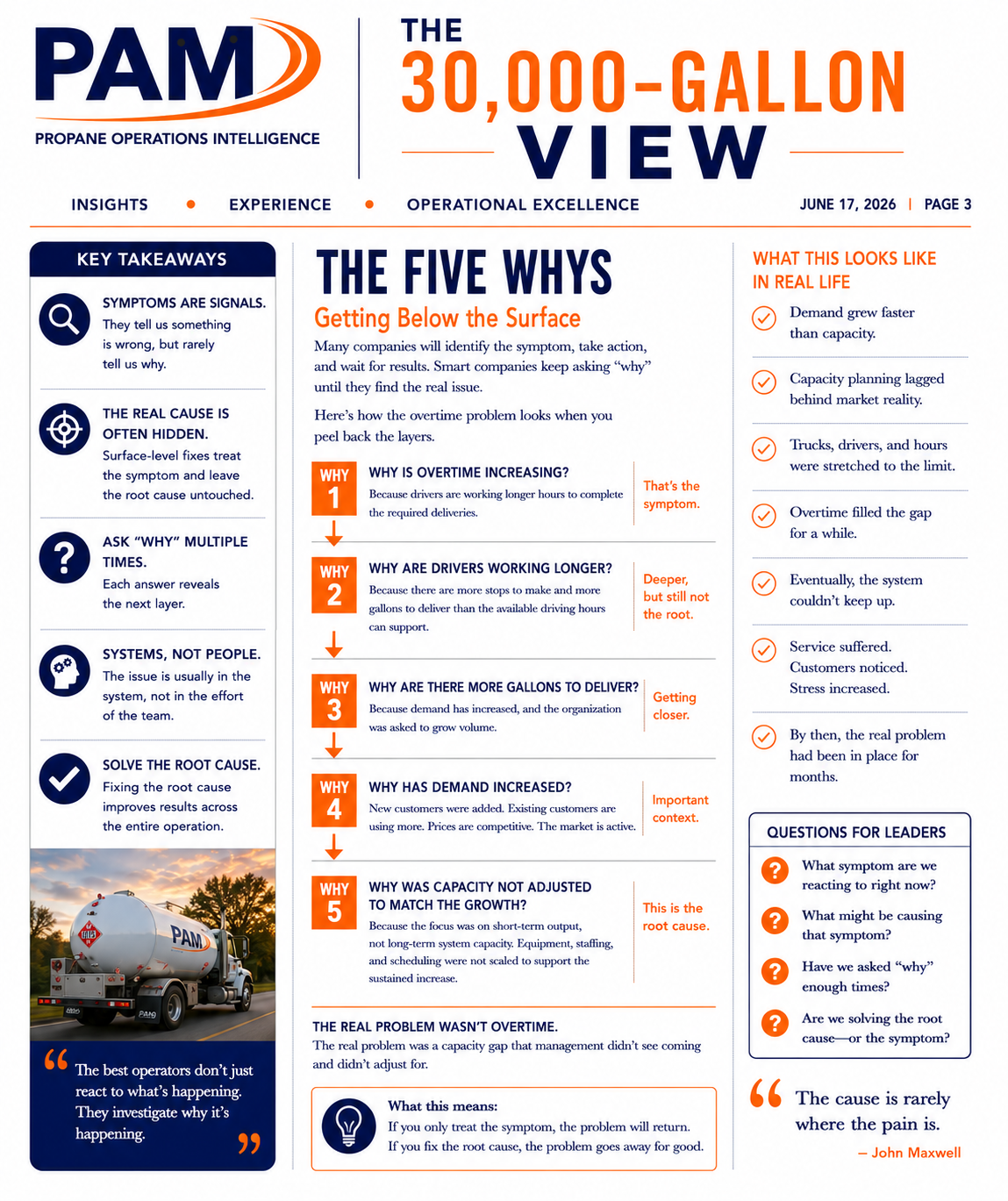
The Five Whys
Getting below the surface.
Many companies identify the symptom, take action, and wait for results. Smart companies keep asking “why” until they find the real issue. Here is how the overtime problem looks when you peel back the layers.
- Why is overtime increasing? Drivers are working longer hours to complete required deliveries. That is the symptom.
- Why are drivers working longer? There are more stops and gallons than available driving hours can support. Deeper, but not the root.
- Why are there more gallons to deliver? Demand increased, and the organization was asked to grow volume. Getting closer.
- Why has demand increased? New customers were added, existing customers are using more, prices are competitive, and the market is active. Important context.
- Why was capacity not adjusted to match the growth? The focus was on short-term output, not long-term system capacity. Equipment, staffing, and scheduling were not scaled to support the sustained increase. This is the root cause.
The real problem wasn’t overtime. It was a capacity gap management didn’t see coming and didn’t adjust for.
What This Looks Like in Real Life
- Demand grew faster than capacity.
- Capacity planning lagged behind market reality.
- Trucks, drivers, and hours were stretched to the limit.
- Overtime filled the gap for a while.
- Eventually, the system couldn’t keep up.
- Service suffered, customers noticed, and stress increased.
- By then, the real problem had been in place for months.
Questions for Leaders
- What symptom are we reacting to right now?
- What might be causing that symptom?
- Have we asked “why” enough times?
- Are we solving the root cause—or the symptom?
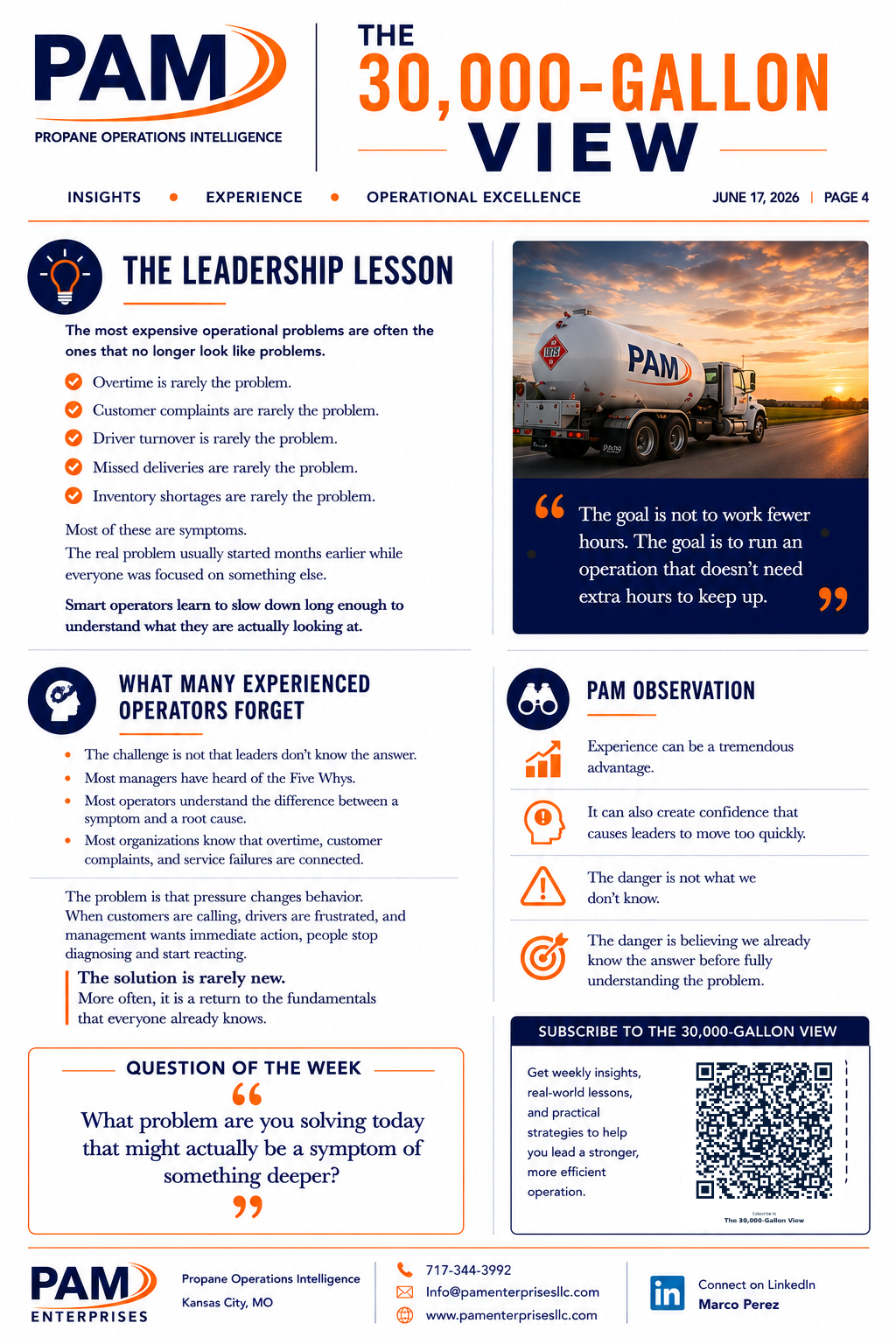
The Leadership Lesson
The most expensive operational problems are often the ones that no longer look like problems.
- Overtime is rarely the problem.
- Customer complaints are rarely the problem.
- Driver turnover is rarely the problem.
- Missed deliveries are rarely the problem.
- Inventory shortages are rarely the problem.
Most of these are symptoms. The real problem usually started months earlier while everyone was focused on something else.
Smart operators learn to slow down long enough to understand what they are actually looking at.
What Many Experienced Operators Forget
- The challenge is not that leaders don’t know the answer.
- Most managers have heard of the Five Whys.
- Most operators understand the difference between a symptom and a root cause.
- Most organizations know that overtime, customer complaints, and service failures are connected.
The problem is that pressure changes behavior. When customers are calling, drivers are frustrated, and management wants immediate action, people stop diagnosing and start reacting.
The solution is rarely new. More often, it is a return to the fundamentals that everyone already knows.
PAM Observation
Experience can be a tremendous advantage. It can also create confidence that causes leaders to move too quickly. The danger is not what we don’t know. The danger is believing we already know the answer before fully understanding the problem.