Web Edition
Capital Allocation + Operational Capability
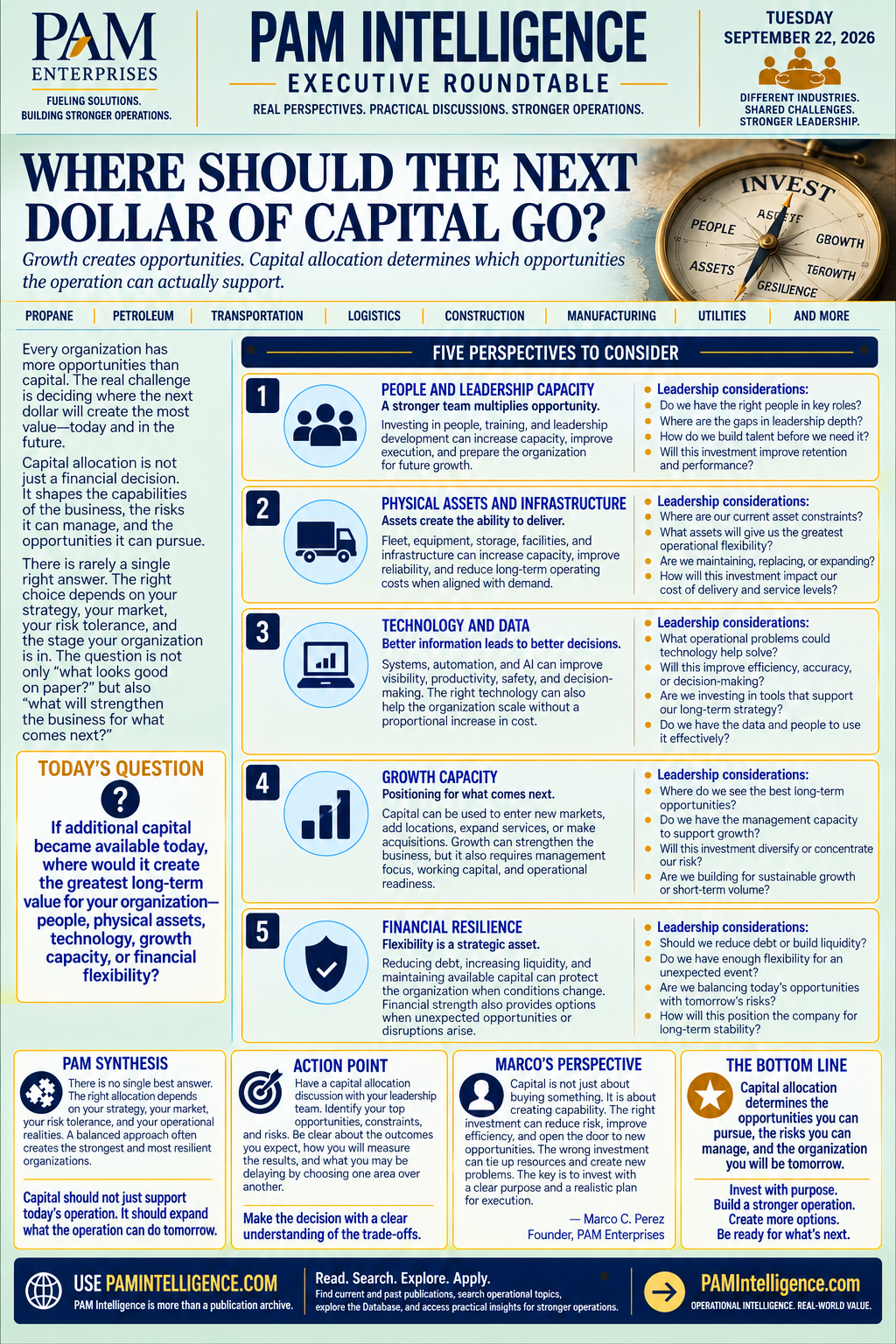
View Designed Edition1 original publication pageToday’s Question
Every organization has more opportunities than capital. The real challenge is deciding where the next dollar will create the most value—today and in the future.
Capital allocation is not just a financial decision. It shapes the capabilities of the business, the risks it can manage, and the opportunities it can pursue.
There is rarely a single right answer. The right choice depends on your strategy, your market, your risk tolerance, and the stage your organization is in. The question is not only “what looks good on paper?” but also “what will strengthen the business for what comes next?”
If additional capital became available today, where would it create the greatest long-term value for your organization—people, physical assets, technology, growth capacity, or financial flexibility?
Five Perspectives From the Executive Roundtable
1. PEOPLE AND LEADERSHIP CAPACITY
A stronger team multiplies opportunity. Investing in people, training, and leadership development can increase capacity, improve execution, and prepare the organization for future growth.
Leadership considerations
- Are we hiring the right people in key roles?
- Where are the gaps in leadership depth?
- How do we build talent before we need it?
- Will this investment improve retention and performance?
2. PHYSICAL ASSETS AND INFRASTRUCTURE
Assets create the ability to deliver. Fleet, equipment, storage, facilities, and infrastructure can increase capacity, improve reliability, and reduce long-term operating costs when aligned with demand.
Leadership considerations
- Where are our current asset constraints?
- What assets will give us the greatest operational flexibility?
- Are we maintaining, replacing, or expanding?
- How will this investment impact our cost of delivery and service levels?
3. TECHNOLOGY AND DATA
Better information leads to better decisions. Systems, automation, and AI can improve visibility, productivity, safety, and decision-making. The right technology can also help the organization scale without a proportional increase in cost.
Leadership considerations
- What operational problems could technology help solve?
- Will this improve efficiency, accuracy, or decision-making?
- Are we investing in tools that support our long-term strategy?
- Do we have the data and people to use it effectively?
4. GROWTH CAPACITY
Positioning for what comes next. Capital can be used to enter new markets, add locations, expand services, or make acquisitions. Growth can strengthen the business, but it also requires management focus, working capital, and operational readiness.
Leadership considerations
- Where do we see the best long-term opportunities?
- Do we have the management capacity to support growth?
- Will this investment diversify or concentrate our risk?
- Are we building for sustainable growth or short-term volume?
5. FINANCIAL RESILIENCE
Flexibility is a strategic asset. Reducing debt, increasing liquidity, and maintaining available capital can protect the organization when conditions change. Financial strength also provides options when unexpected opportunities or disruptions arise.
Leadership considerations
- Should we reduce debt or build liquidity?
- Do we have enough flexibility for an unexpected event?
- Are we balancing today’s opportunities with tomorrow’s risks?
- How will this position the company for long-term stability?