Web Edition
A practical operating perspective on where AI can create value, what should remain under human judgment, and how to prepare before choosing a platform.
View Designed Edition4 original publication pagesThe Bigger Picture
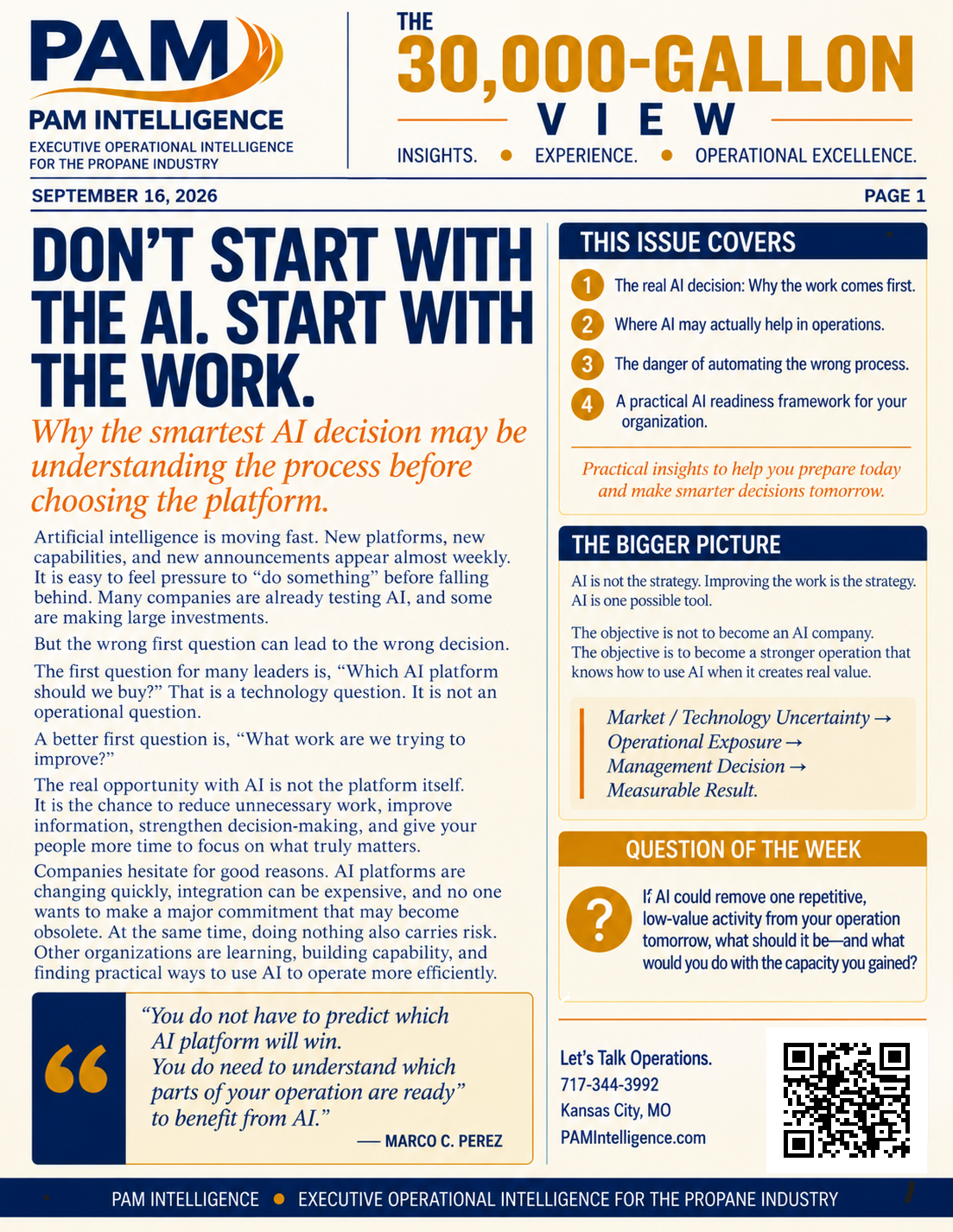
Artificial intelligence is moving fast. New platforms, new capabilities, and new announcements appear almost weekly. It is easy to feel pressure to “do something” before falling behind. Many companies are already testing AI, and some are making large investments.
But the wrong first question can lead to the wrong decision. The first question for many leaders is, “Which AI platform should we buy?” That is a technology question. It is not an operational question.
A better first question is, “What work are we trying to improve?” The real opportunity with AI is not the platform itself. It is the chance to reduce unnecessary work, improve information, strengthen decision-making, and give your people more time to focus on what truly matters.
Companies hesitate for good reasons. AI platforms are changing quickly, integration can be expensive, and no one wants to make a major commitment that may become obsolete. At the same time, doing nothing also carries risk. Other organizations are learning, building capability, and finding practical ways to use AI to operate more efficiently.
Key Takeaway“You do not have to predict which AI platform will win. You do need to understand which parts of your operation are ready to benefit from AI.” — Marco C. Perez
AI is not the strategy. Improving the work is the strategy. AI is one possible tool.
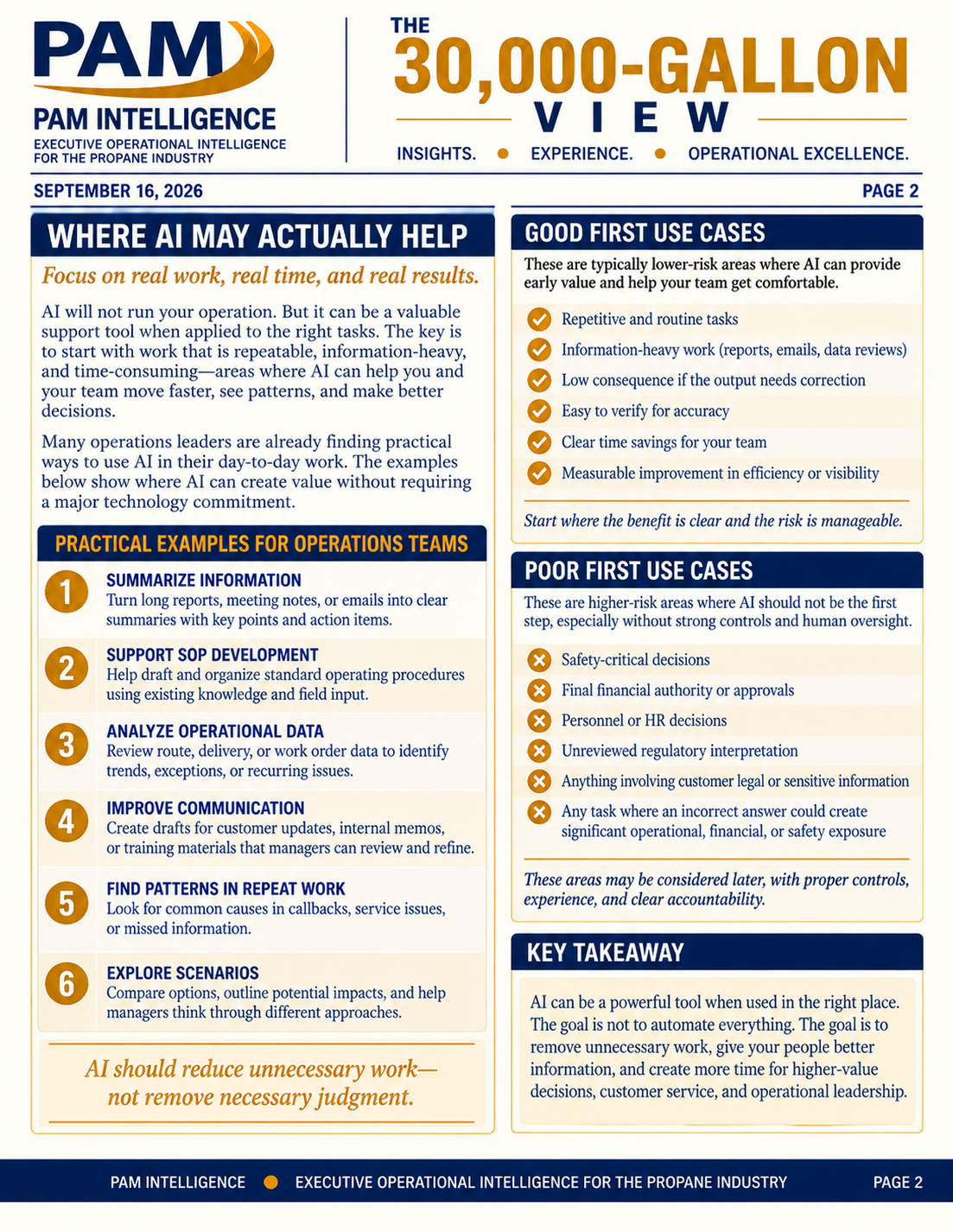
Where AI May Actually Help
AI will not run your operation. But it can be a valuable support tool when applied to the right tasks. The key is to start with work that is repeatable, information-heavy, and time-consuming—areas where AI can help you and your team move faster, see patterns, and make better decisions.
Practical Examples for Operations Teams
- Summarize information. Turn long reports, meeting notes, or emails into clear summaries with key points and action items.
- Support SOP development. Help draft and organize standard operating procedures using existing knowledge and field input.
- Analyze operational data. Review route, delivery, or work-order data to identify trends, exceptions, or recurring issues.
- Improve communication. Create drafts for customer updates, internal memos, or training materials that managers can review and refine.
- Find patterns in repeat work. Look for common causes in callbacks, service issues, or missed information.
- Explore scenarios. Compare options, outline potential impacts, and help managers think through different approaches.
PAM InterpretationAI should reduce unnecessary work—not remove necessary judgment.
Good First Use Cases
- Repetitive and routine tasks
- Information-heavy work such as reports, emails, and data reviews
- Low consequence if the output needs correction
- Easy to verify for accuracy
- Clear time savings for your team
- Measurable improvement in efficiency or visibility
Poor First Use Cases
- Safety-critical decisions
- Final financial authority or approvals
- Personnel or HR decisions
- Unreviewed regulatory interpretation
- Anything involving customer legal or sensitive information
- Any task where an incorrect answer could create significant operational, financial, or safety exposure
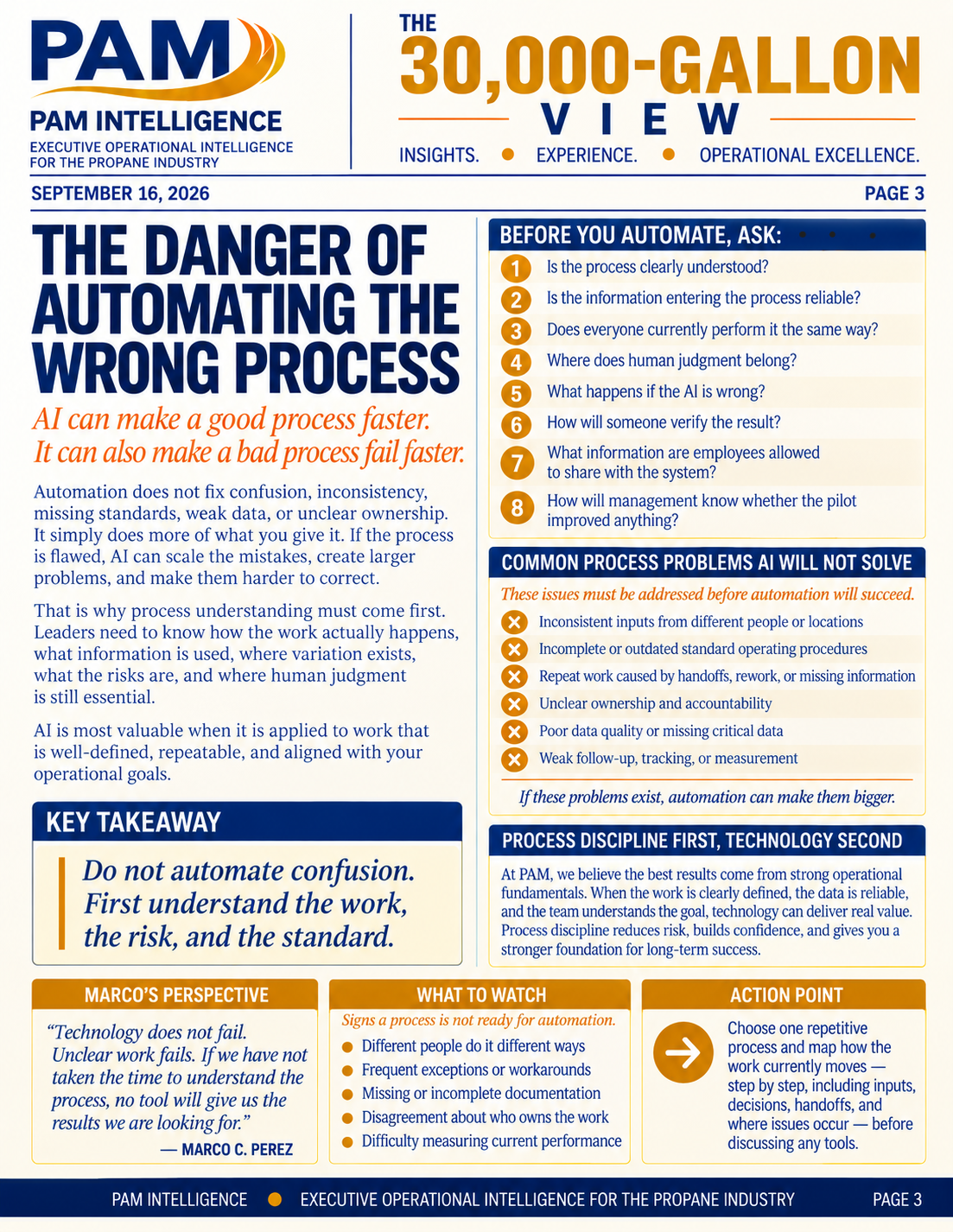
The Danger of Automating the Wrong Process
Automation does not fix confusion, inconsistency, missing standards, weak data, or unclear ownership. It simply does more of what you give it. If the process is flawed, AI can scale the mistakes, create larger problems, and make them harder to correct.
That is why process understanding must come first. Leaders need to know how the work actually happens, what information is used, where variation exists, what the risks are, and where human judgment is still essential.
AI is most valuable when it is applied to work that is well-defined, repeatable, and aligned with your operational goals.
Before You Automate, Ask
- Is the process clearly understood?
- Is the information entering the process reliable?
- Does everyone currently perform it the same way?
- Where does human judgment belong?
- What happens if the AI is wrong?
- How will someone verify the result?
- What information are employees allowed to share with the system?
- How will management know whether the pilot improved anything?
Common Process Problems AI Will Not Solve
- Inconsistent inputs from different people or locations
- Incomplete or outdated standard operating procedures
- Repeat work caused by handoffs, rework, or missing information
- Unclear ownership and accountability
- Poor data quality or missing critical data
- Weak follow-up, tracking, or measurement
Marco’s Perspective“Technology does not fail. Unclear work fails. If we have not taken the time to understand the process, no tool will give us the results we are looking for.” — Marco C. Perez
Key TakeawayDo not automate confusion. First understand the work, the risk, and the standard.
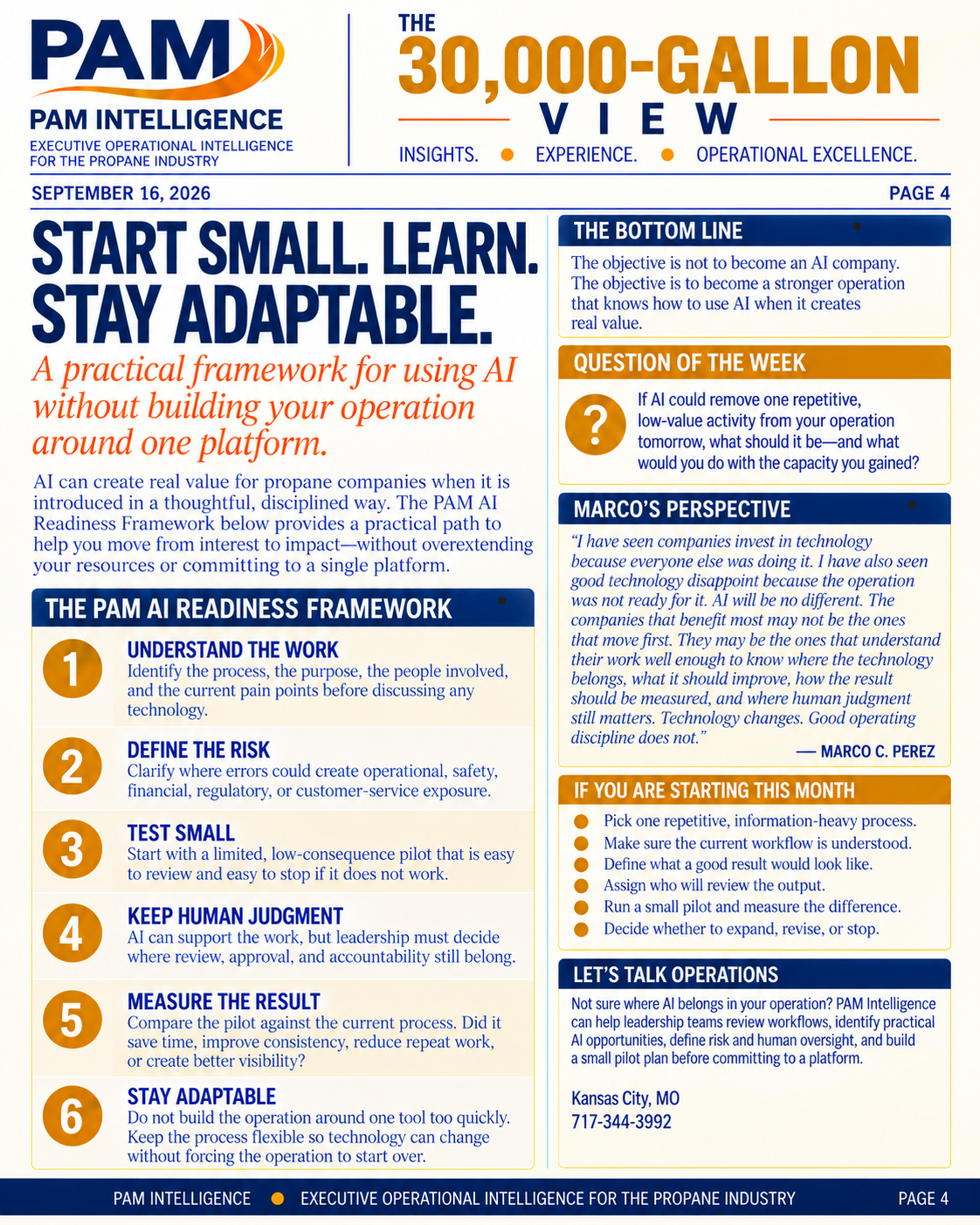
Start Small. Learn. Stay Adaptable.
AI can create real value for propane companies when it is introduced in a thoughtful, disciplined way. The PAM AI Readiness Framework provides a practical path to help you move from interest to impact—without overextending your resources or committing to a single platform.
- Understand the work. Identify the process, the purpose, the people involved, and the current pain points before discussing any technology.
- Define the risk. Clarify where errors could create operational, safety, financial, regulatory, or customer-service exposure.
- Test small. Start with a limited, low-consequence pilot that is easy to review and easy to stop if it does not work.
- Keep human judgment. AI can support the work, but leadership must decide where review, approval, and accountability still belong.
- Measure the result. Compare the pilot against the current process. Did it save time, improve consistency, reduce repeat work, or create better visibility?
- Stay adaptable. Do not build the operation around one tool too quickly. Keep the process flexible so technology can change without forcing the operation to start over.
If You Are Starting This Month
- Pick one repetitive, information-heavy process.
- Make sure the current workflow is understood.
- Define what a good result would look like.
- Assign who will review the output.
- Run a small pilot and measure the difference.
- Decide whether to expand, revise, or stop.