Web Edition
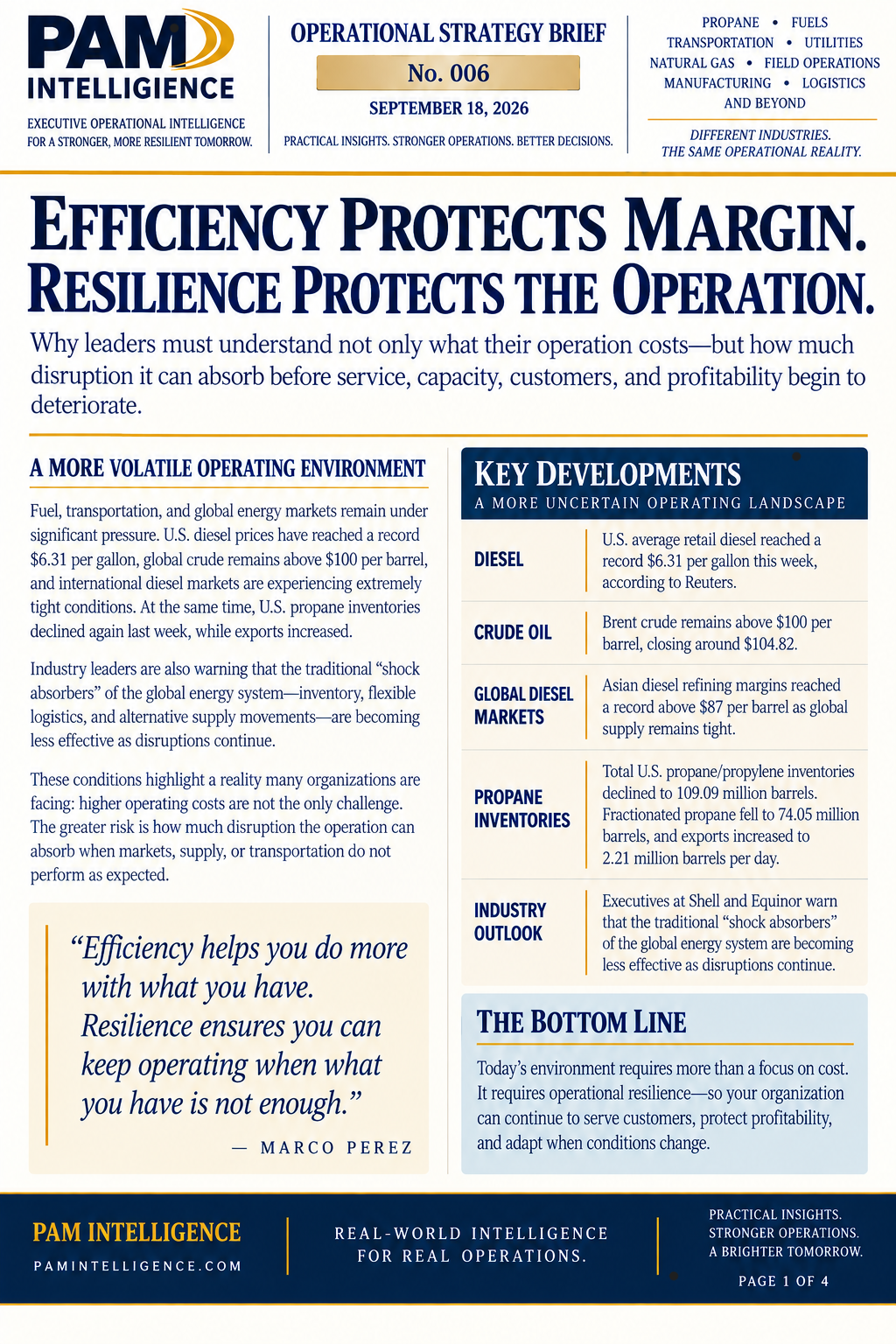
Why leaders must understand not only what their operation costs—but how much disruption it can absorb before service, capacity, customers, and profitability begin to deteriorate.
View Designed Edition4 original publication pagesA More Volatile Operating Environment
Fuel, transportation, and global energy markets remain under significant pressure. U.S. diesel prices have reached a record $6.31 per gallon, global crude remains above $100 per barrel, and international diesel markets are experiencing extremely tight conditions. At the same time, U.S. propane inventories declined again last week, while exports increased.
Industry leaders are also warning that the traditional “shock absorbers” of the global energy system—inventory, flexible logistics, and alternative supply movements—are becoming less effective as disruptions continue.
These conditions highlight a reality many organizations are facing: higher operating costs are not the only challenge. The greater risk is how much disruption the operation can absorb when markets, supply, or transportation do not perform as expected.
“Efficiency helps you do more with what you have. Resilience ensures you can keep operating when what you have is not enough.”— Marco Perez
Key Developments
A More Uncertain Operating Landscape
Diesel
U.S. average retail diesel reached a record $6.31 per gallon this week, according to Reuters.
Crude Oil
Brent crude remains above $100 per barrel, closing around $104.82.
Global Diesel Markets
Asian diesel refining margins reached a record above $87 per barrel as global supply remains tight.
Propane Inventories
Total U.S. propane/propylene inventories declined to 109.09 million barrels. Fractionated propane fell to 74.05 million barrels, and exports increased to 2.21 million barrels per day.
Industry Outlook
Executives at Shell and Equinor warn that the traditional “shock absorbers” of the global energy system are becoming less effective as disruptions continue.
Understand Your Exposure
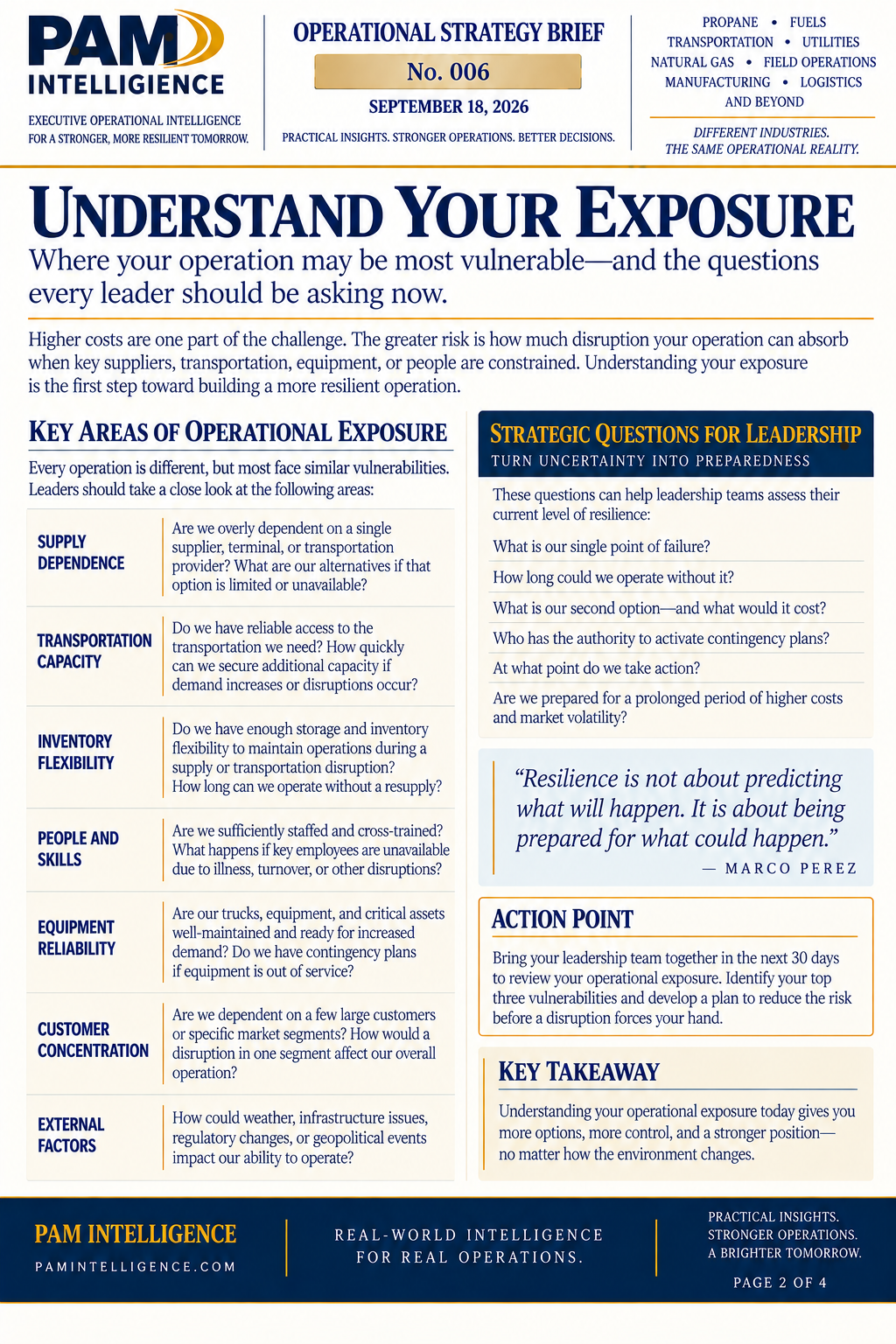
Where your operation may be most vulnerable—and the questions every leader should be asking now.
Higher costs are one part of the challenge. The greater risk is how much disruption your operation can absorb when key suppliers, transportation, equipment, or people are constrained. Understanding your exposure is the first step toward building a more resilient operation.
Key Areas of Operational Exposure
Every operation is different, but most face similar vulnerabilities. Leaders should take a close look at the following areas:
Supply Dependence
Are we overly dependent on a single supplier, terminal, or transportation provider? What are our alternatives if that option is limited or unavailable?
Transportation Capacity
Do we have reliable access to the transportation we need? How quickly can we secure additional capacity if demand increases or disruptions occur?
Inventory Flexibility
Do we have enough storage and inventory flexibility to maintain operations during a supply or transportation disruption? How long can we operate without a resupply?
People and Skills
Are we sufficiently staffed and cross-trained? What happens if key employees are unavailable due to illness, turnover, or other disruptions?
Equipment Reliability
Are our trucks, equipment, and critical assets well-maintained and ready for increased demand? Do we have contingency plans if equipment is out of service?
Customer Concentration
Are we dependent on a few large customers or specific market segments? How would a disruption in one segment affect our overall operation?
External Factors
How could weather, infrastructure issues, regulatory changes, or geopolitical events impact our ability to operate?
Strategic Questions for Leadership
Turn Uncertainty Into Preparedness
These questions can help leadership teams assess their current level of resilience:
- What is our single point of failure?
- How long could we operate without it?
- What is our second option—and what would it cost?
- Who has the authority to activate contingency plans?
- At what point do we take action?
- Are we prepared for a prolonged period of higher costs and market volatility?
“Resilience is not about predicting what will happen. It is about being prepared for what could happen.”— Marco Perez
Building a More Resilient Operation
Practical steps leaders can take now to reduce risk and increase flexibility.
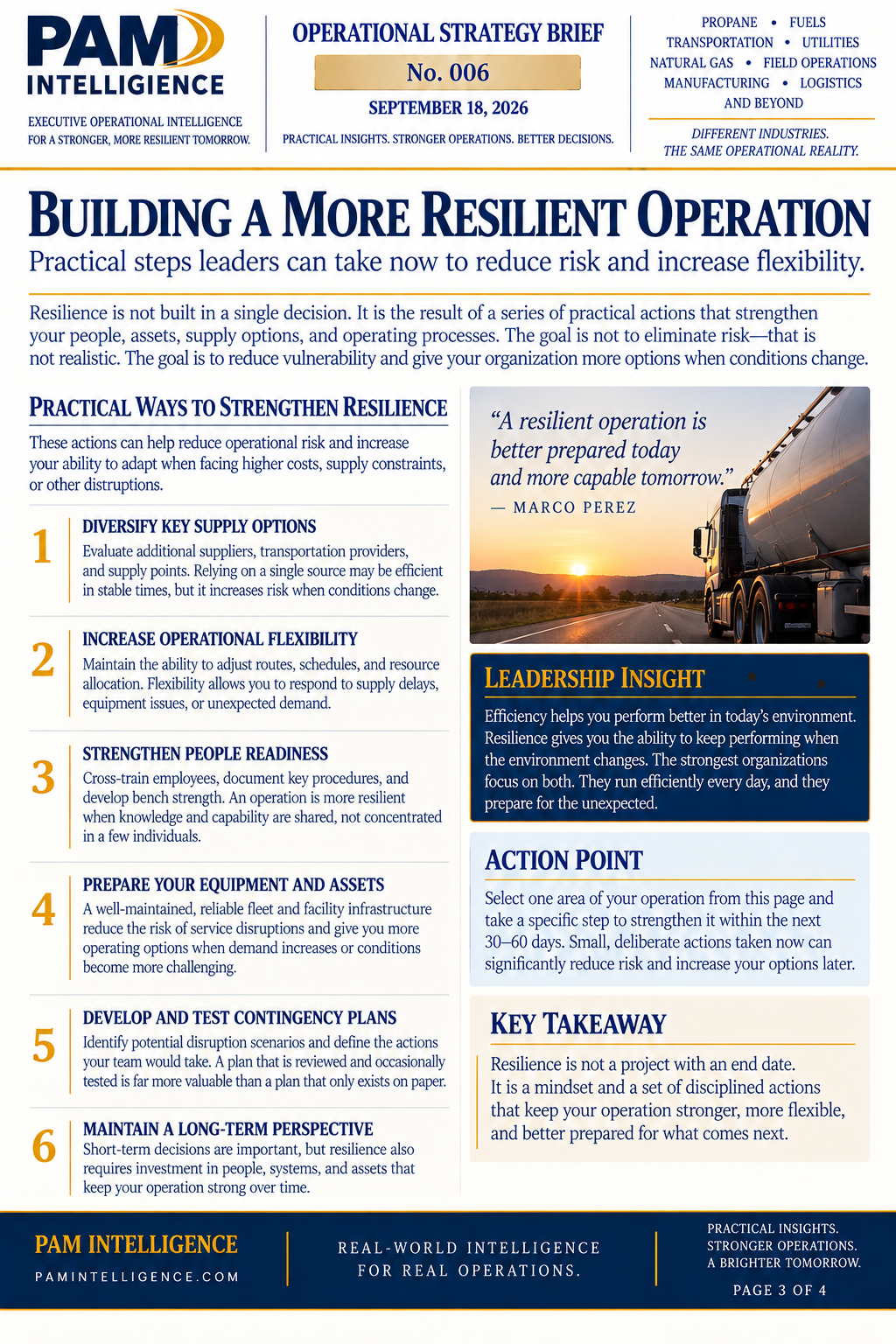
Resilience is not built in a single decision. It is the result of a series of practical actions that strengthen your people, assets, supply options, and operating processes. The goal is not to eliminate risk—that is not realistic. The goal is to reduce vulnerability and give your organization more options when conditions change.
Practical Ways to Strengthen Resilience
These actions can help reduce operational risk and increase your ability to adapt when facing higher costs, supply constraints, or other disruptions.
- Diversify Key Supply Options Evaluate additional suppliers, transportation providers, and supply points. Relying on a single source may be efficient in stable times, but it increases risk when conditions change.
- Increase Operational Flexibility Maintain the ability to adjust routes, schedules, and resource allocation. Flexibility allows you to respond to supply delays, equipment issues, or unexpected demand.
- Strengthen People Readiness Cross-train employees, document key procedures, and develop bench strength. An operation is more resilient when knowledge and capability are shared, not concentrated in a few individuals.
- Prepare Your Equipment and Assets A well-maintained, reliable fleet and facility infrastructure reduce the risk of service disruptions and give you more operating options when demand increases or conditions become more challenging.
- Develop and Test Contingency Plans Identify potential disruption scenarios and define the actions your team would take. A plan that is reviewed and occasionally tested is far more valuable than a plan that only exists on paper.
- Maintain a Long-Term Perspective Short-term decisions are important, but resilience also requires investment in people, systems, and assets that keep your operation strong over time.
“A resilient operation is better prepared today and more capable tomorrow.”— Marco Perez
Lead Today for a Stronger Tomorrow
Turn awareness into action and build an operation that can withstand what comes next.
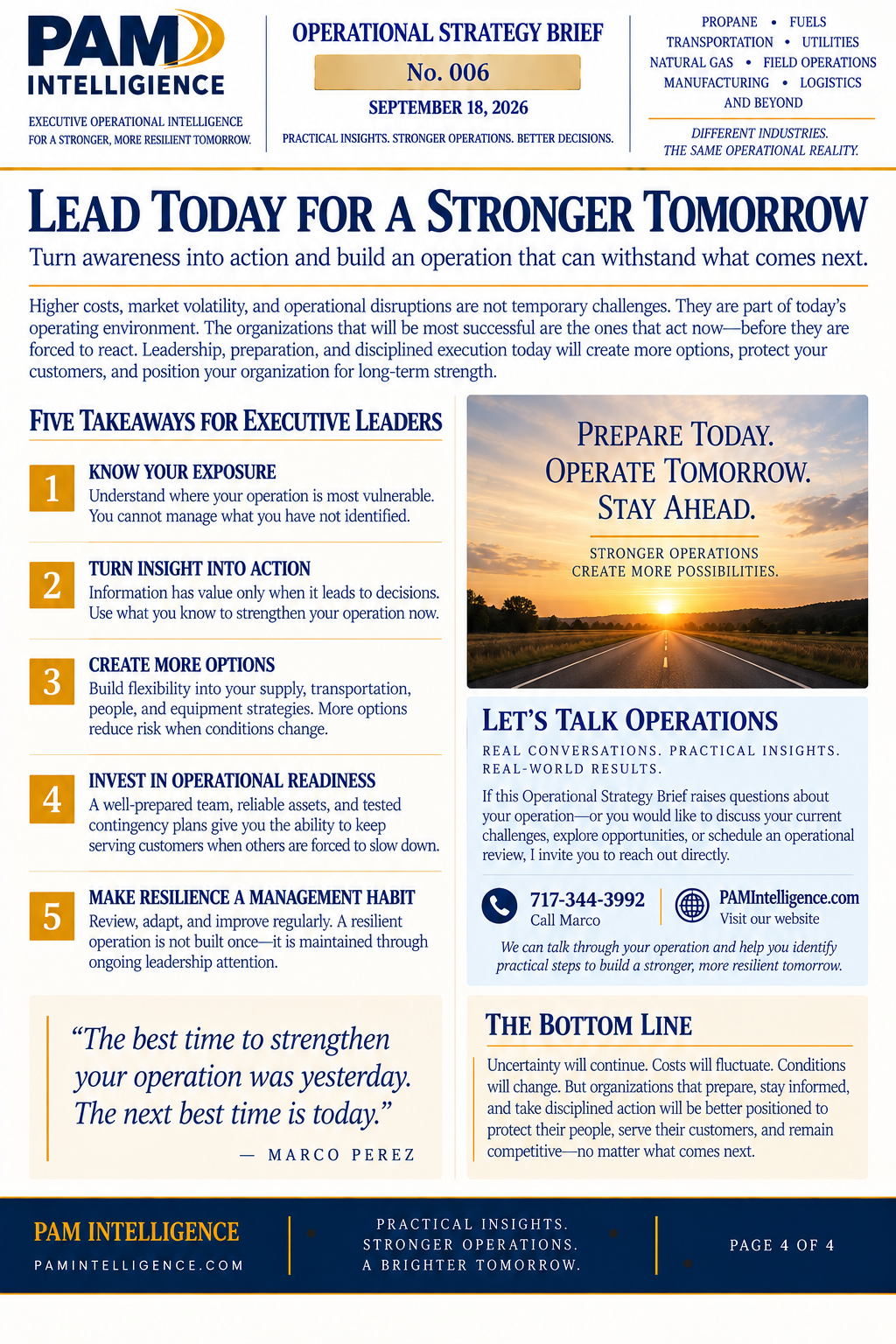
Higher costs, market volatility, and operational disruptions are not temporary challenges. They are part of today’s operating environment. The organizations that will be most successful are the ones that act now—before they are forced to react. Leadership, preparation, and disciplined execution today will create more options, protect your customers, and position your organization for long-term strength.
Five Takeaways for Executive Leaders
- Know Your Exposure Understand where your operation is most vulnerable. You cannot manage what you have not identified.
- Turn Insight Into Action Information has value only when it leads to decisions. Use what you know to strengthen your operation now.
- Create More Options Build flexibility into your supply, transportation, people, and equipment strategies. More options reduce risk when conditions change.
- Invest in Operational Readiness A well-prepared team, reliable assets, and tested contingency plans give you the ability to keep serving customers when others are forced to slow down.
- Make Resilience a Management Habit Review, adapt, and improve regularly. A resilient operation is not built once—it is maintained through ongoing leadership attention.
“The best time to strengthen your operation was yesterday. The next best time is today.”— Marco Perez