Web Edition
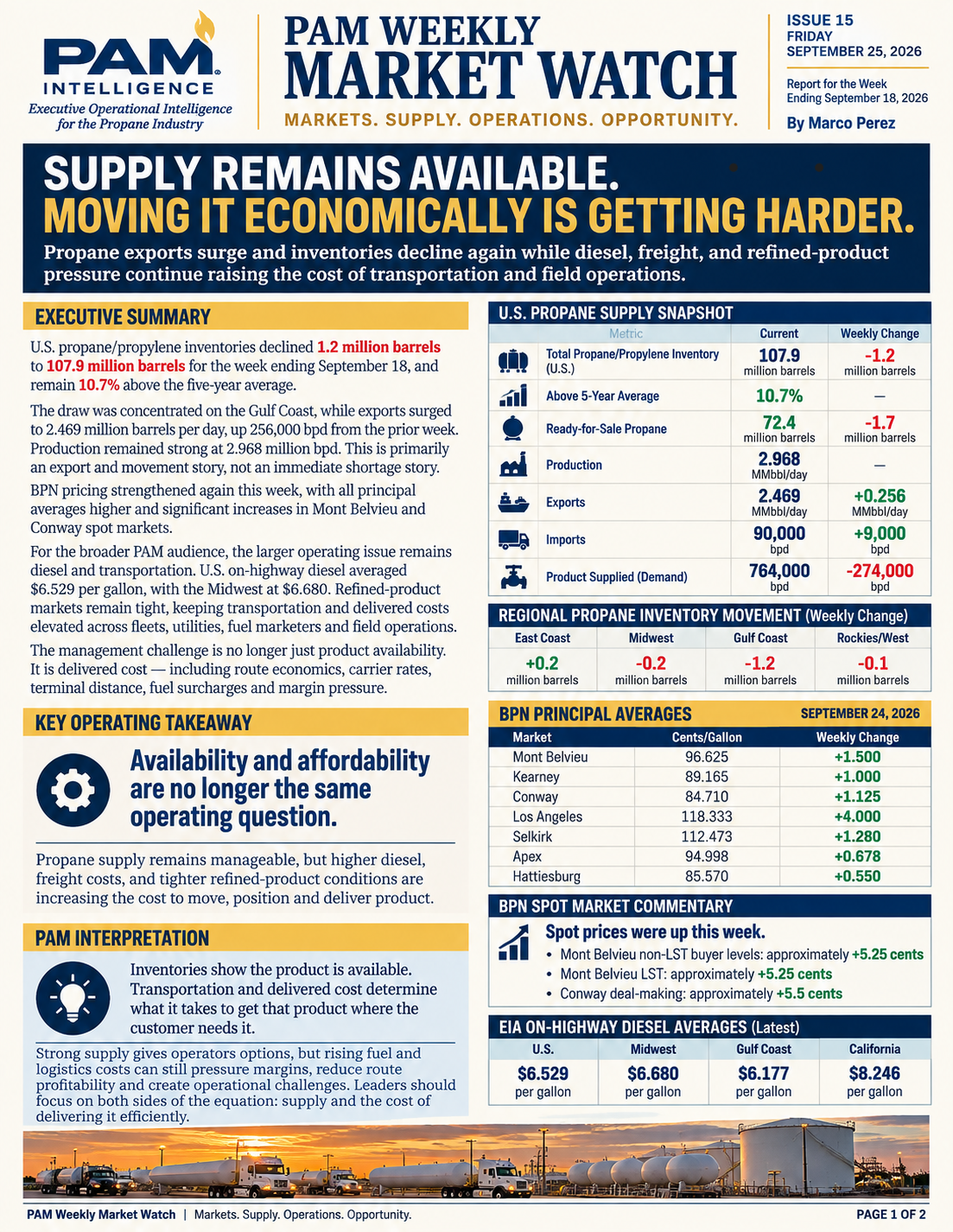
Availability and affordability were no longer the same operating question.
View Designed Edition2 original publication pagesExecutive Summary
U.S. propane/propylene inventories declined 1.2 million barrels to 107.9 million barrels for the week ending September 18 and remained 10.7% above the five-year average.
The draw was concentrated on the Gulf Coast, while exports surged to 2.469 million barrels per day, up 256,000 barrels per day from the prior week. Production remained strong at 2.968 million barrels per day. This was primarily an export and movement story, not an immediate shortage story.
BPN pricing strengthened again, with all principal averages higher and significant increases in Mont Belvieu and Conway spot markets.
For the broader PAM audience, the larger operating issue remained diesel and transportation. U.S. on-highway diesel averaged $6.529 per gallon, with the Midwest at $6.680. Refined-product markets remained tight, keeping transportation and delivered costs elevated across fleets, utilities, fuel marketers, and field operations.
The management challenge was no longer just product availability. It was delivered cost—including route economics, carrier rates, terminal distance, fuel surcharges, and margin pressure.
Core conclusion: Supply remains available. Moving it economically is getting harder.
U.S. Propane Supply Snapshot
| Metric | Current | Weekly change |
|---|---|---|
| Total propane/propylene inventory | 107.9 million barrels | −1.2 million barrels |
| Above five-year average | 10.7% | — |
| Ready-for-sale propane | 72.4 million barrels | −1.7 million barrels |
| Production | 2.968 MMbbl/day | — |
| Exports | 2.469 MMbbl/day | +0.256 MMbbl/day |
| Imports | 90,000 bpd | +9,000 bpd |
| Product supplied | 764,000 bpd | −274,000 bpd |
Inventories declined again, driven by higher exports. Supply remained manageable, but exports accelerated and wholesale prices moved higher.
Regional Inventory Movement
- East Coast: +0.2 million barrels
- Midwest: −0.2 million barrels
- Gulf Coast: −1.2 million barrels
- Rockies/West: −0.1 million barrels
BPN Principal Averages — September 24, 2026
| Market | Cents/gallon | Weekly change |
|---|---|---|
| Mont Belvieu | 96.625¢ | +1.500¢ |
| Kearney | 89.165¢ | +1.000¢ |
| Conway | 84.710¢ | +1.125¢ |
| Los Angeles | 118.333¢ | +4.000¢ |
| Selkirk | 112.473¢ | +1.280¢ |
| Apex | 94.998¢ | +0.678¢ |
| Hattiesburg | 85.570¢ | +0.550¢ |
Spot prices were up this week. Mont Belvieu non-LST buyer levels were approximately +5.25 cents, Mont Belvieu LST approximately +5.25 cents, and Conway deal-making approximately +5.5 cents.
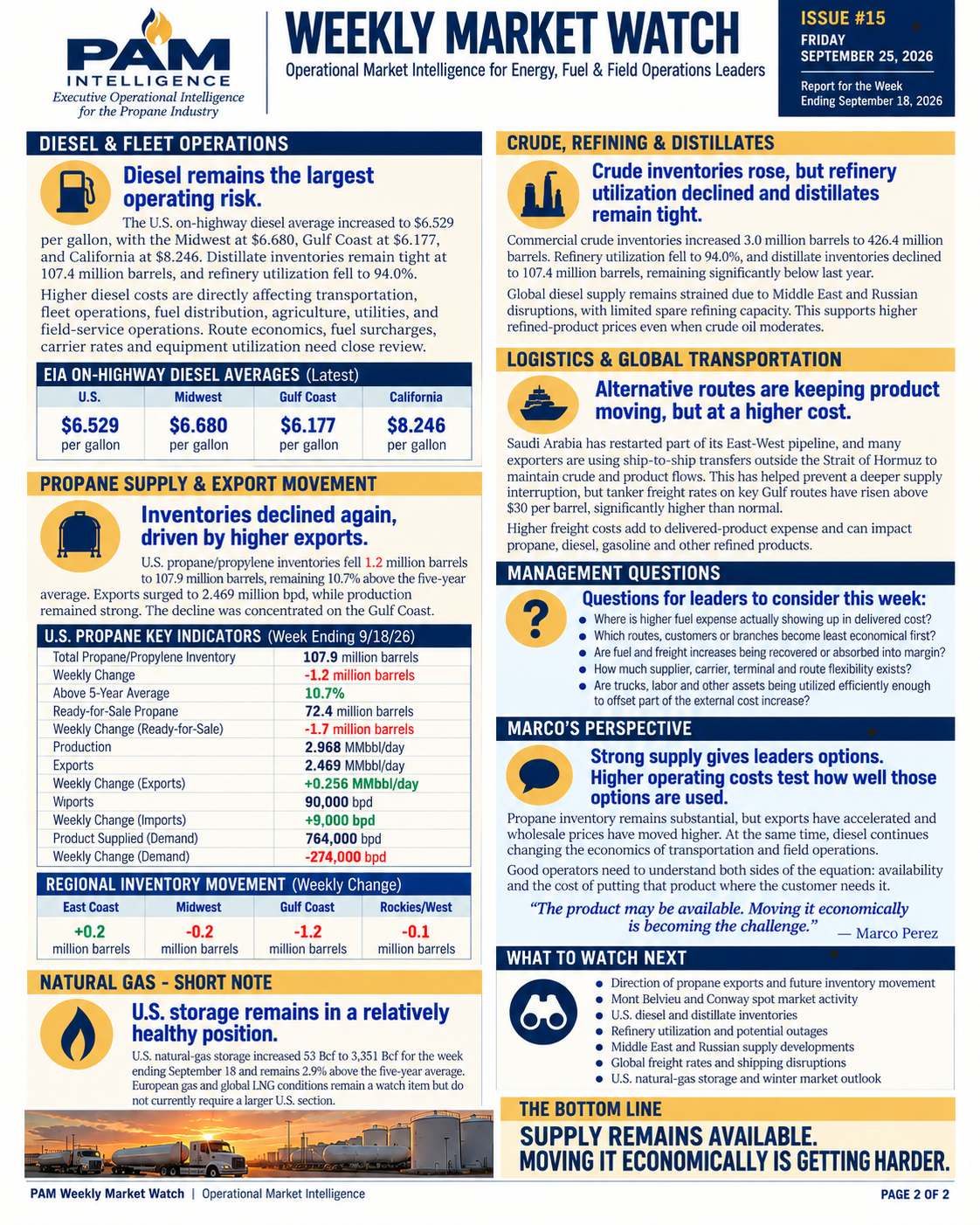
Diesel & Fleet Operations
Diesel remained the largest operating risk. The U.S. on-highway diesel average increased to $6.529 per gallon, with the Midwest at $6.680, Gulf Coast at $6.177, and California at $8.246. Distillate inventories remained tight at 107.4 million barrels, and refinery utilization fell to 94.0%.
Higher diesel costs were directly affecting transportation, fleet operations, fuel distribution, agriculture, utilities, and field-service operations. Route economics, fuel surcharges, carrier rates, cost recovery, margin, and equipment utilization needed close review.
Crude, Refining & Distillates
Crude inventories rose, but refinery utilization declined and distillates remained tight. Commercial crude inventories increased 3.0 million barrels to 426.4 million barrels. Refinery utilization fell to 94.0%, and distillate inventories declined to 107.4 million barrels, remaining significantly below last year.
Global diesel supply remained strained due to Middle East and Russian disruptions, with limited spare refining capacity. This supported higher refined-product prices even when crude oil moderated.
Logistics & Global Transportation
Alternative routes were keeping product moving, but at a higher cost. Saudi Arabia had restarted part of its East-West pipeline, and many exporters were using ship-to-ship transfers outside the Strait of Hormuz to maintain crude and product flows. This helped prevent a deeper supply interruption, but tanker freight rates on key Gulf routes had risen above $30 per barrel, significantly higher than normal.
Higher freight costs added to delivered-product expense and could affect propane, diesel, gasoline, and other refined products.
Natural Gas — Short Note
U.S. natural-gas storage increased 53 Bcf to 3,351 Bcf for the week ending September 18 and remained 2.9% above the five-year average. European gas and global LNG conditions remained a watch item but did not require a larger U.S. section in this report.
This statement is preserved as historical context from September 25, 2026.
Management Questions
- Where is higher fuel expense actually showing up in delivered cost?
- Which routes, customers, or branches become least economical first?
- Are fuel and freight increases being recovered or absorbed into margin?
- How much supplier, carrier, terminal, and route flexibility exists?
- Are trucks, labor, and other assets being utilized efficiently enough to offset part of the external cost increase?
What to Watch Next
- Direction of propane exports and future inventory movement
- Mont Belvieu and Conway spot market activity
- U.S. diesel and distillate inventories
- Refinery utilization and potential outages
- Middle East and Russian supply developments
- Global freight rates and shipping disruptions
- U.S. natural-gas storage and winter market outlook
This watch list is preserved as historical forward-looking context from September 25, 2026.
Marco’s Perspective
Strong supply gives leaders options. Higher operating costs test how well those options are used.
Propane inventory remained substantial, but exports accelerated and wholesale prices moved higher. At the same time, diesel continued changing the economics of transportation and field operations.
Good operators needed to understand both sides of the equation: availability and the cost of putting that product where the customer needs it.
The product may be available. Moving it economically is becoming the challenge.
ASK PAM
Put This Market Watch to Work
Management question: “Supply is still available, but transportation costs are rising. What should management measure before margins deteriorate?”
- What is happening? As of September 25, 2026, propane remained available, but rising diesel, freight, and refined-product pressure were increasing the cost of moving and delivering it.
- What should we measure? Track delivered cost by route and branch, miles, idle time, carrier and terminal charges, fuel surcharges, recovery rates, customer margin, gallons and stops per route, and asset utilization.
- What may be causing it? Higher diesel, longer or costlier transportation paths, refinery and distillate tightness, accelerated exports, weak cost recovery, and inefficient routes can compound margin pressure.
- What can management control? Route design, terminal and supplier options, carrier strategy, surcharge discipline, pricing, customer and branch economics, and truck and labor utilization.
- What decision may need to be made? Leaders may need to reprice, reroute, change carrier or supply options, adjust service commitments, or stop accepting work whose delivered cost cannot be supported.
- What practical step comes next? Review one week of delivered cost and margin by route, customer, and branch, then identify where diesel and freight pressure are appearing first.
This answer uses the report’s dated September 25, 2026 evidence and approved PAM operating principles. It does not represent current market conditions.