Web Edition
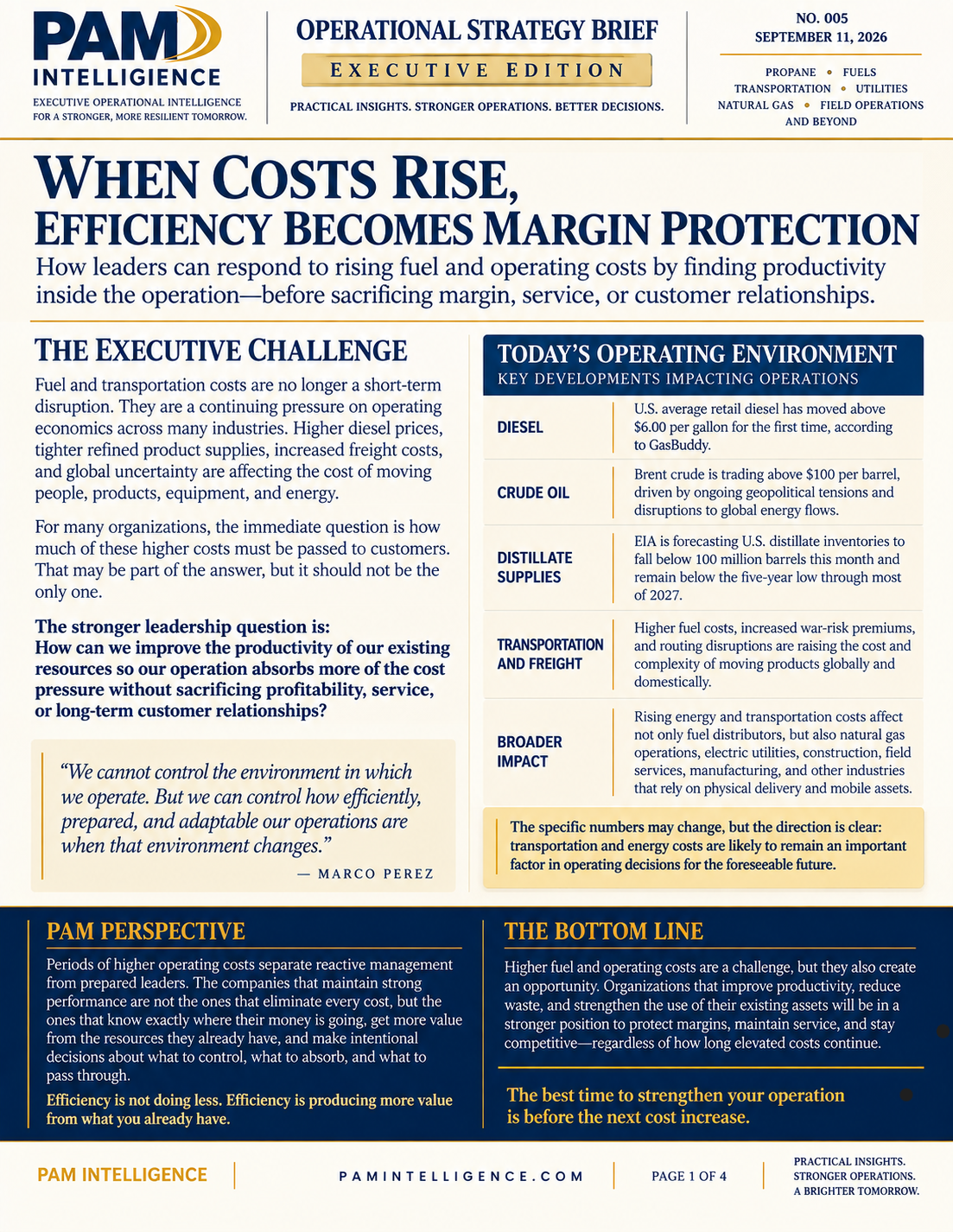
How leaders can respond to rising fuel and operating costs by finding productivity inside the operation—before sacrificing margin, service, or customer relationships.
View Designed Edition4 original publication pagesThe Executive Challenge
Fuel and transportation costs are no longer a short-term disruption. They are a continuing pressure on operating economics across many industries. Higher diesel prices, tighter refined product supplies, increased freight costs, and global uncertainty are affecting the cost of moving people, products, equipment, and energy.
For many organizations, the immediate question is how much of these higher costs must be passed to customers. That may be part of the answer, but it should not be the only one.
The stronger leadership question is:
How can we improve the productivity of our existing resources so our operation absorbs more of the cost pressure without sacrificing profitability, service, or long-term customer relationships?
“We cannot control the environment in which we operate. But we can control how efficiently, prepared, and adaptable our operations are when that environment changes.”— Marco Perez
Today’s Operating Environment
Key Developments Impacting Operations
Diesel
U.S. average retail diesel has moved above $6.00 per gallon for the first time, according to GasBuddy.
Crude Oil
Brent crude is trading above $100 per barrel, driven by ongoing geopolitical tensions and disruptions to global energy flows.
Distillate Supplies
EIA is forecasting U.S. distillate inventories to fall below 100 million barrels this month and remain below the five-year low through most of 2027.
Transportation and Freight
Higher fuel costs, increased war-risk premiums, and routing disruptions are raising the cost and complexity of moving products globally and domestically.
Broader Impact
Rising energy and transportation costs affect not only fuel distributors, but also natural gas operations, electric utilities, construction, field services, manufacturing, and other industries that rely on physical delivery and mobile assets.
Turning Pressure Into Performance
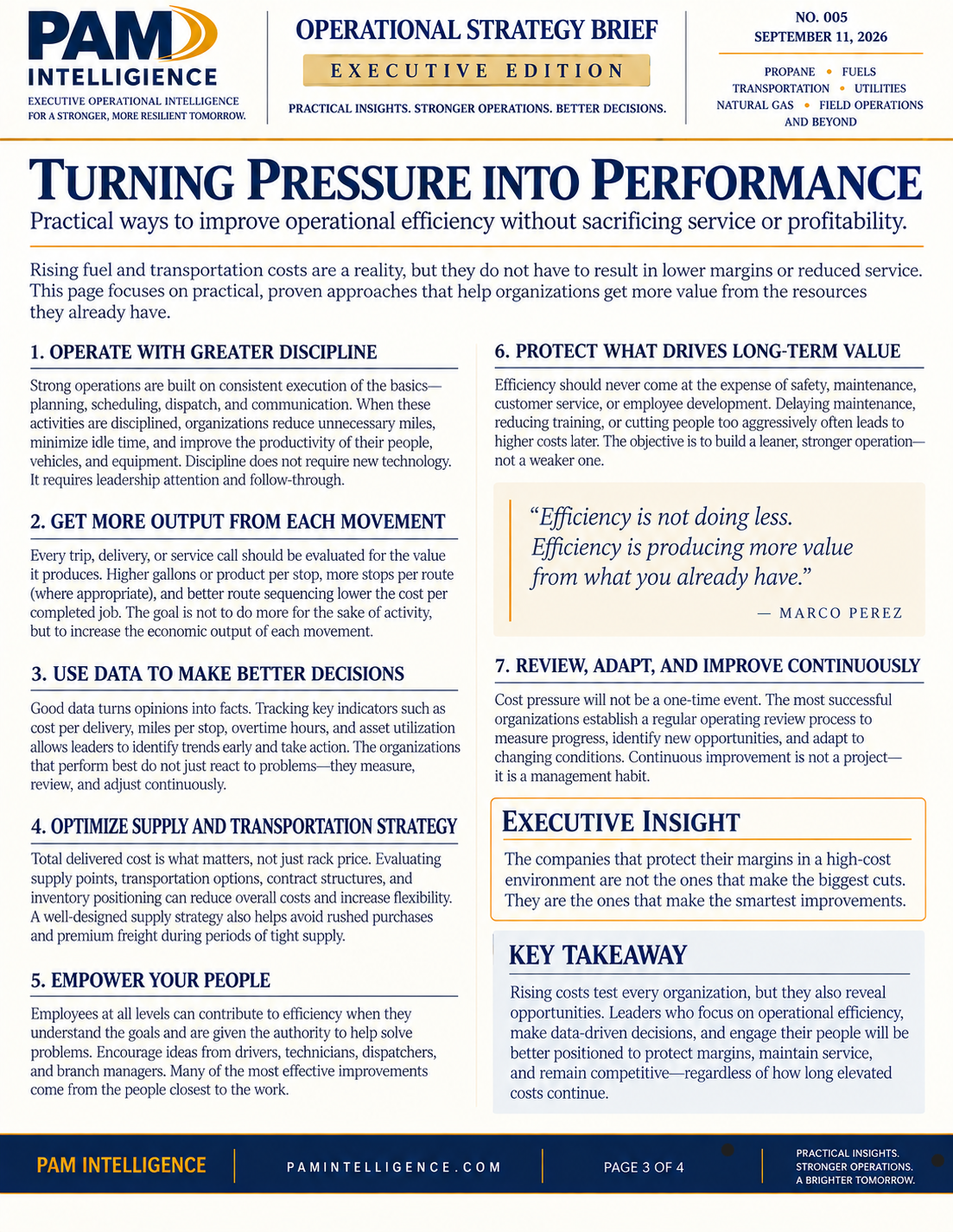
Practical ways to improve operational efficiency without sacrificing service or profitability.
Rising fuel and transportation costs are a reality, but they do not have to result in lower margins or reduced service. This page focuses on practical, proven approaches that help organizations get more value from the resources they already have.
- Operate With Greater Discipline Strong operations are built on consistent execution of the basics—planning, scheduling, dispatch, and communication. When these activities are disciplined, organizations reduce unnecessary miles, minimize idle time, and improve the productivity of their people, vehicles, and equipment. Discipline does not require new technology. It requires leadership attention and follow-through.
- Get More Output From Each Movement Every trip, delivery, or service call should be evaluated for the value it produces. Higher gallons or product per stop, more stops per route (where appropriate), and better route sequencing lower the cost per completed job. The goal is not to do more for the sake of activity, but to increase the economic output of each movement.
- Use Data to Make Better Decisions Good data turns opinions into facts. Tracking key indicators such as cost per delivery, miles per stop, overtime hours, and asset utilization allows leaders to identify trends early and take action. The organizations that perform best do not just react to problems—they measure, review, and adjust continuously.
- Optimize Supply and Transportation Strategy Total delivered cost is what matters, not just rack price. Evaluating supply points, transportation options, contract structures, and inventory positioning can reduce overall costs and increase flexibility. A well-designed supply strategy also helps avoid rushed purchases and premium freight during periods of tight supply.
- Empower Your People Employees at all levels can contribute to efficiency when they understand the goals and are given the authority to help solve problems. Encourage ideas from drivers, technicians, dispatchers, and branch managers. Many of the most effective improvements come from the people closest to the work.
- Protect What Drives Long-Term Value Efficiency should never come at the expense of safety, maintenance, customer service, or employee development. Delaying maintenance, reducing training, or cutting people too aggressively often leads to higher costs later. The objective is to build a leaner, stronger operation—not a weaker one.
“Efficiency is not doing less. Efficiency is producing more value from what you already have.”— Marco Perez
7. Review, Adapt, and Improve Continuously
Cost pressure will not be a one-time event. The most successful organizations establish a regular operating review process to measure progress, identify new opportunities, and adapt to changing conditions. Continuous improvement is not a project—it is a management habit.
From Insight to Action
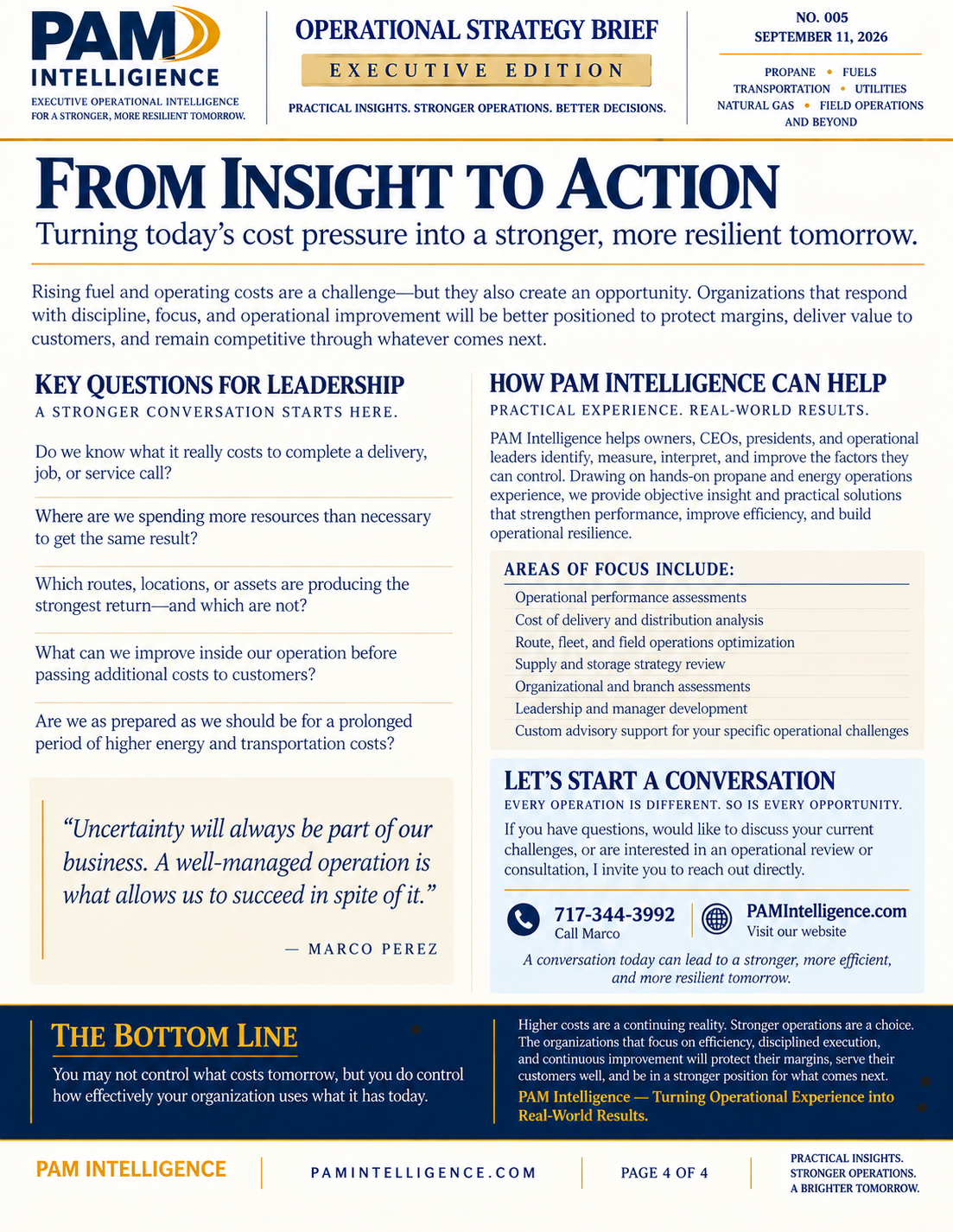
Turning today’s cost pressure into a stronger, more resilient tomorrow.
Rising fuel and operating costs are a challenge—but they also create an opportunity. Organizations that respond with discipline, focus, and operational improvement will be better positioned to protect margins, deliver value to customers, and remain competitive through whatever comes next.
Key Questions for Leadership
A Stronger Conversation Starts Here.
- Do we know what it really costs to complete a delivery, job, or service call?
- Where are we spending more resources than necessary to get the same result?
- Which routes, locations, or assets are producing the strongest return—and which are not?
- What can we improve inside our operation before passing additional costs to customers?
- Are we as prepared as we should be for a prolonged period of higher energy and transportation costs?
“Uncertainty will always be part of our business. A well-managed operation is what allows us to succeed in spite of it.”— Marco Perez
How PAM Intelligence Can Help
Practical Experience. Real-World Results.
PAM Intelligence helps owners, CEOs, presidents, and operational leaders identify, measure, interpret, and improve the factors they can control. Drawing on hands-on propane and energy operations experience, we provide objective insight and practical solutions that strengthen performance, improve efficiency, and build operational resilience.
Areas of Focus Include:
- Operational performance assessments
- Cost of delivery and distribution analysis
- Route, fleet, and field operations optimization
- Supply and storage strategy review
- Organizational and branch assessments
- Leadership and manager development
- Custom advisory support for your specific operational challenges