Web Edition
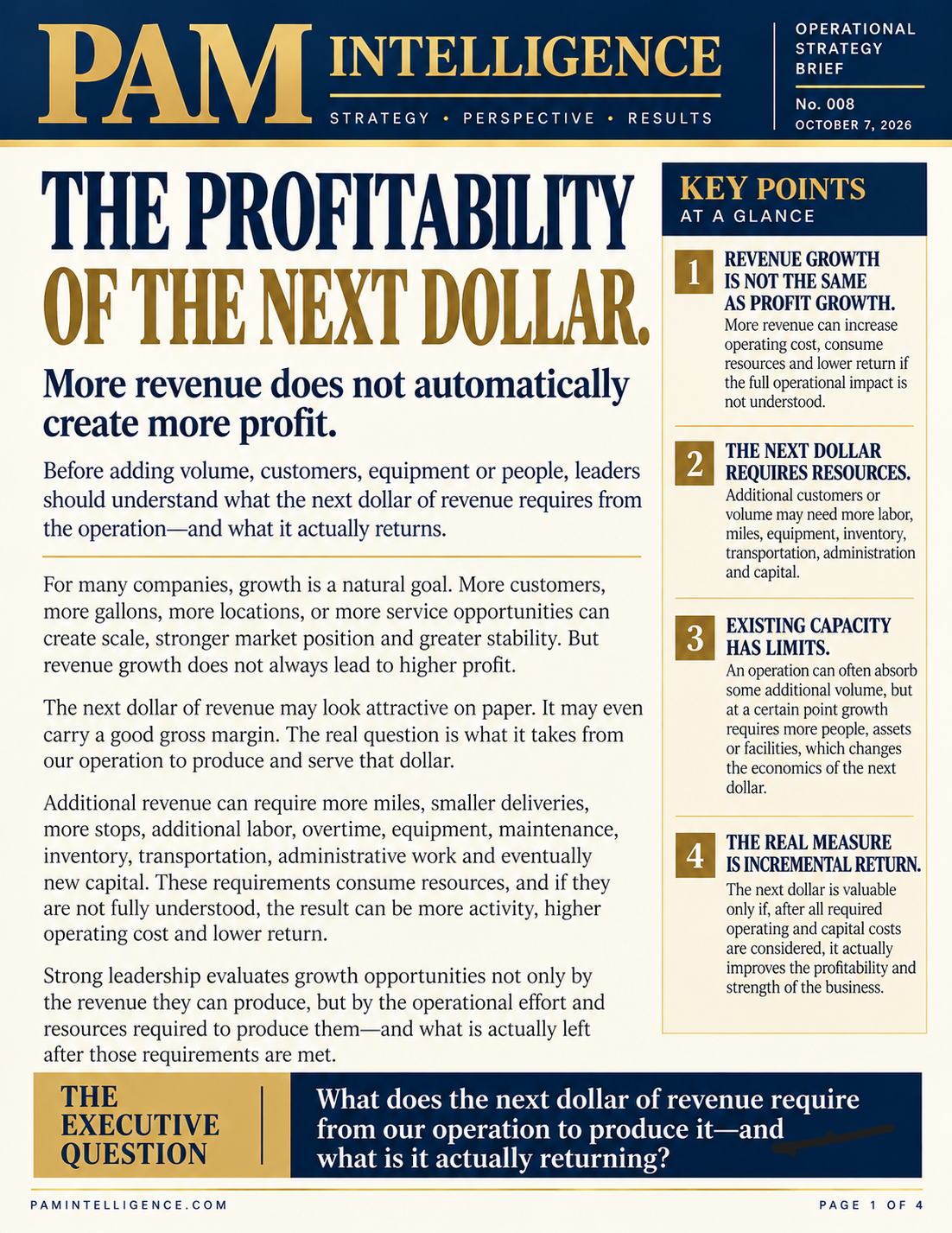
Before adding volume, customers, equipment, or people, understand what the next dollar of revenue requires from the operation—and what it actually returns.
View Designed Edition4 original publication pagesThe Profitability of the Next Dollar
For many companies, growth is a natural goal. More customers, more gallons, more locations, or more service opportunities can create scale, stronger market position, and greater stability. But revenue growth does not always lead to higher profit.
The next dollar of revenue may look attractive on paper and may carry a good gross margin. The real question is what it takes from the operation to produce and serve that dollar.
Additional revenue can require more miles, smaller deliveries, more stops, additional labor, overtime, equipment, maintenance, inventory, transportation, administrative work, and eventually new capital. Those requirements consume resources; if they are not fully understood, the result can be more activity, higher operating cost, and lower return.
Strong leadership evaluates growth opportunities not only by the revenue they can produce, but by the operational effort and resources required—and what remains after those requirements are met.
Key Points at a Glance
- Revenue growth is not the same as profit growth. More revenue can increase operating cost, consume resources, and lower return if the full operational impact is not understood.
- The next dollar requires resources. Additional customers or volume may require more labor, miles, equipment, inventory, transportation, administration, and capital.
- Existing capacity has limits. An operation may absorb some additional volume, but at a certain point growth requires more people, assets, or facilities and changes the economics.
- The real measure is incremental return. The next dollar is valuable only if, after all required operating and capital costs are considered, it improves profitability and strengthens the business.
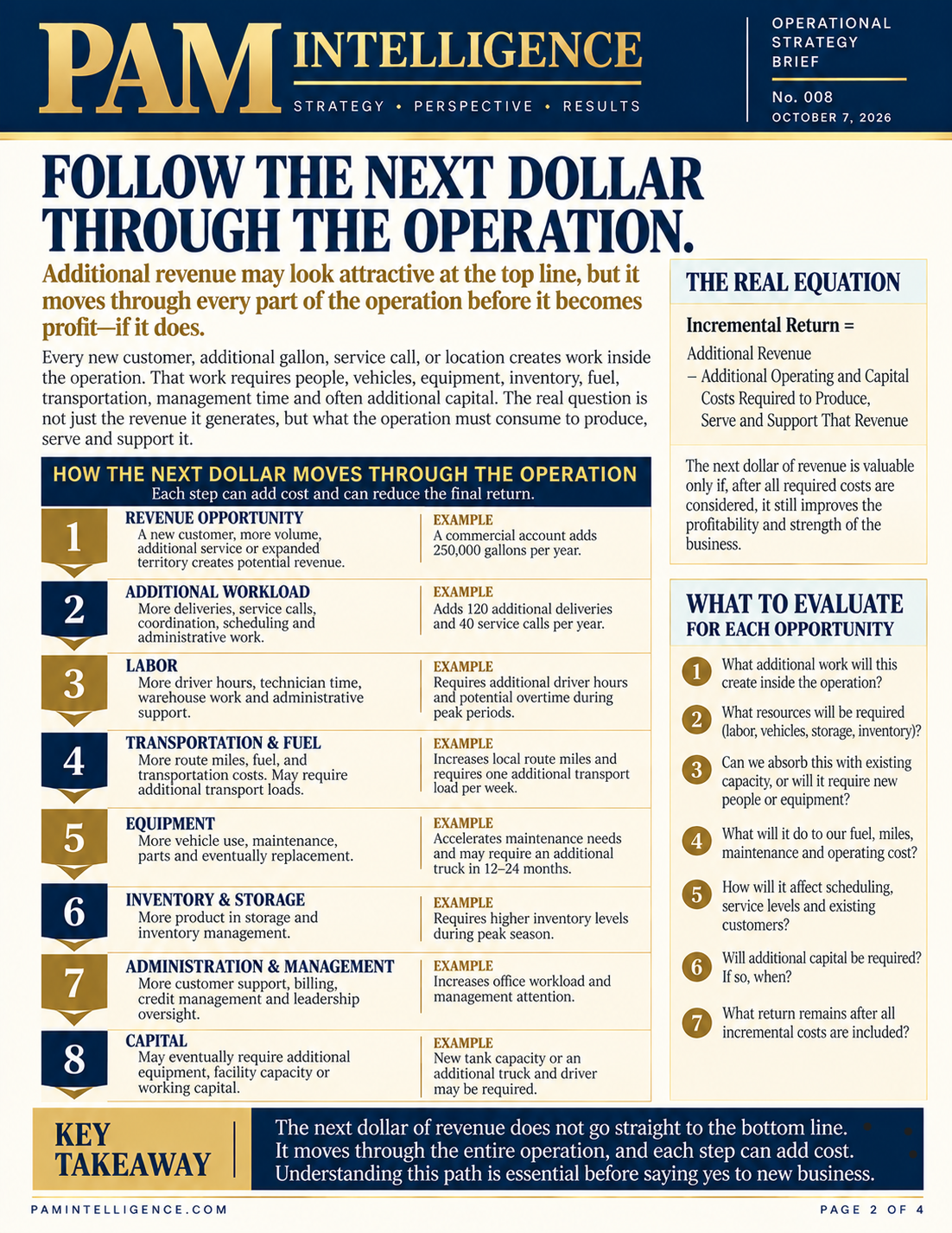
Follow the Next Dollar Through the Operation
Additional revenue may look attractive at the top line, but it moves through every part of the operation before it becomes profit—if it does.
Every new customer, additional gallon, service call, or location creates work inside the operation. That work requires people, vehicles, equipment, inventory, fuel, transportation, management time, and often additional capital. The real question is not just the revenue generated, but what the operation must consume to produce, serve, and support it.
Eight-Stage Operational Path
- Revenue Opportunity. A new customer, more volume, additional service, or expanded territory creates potential revenue.
- Additional Workload. More deliveries, service calls, coordination, scheduling, and administrative work.
- Labor. More driver hours, technician time, warehouse work, administrative support, and possible overtime.
- Transportation & Fuel. More route miles, fuel, transportation cost, and potentially additional transport loads.
- Equipment. More vehicle use, maintenance, parts, and eventually replacement.
- Inventory & Storage. More product in storage and more inventory-management requirements.
- Administration & Management. More customer support, billing, credit management, leadership attention, and oversight.
- Capital. Potential additional equipment, facility capacity, or working capital.
What to Evaluate for Each Opportunity
- What additional work will this create inside the operation?
- What resources will be required—labor, vehicles, storage, and inventory?
- Can we absorb this with existing capacity, or will it require new people or equipment?
- What will it do to fuel, miles, maintenance, and operating cost?
- How will it affect scheduling, service levels, and existing customers?
- Will additional capital be required? If so, when?
- What return remains after all incremental costs are included?
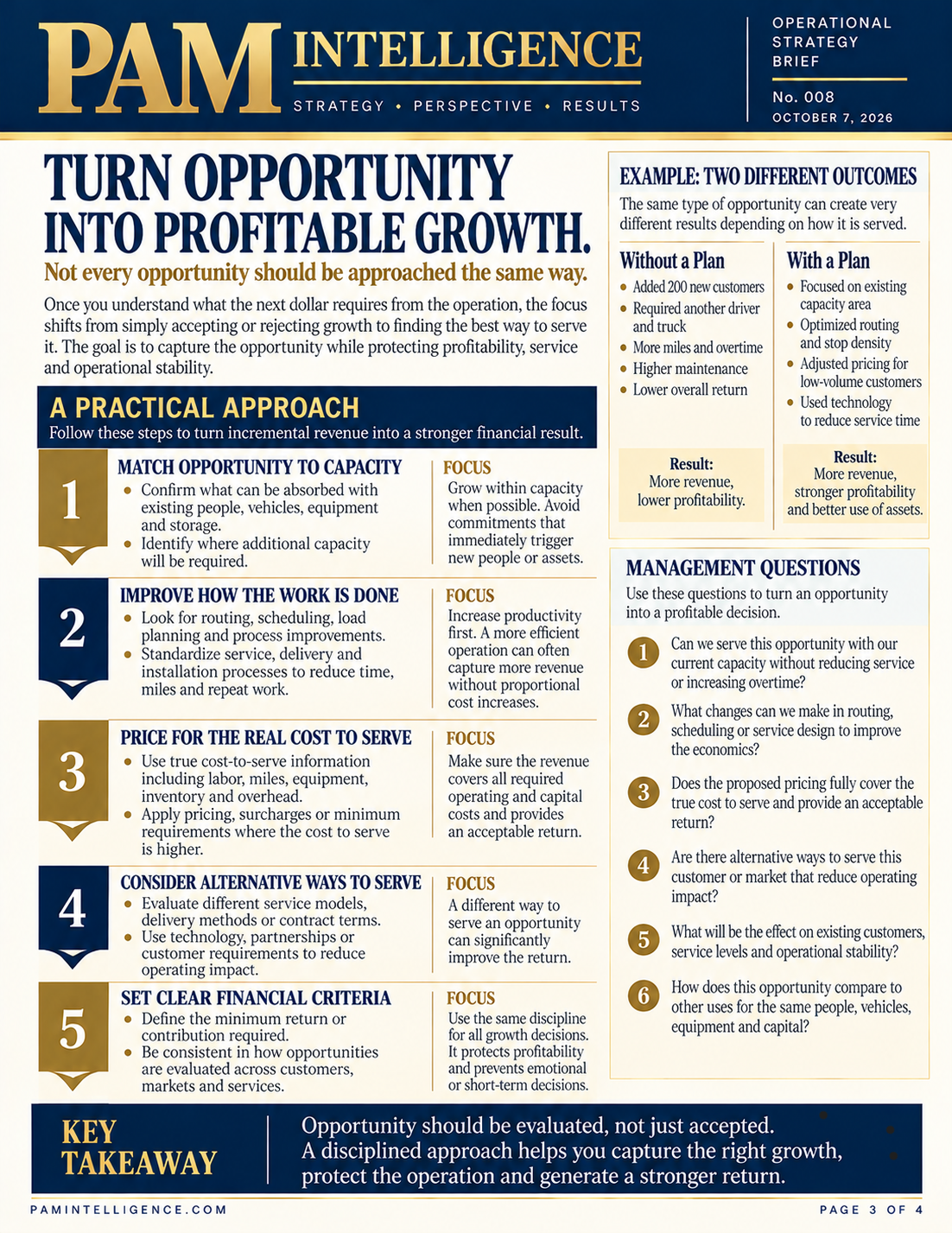
Turn Opportunity into Profitable Growth
Not every opportunity should be approached the same way.
Once the operation understands what the next dollar requires, the focus shifts from simply accepting or rejecting growth to finding the best way to serve it. The goal is to capture opportunity while protecting profitability, service, and operational stability.
Five-Step Practical Approach
- Match Opportunity to Capacity. Confirm what existing people, vehicles, equipment, and storage can absorb; identify where added capacity will be required.
- Improve How the Work Is Done. Look for routing, scheduling, load-planning, and process improvements. Standardize service and delivery processes to reduce time, miles, and repeat work.
- Price for the Real Cost to Serve. Use true cost-to-serve information including labor, miles, equipment, inventory, and overhead. Apply pricing, surcharges, or minimum requirements where service cost is higher.
- Consider Alternative Ways to Serve. Evaluate different service models, delivery methods, contract terms, technology, partnerships, or customer requirements that reduce operating impact.
- Set Clear Financial Criteria. Define the minimum return or contribution required and evaluate opportunities consistently across customers, markets, and services.
Two Different Outcomes
Without a plan: adding customers can require another driver and truck, more miles and overtime, and higher maintenance—producing more revenue but lower profitability.
With a plan: focusing on an existing capacity area, optimizing routing and stop density, adjusting pricing for low-volume customers, and using technology to reduce service time can produce more revenue, stronger profitability, and better use of assets.
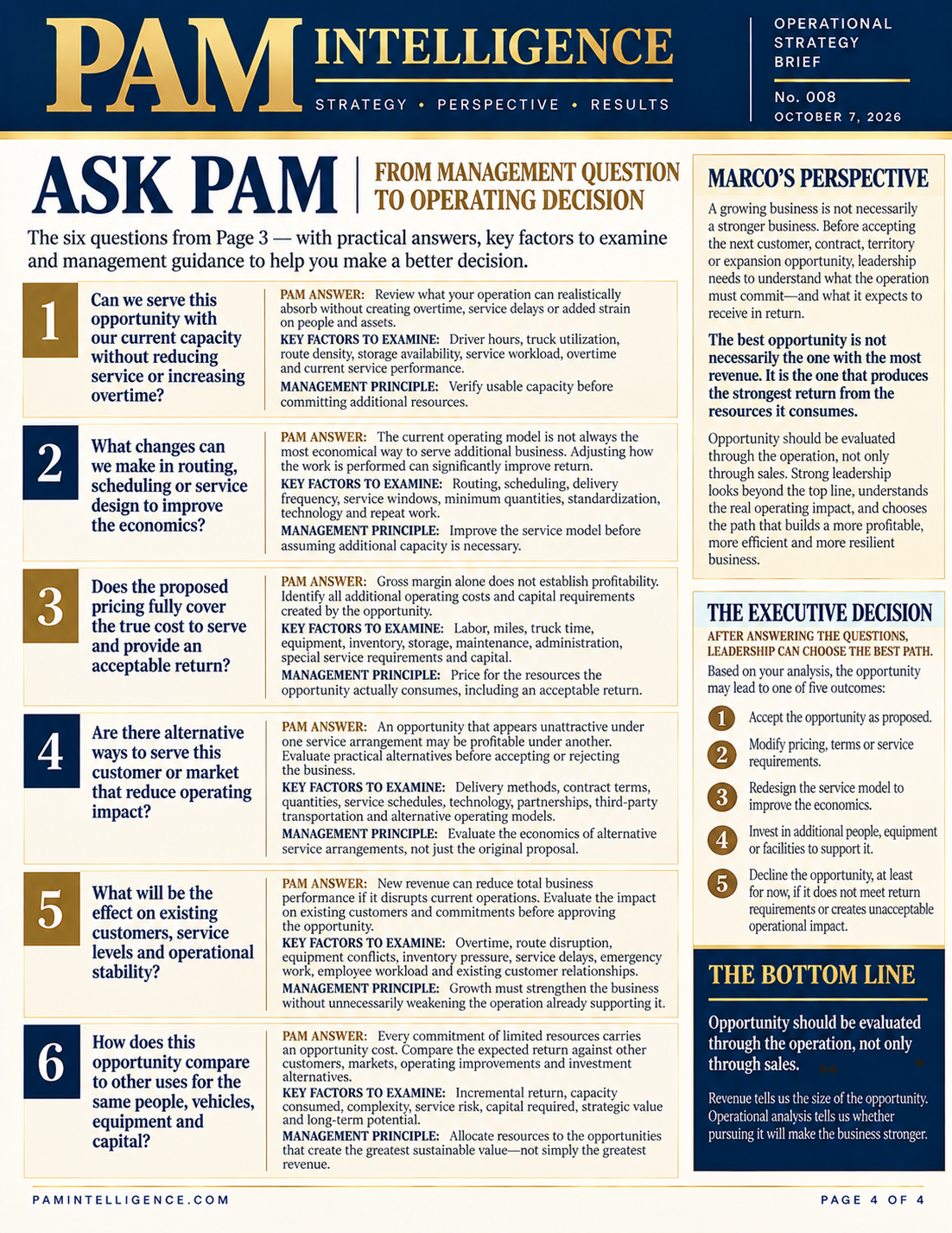
ASK PAM: From Management Question to Operating Decision
The following six questions connect opportunity analysis to practical management decisions.
Can we serve this opportunity with our current capacity without reducing service or increasing overtime?
PAM Answer: Review what the operation can realistically absorb without creating overtime, service delays, or added strain on people and assets.
Key Factors to Examine: Driver hours, truck utilization, route density, storage availability, service workload, overtime, and current service performance.
Management Principle: Verify usable capacity before committing additional resources.
What changes can we make in routing, scheduling, or service design to improve the economics?
PAM Answer: The current operating model is not always the most economical way to serve additional business. Adjusting how work is performed can significantly improve return.
Key Factors to Examine: Routing, scheduling, delivery frequency, service windows, minimum quantities, standardization, technology, and repeat work.
Management Principle: Improve the service model before assuming additional capacity is necessary.
Does the proposed pricing fully cover the true cost to serve and provide an acceptable return?
PAM Answer: Gross margin alone does not establish profitability. Identify all additional operating costs and capital requirements created by the opportunity.
Key Factors to Examine: Labor, miles, truck time, equipment, inventory, storage, maintenance, administration, service requirements, and capital.
Management Principle: Price for the resources the opportunity actually consumes, including an acceptable return.
Are there alternative ways to serve this customer or market that reduce operating impact?
PAM Answer: An opportunity that appears unattractive under one service arrangement may be profitable under another. Evaluate practical alternatives before accepting or rejecting it.
Key Factors to Examine: Delivery methods, contract terms, quantities, service schedules, technology, partnerships, third-party transportation, and alternative operating models.
Management Principle: Evaluate the economics of alternative service arrangements, not just the original request.
What will be the effect on existing customers, service levels, and operational stability?
PAM Answer: New revenue can reduce total business performance if it disrupts current operations. Evaluate the effect on existing customers and commitments before approving the opportunity.
Key Factors to Examine: Overtime, route disruption, equipment conflict, inventory pressure, service delays, emergency work, employee workload, and existing customer relationships.
Management Principle: Growth must strengthen the business without unnecessarily weakening the operation already supporting it.
How does this opportunity compare to other uses for the same people, vehicles, equipment, and capital?
PAM Answer: Every commitment of limited resources carries an opportunity cost. Compare expected return against other customers, markets, operating improvements, and investment alternatives.
Key Factors to Examine: Incremental return, capacity consumed, complexity, service risk, capital required, strategic value, and long-term potential.
Management Principle: Allocate resources to opportunities that create the greatest sustainable value—not simply the greatest revenue.
The Executive Decision
After answering the questions, leadership can choose the best path:
- Accept the opportunity as proposed.
- Modify pricing, terms, or service requirements.
- Redesign the service model to improve the economics.
- Invest in additional people, equipment, or facilities to support it.
- Decline the opportunity, at least for now, if it does not meet return requirements or creates unacceptable operational impact.
ASK PAM
Evaluate the Next Dollar Before You Commit
ASK PAM should not assume that more revenue is automatically good or bad. Evaluate the opportunity through workload, labor, transportation and fuel, equipment, inventory and storage, administration, capital, and incremental return.
Useful company-specific inputs include expected annual revenue or gallons, gross margin, deliveries and stops, gallons or revenue per stop, route miles, driver hours, overtime, service calls, equipment utilization, maintenance impact, inventory and storage requirements, transportation requirements, administrative effort, customer-service requirements, additional capital, and expected return.
If those inputs are unavailable, request them rather than inventing costs, capacity, or return figures. Distinguish delivery and operating economics from total-company profitability and formal accounting results.