Web Edition
Operational resilience is the ability to keep making good decisions, serving customers, and protecting people and assets when something does not go as planned.
View Designed Edition4 original publication pagesA Good Operation Should Survive a Bad Day
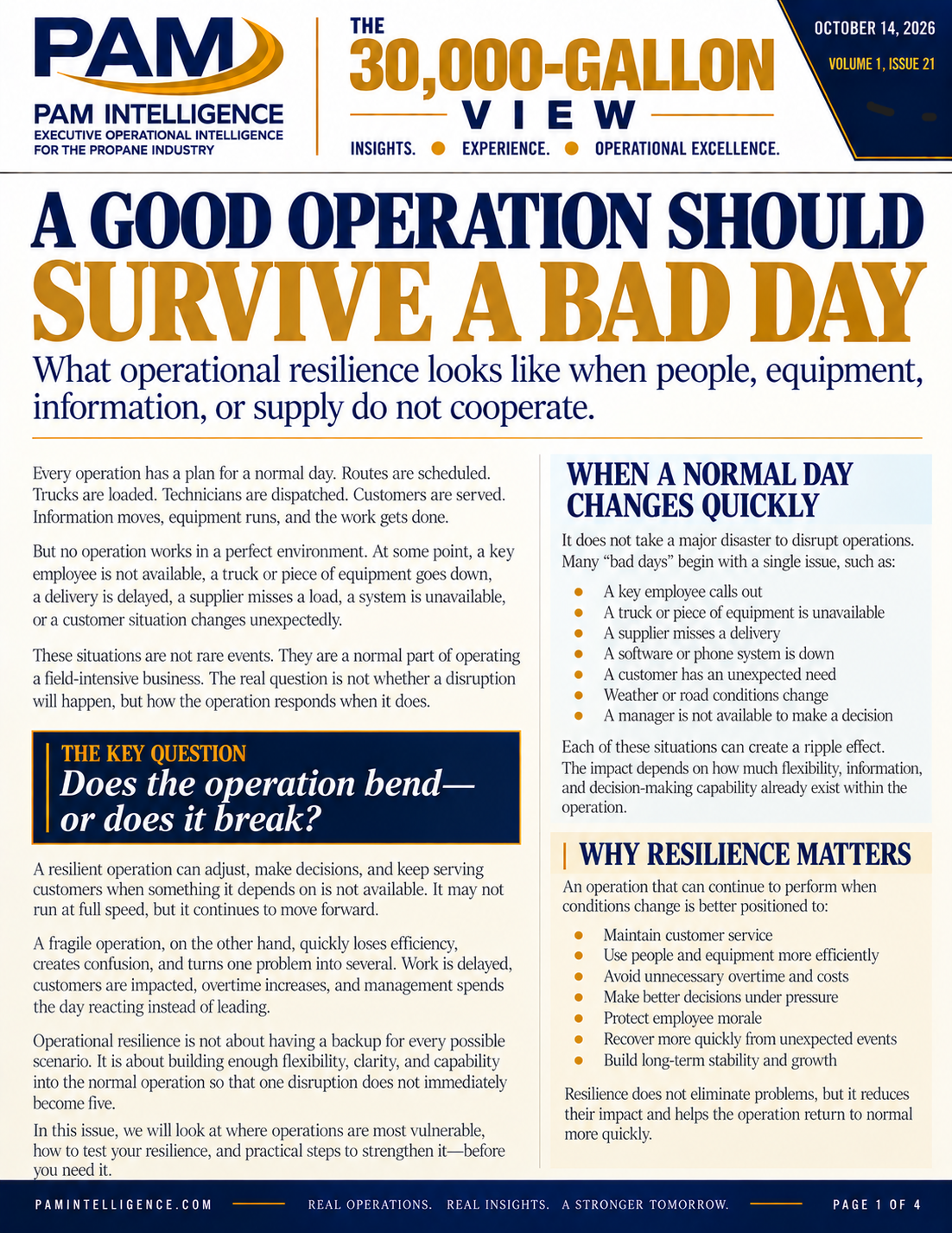
Every operation has a plan for a normal day. Routes are scheduled. Trucks are loaded. Technicians are dispatched. Customers are served. Information moves, equipment runs, and the work gets done.
But no operation works in a perfect environment. At some point, a key employee is not available, a truck or piece of equipment goes down, a delivery is delayed, a supplier misses a load, a system is unavailable, or a customer situation changes unexpectedly.
These situations are not rare events. They are a normal part of operating a field-intensive business. The real question is not whether a disruption will happen, but how the operation responds when it does.
A resilient operation can adjust, make decisions, and keep serving customers when something it depends on is not available. It may not run at full speed, but it continues to move forward.
A fragile operation, on the other hand, quickly loses efficiency, creates confusion, and turns one problem into several. Work is delayed, customers are impacted, overtime increases, and management spends the day reacting instead of leading.
Operational resilience is not about having a backup for every possible scenario. It is about building enough flexibility, clarity, and capability into the normal operation so that one disruption does not immediately become five.
In this issue, we will look at where operations are most vulnerable, how to test your resilience, and practical steps to strengthen it—before you need it.
When a Normal Day Changes Quickly
It does not take a major disaster to disrupt operations. Many “bad days” begin with a single issue, such as:
- A key employee calls out
- A truck or piece of equipment is unavailable
- A supplier misses a delivery
- A software or phone system is down
- A customer has an unexpected need
- Weather or road conditions change
- A manager is not available to make a decision
Each of these situations can create a ripple effect. The impact depends on how much flexibility, information, and decision-making capability already exist within the operation.
Why Resilience Matters
An operation that can continue to perform when conditions change is better positioned to:
- Maintain customer service
- Use people and equipment more efficiently
- Avoid unnecessary overtime and costs
- Make better decisions under pressure
- Protect employee morale
- Recover more quickly from unexpected events
- Build long-term stability and growth
Resilience does not eliminate problems, but it reduces their impact and helps the operation return to normal more quickly.
Find the Single Points of Failure
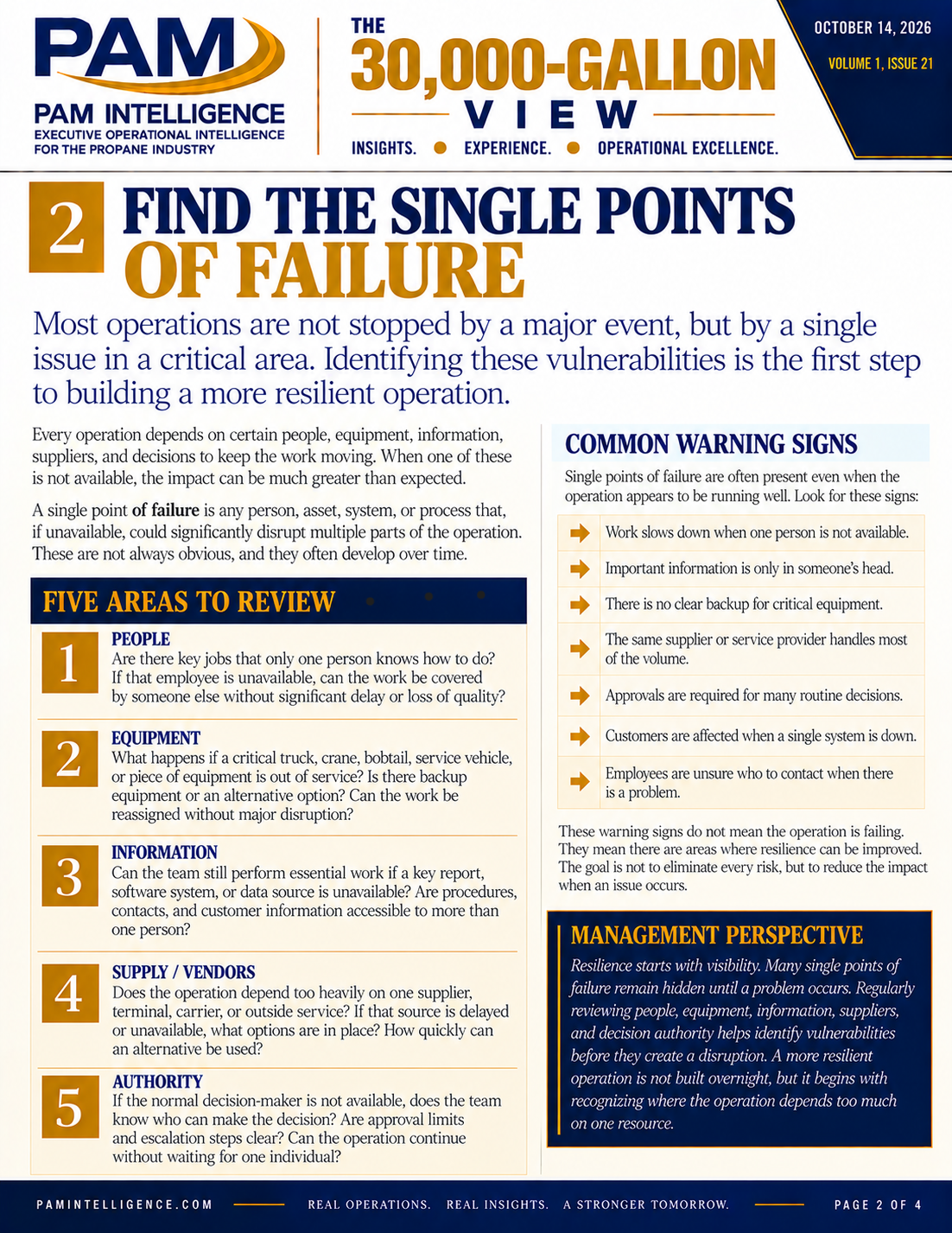
Most operations are not stopped by a major event, but by a single issue in a critical area. Identifying these vulnerabilities is the first step to building a more resilient operation.
Every operation depends on certain people, equipment, information, suppliers, and decisions to keep the work moving. When one of these is not available, the impact can be much greater than expected.
A single point of failure is any person, asset, system, or process that, if unavailable, could significantly disrupt multiple parts of the operation. These are not always obvious, and they often develop over time.
Five Areas to Review
- People. Are there key jobs that only one person knows how to do? If that employee is unavailable, can the work be covered by someone else without significant delay or loss of quality?
- Equipment. What happens if a critical truck, crane, bobtail, service vehicle, or piece of equipment is out of service? Is there backup equipment or an alternative option? Can the work be reassigned without major disruption?
- Information. Can the team still perform essential work if a key report, software system, or data source is unavailable? Are procedures, contacts, and customer information accessible to more than one person?
- Supply / Vendors. Does the operation depend too heavily on one supplier, terminal, carrier, or outside service? If that source is delayed or unavailable, what options are in place? How quickly can an alternative be used?
- Authority. If the normal decision-maker is not available, does the team know who can make the decision? Are approval limits and escalation steps clear? Can the operation continue without waiting for one individual?
Common Warning Signs
Single points of failure are often present even when the operation appears to be running well. Look for these signs:
- Work slows down when one person is not available.
- Important information is only in someone’s head.
- There is no clear backup for critical equipment.
- The same supplier or service provider handles most of the volume.
- Approvals are required for many routine decisions.
- Customers are affected when a single system is down.
- Employees are unsure who to contact when there is a problem.
These warning signs do not mean the operation is failing. They mean there are areas where resilience can be improved. The goal is not to eliminate every risk, but to reduce the impact when an issue occurs.
Run the Bad-Day Test Before You Need It
A simple, practical exercise can show how your operation will respond when an important resource is suddenly not available.
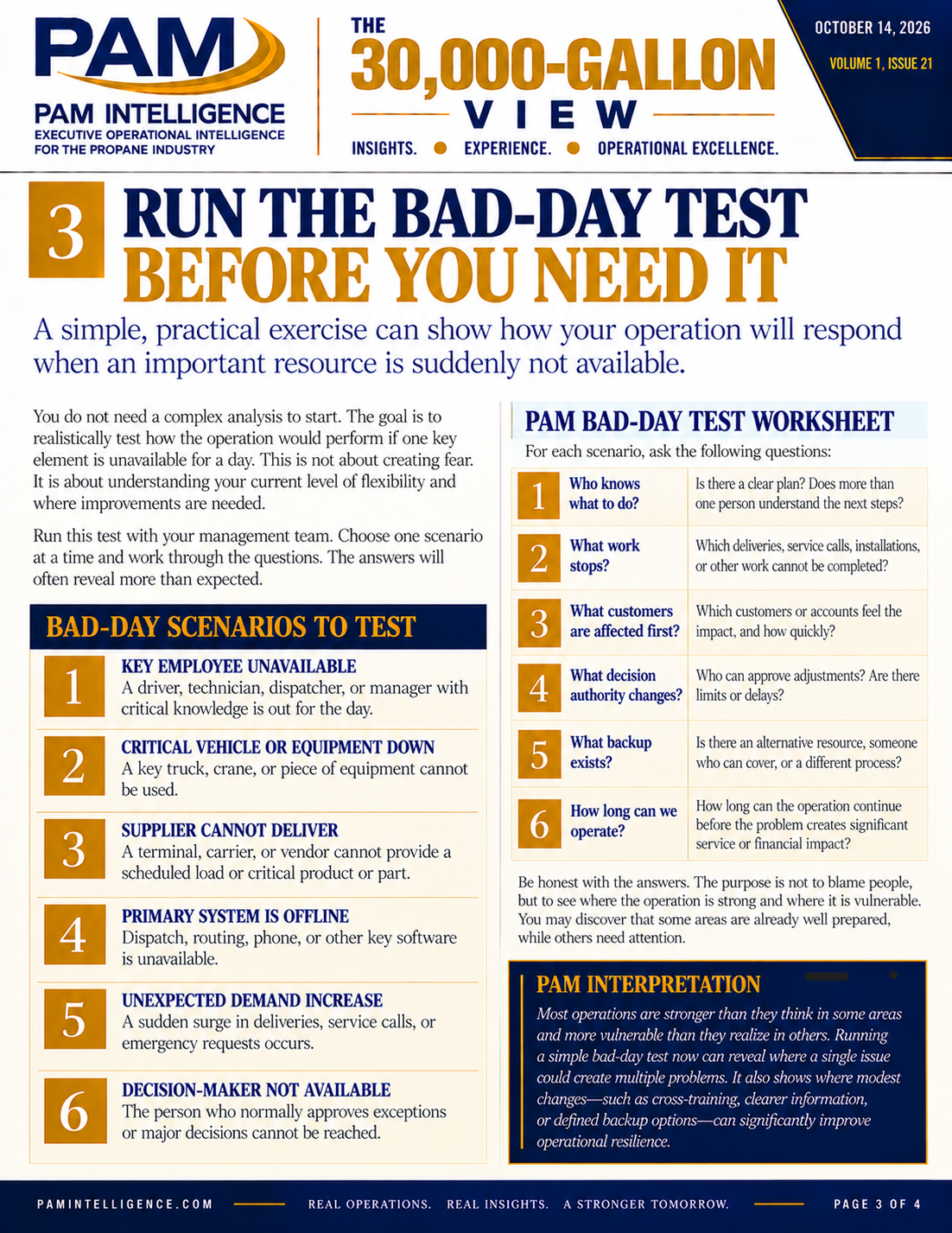
You do not need a complex analysis to start. The goal is to realistically test how the operation would perform if one key element is unavailable for a day. This is not about creating fear. It is about understanding your current level of flexibility and where improvements are needed.
Run this test with your management team. Choose one scenario at a time and work through the questions. The answers will often reveal more than expected.
Bad-Day Scenarios to Test
- Key Employee Unavailable. A driver, technician, dispatcher, or manager with critical knowledge is out for the day.
- Critical Vehicle or Equipment Down. A key truck, crane, or piece of equipment cannot be used.
- Supplier Cannot Deliver. A terminal, carrier, or vendor cannot provide a scheduled load or critical product or part.
- Primary System Is Offline. Dispatch, routing, phone, or other key software is unavailable.
- Unexpected Demand Increase. A sudden surge in deliveries, service calls, or emergency requests occurs.
- Decision-Maker Not Available. The person who normally approves exceptions or major decisions cannot be reached.
PAM Bad-Day Test Worksheet
For each scenario, ask the following questions:
- Who knows what to do? Is there a clear plan? Does more than one person understand the next steps?
- What work stops? Which deliveries, service calls, installations, or other work cannot be completed?
- What customers are affected first? Which customers or accounts feel the impact, and how quickly?
- What decision authority changes? Who can approve adjustments? Are there limits or delays?
- What backup exists? Is there an alternative resource, someone who can cover, or a different process?
- How long can we operate? How long can the operation continue before the problem creates significant service or financial impact?
Be honest with the answers. The purpose is not to blame people, but to see where the operation is strong and where it is vulnerable. You may discover that some areas are already well prepared, while others need attention.
Build Resilience Before You Need It
Strengthening key areas now helps your operation respond faster, reduce the impact when problems occur, and keep customers served.
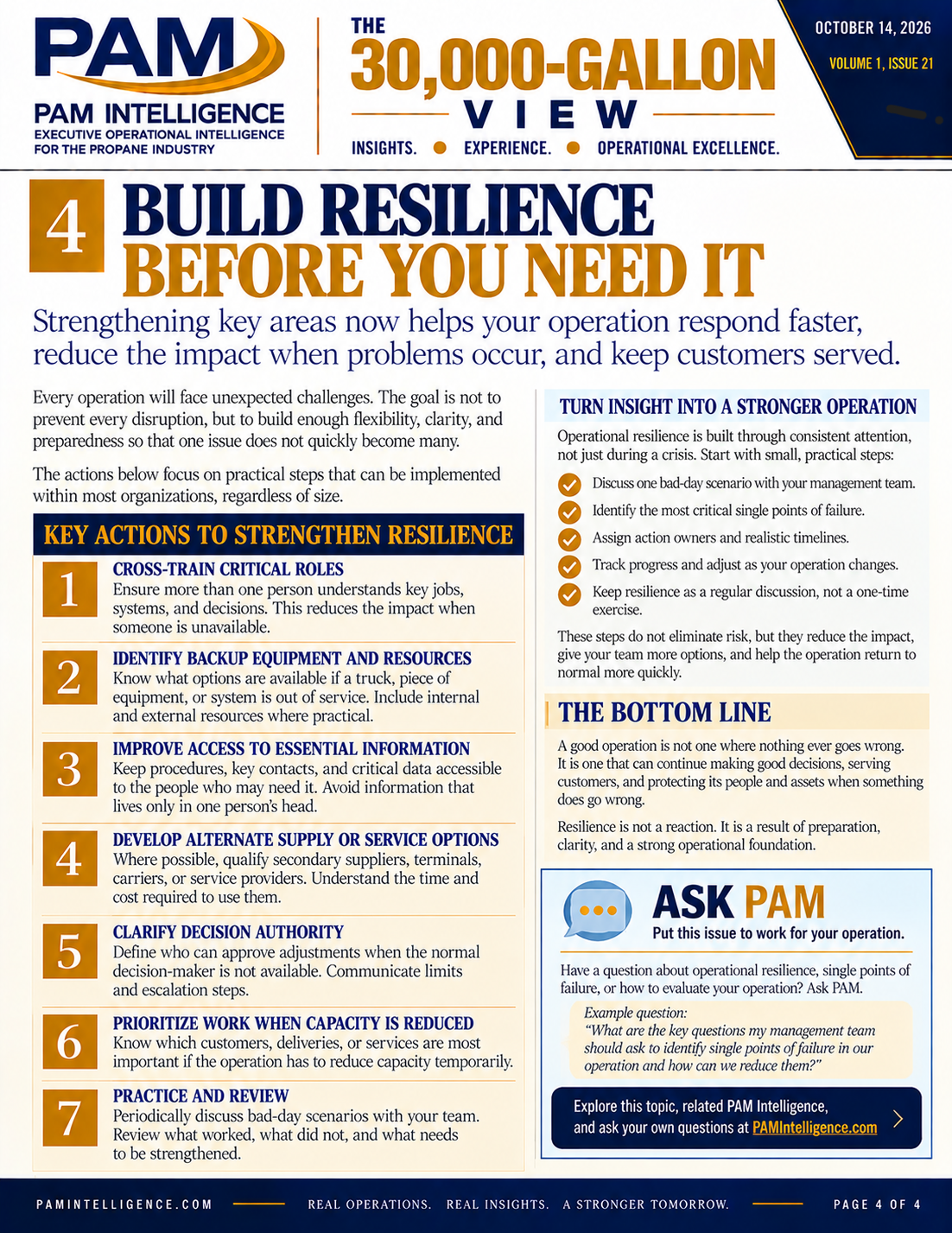
Every operation will face unexpected challenges. The goal is not to prevent every disruption, but to build enough flexibility, clarity, and preparedness so that one issue does not quickly become many.
The actions below focus on practical steps that can be implemented within most organizations, regardless of size.
Key Actions to Strengthen Resilience
- Cross-Train Critical Roles. Ensure more than one person understands key jobs, systems, and decisions. This reduces the impact when someone is unavailable.
- Identify Backup Equipment and Resources. Know what options are available if a truck, piece of equipment, or system is out of service. Include internal and external resources where practical.
- Improve Access to Essential Information. Keep procedures, key contacts, and critical data accessible to the people who may need it. Avoid information that lives only in one person’s head.
- Develop Alternate Supply or Service Options. Where possible, qualify secondary suppliers, terminals, carriers, or service providers. Understand the time and cost required to use them.
- Clarify Decision Authority. Define who can approve adjustments when the normal decision-maker is not available. Communicate limits and escalation steps.
- Prioritize Work When Capacity Is Reduced. Know which customers, deliveries, or services are most important if the operation has to reduce capacity temporarily.
- Practice and Review. Periodically discuss bad-day scenarios with your team. Review what worked, what did not, and what needs to be strengthened.
Turn Insight into a Stronger Operation
Operational resilience is built through consistent attention, not just during a crisis. Start with small, practical steps:
- Discuss one bad-day scenario with your management team.
- Identify the most critical single points of failure.
- Assign action owners and realistic timelines.
- Track progress and adjust as your operation changes.
- Keep resilience as a regular discussion, not a one-time exercise.
These steps do not eliminate risk, but they reduce the impact, give your team more options, and help the operation return to normal more quickly.
The Bottom Line
A good operation is not one where nothing ever goes wrong. It is one that can continue making good decisions, serving customers, and protecting its people and assets when something does go wrong.
Resilience is not a reaction. It is a result of preparation, clarity, and a strong operational foundation.
ASK PAM: Put This Issue to Work
Question: “What are the key questions my management team should ask to identify single points of failure in our operation and how can we reduce them?”
What is happening? Determine where one unavailable person, asset, system, supplier, or decision-maker could interrupt several parts of the operation.
What should you measure? For each bad-day scenario, identify what work stops, which customers are affected first, and how long the operation can continue before service or financial impact becomes significant.
What may be causing it? Look for dependence on one person’s knowledge, one critical asset, inaccessible information, one supplier or service provider, or approvals that cannot move without one individual.
What can management control? Cross-train critical roles, improve access to essential information, identify backup equipment and resources, qualify alternate supply or service options, and clarify decision limits and escalation steps.
What decision may need to be made? Decide which single points of failure create the greatest operating exposure and which backup, authority, or prioritization changes must be established first.
What practical step comes next? Choose one realistic bad-day scenario, work through the six PAM Bad-Day Test questions with the management team, assign action owners and timelines, and review the result as the operation changes.