Web Edition
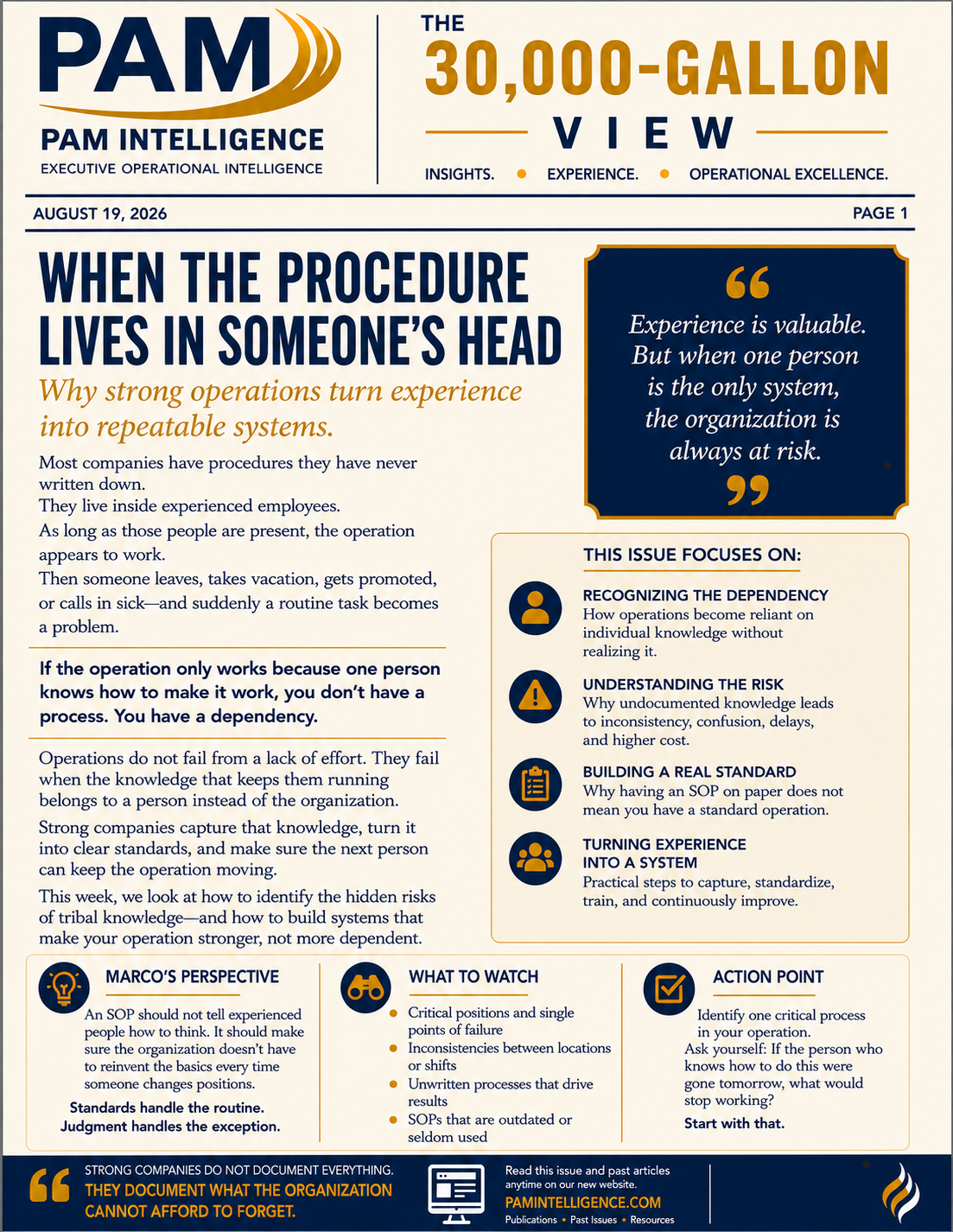
Experience is valuable. But when one person is the only system, the organization is always at risk.
View Designed Edition4 original publication pagesThe Hidden Dependency
Most companies have procedures they have never written down. They live inside experienced employees. As long as those people are present, the operation appears to work. Then someone leaves, takes vacation, gets promoted, or calls in sick—and suddenly a routine task becomes a problem.
If the operation only works because one person knows how to make it work, you don’t have a process. You have a dependency.
Operations do not fail from a lack of effort. They fail when the knowledge that keeps them running belongs to a person instead of the organization.
Strong companies capture that knowledge, turn it into clear standards, and make sure the next person can keep the operation moving. The work is to recognize the dependency, understand the risk, build a real standard, and turn experience into a system.
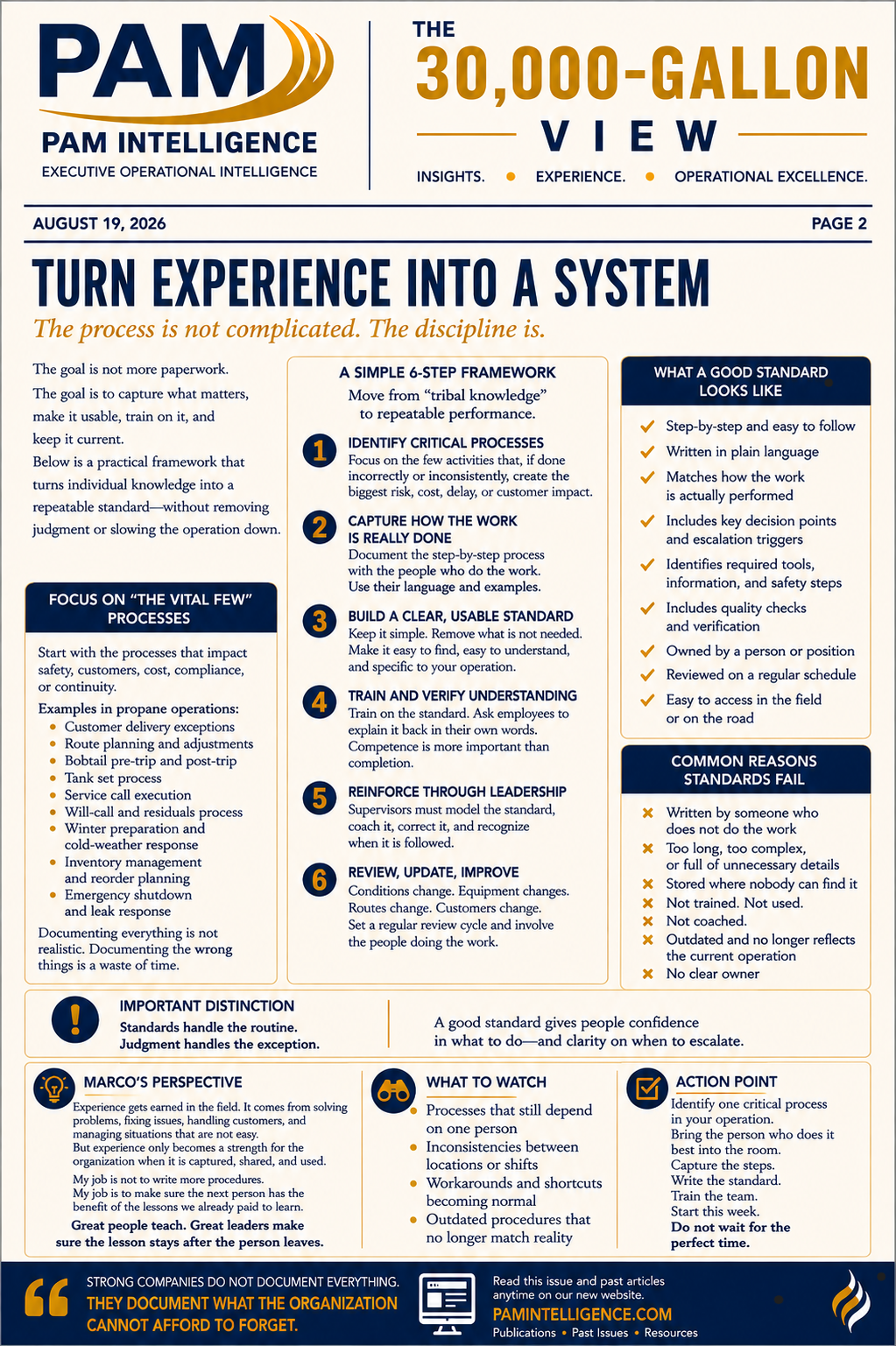
Turn Experience Into a System
The process is not complicated. The discipline is.
The goal is not more paperwork. The goal is to capture what matters, make it usable, train on it, and keep it current—without removing judgment or slowing the operation down.
Focus on the “Vital Few” Processes
Start with processes that affect safety, customers, cost, compliance, or continuity: customer delivery exceptions; route planning and adjustments; bobtail pre-trip and post-trip; tank set process; service call execution; will-call and residuals; winter preparation and cold-weather response; inventory management and reorder planning; and emergency shutdown and leak response.
Documenting everything is not realistic. Documenting the wrong things is a waste of time.
A Simple Six-Step Framework
- Identify critical processes. Focus on activities that create the biggest risk, cost, delay, or customer impact if performed incorrectly or inconsistently.
- Capture how the work is really done. Document the process with the people who do the work, using their language and examples.
- Build a clear, usable standard. Keep it simple, easy to find, easy to understand, and specific to the operation.
- Train and verify understanding. Ask employees to explain it back in their own words. Competence matters more than completion.
- Reinforce through leadership. Supervisors must model, coach, correct, and recognize when it is followed.
- Review, update, improve. Conditions, equipment, routes, and customers change. Review regularly with the people doing the work.
What a Good Standard Looks Like
- Step-by-step, plain-language, and easy to follow
- Matches how the work is actually performed
- Includes decision points, escalation triggers, tools, information, safety steps, quality checks, and verification
- Owned by a person or position and reviewed regularly
- Easy to access in the field or on the road
Common Reasons Standards Fail
- Written by someone who does not do the work
- Too long, too complex, or full of unnecessary detail
- Stored where nobody can find it
- Not trained, used, coached, or owned
- Outdated and no longer reflective of the current operation
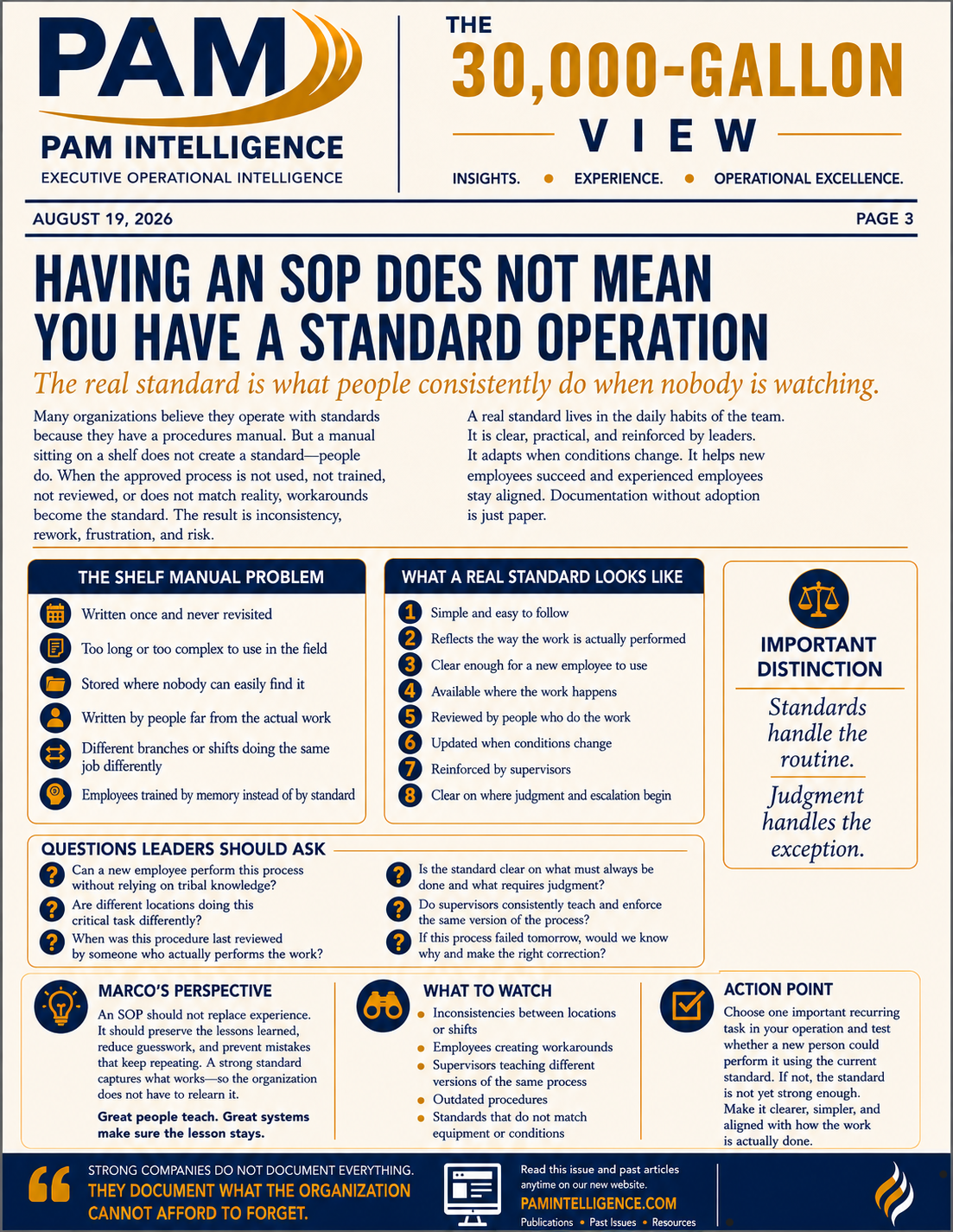
Having an SOP Does Not Mean You Have a Standard Operation
The real standard is what people consistently do when nobody is watching.
A manual sitting on a shelf does not create a standard—people do. When the approved process is not used, trained, reviewed, or matched to reality, workarounds become the standard. The result is inconsistency, rework, frustration, and risk.
A real standard lives in the daily habits of the team. It is clear, practical, reinforced by leaders, adapts when conditions change, and helps new employees succeed while experienced employees stay aligned. Documentation without adoption is just paper.
The Shelf Manual Problem
- Written once and never revisited
- Too long or complex to use in the field
- Stored where nobody can easily find it
- Written by people far from the actual work
- Different branches or shifts doing the same job differently
- Employees trained by memory instead of by standard
Questions Leaders Should Ask
- Can a new employee perform this process without relying on tribal knowledge?
- Are different locations doing this critical task differently?
- When was this procedure last reviewed by someone who actually performs the work?
- Is the standard clear on what must always be done and what requires judgment?
- Do supervisors consistently teach and enforce the same version?
- If this process failed tomorrow, would we know why and make the right correction?
Leadership Action
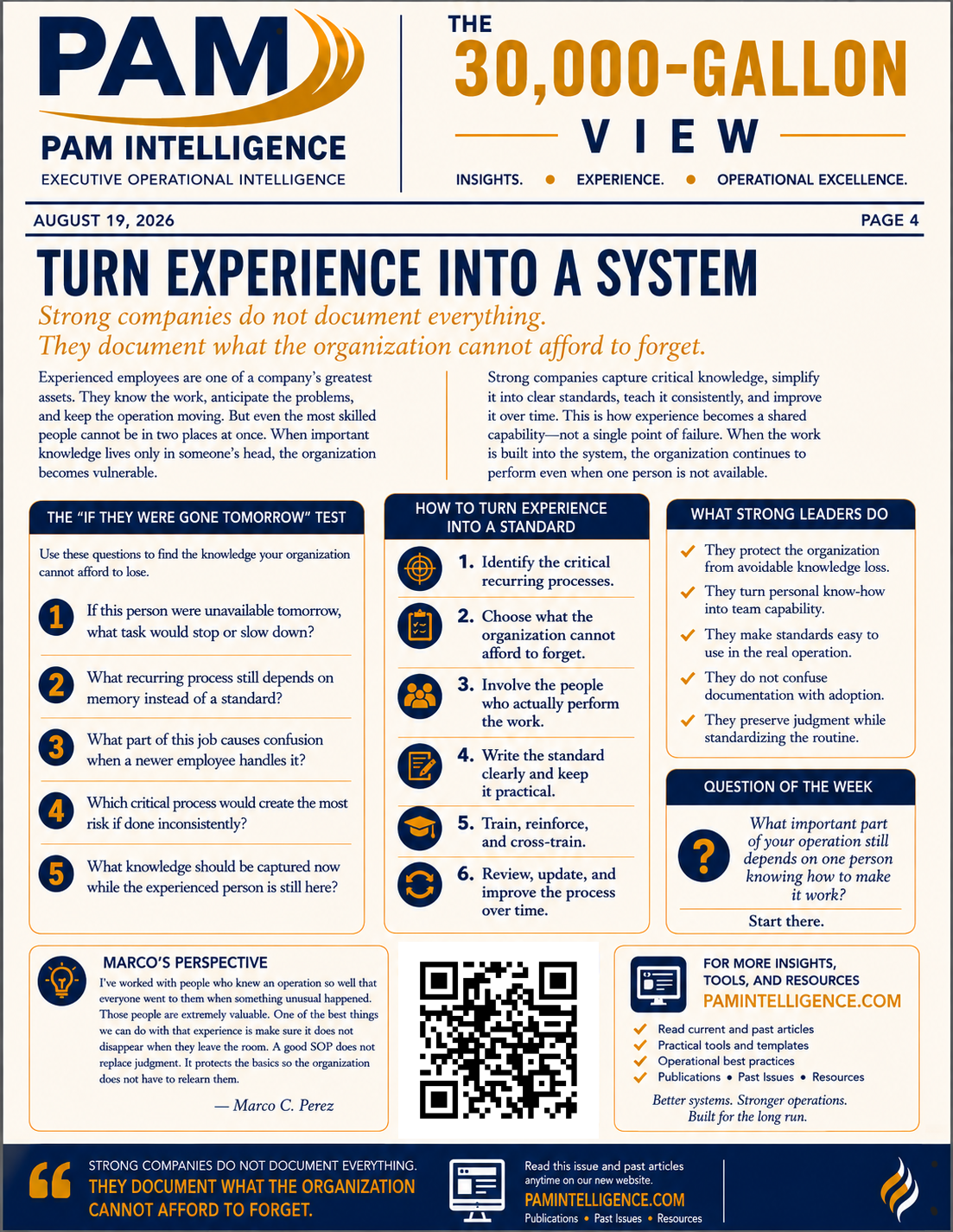
Experienced employees are one of a company’s greatest assets. But even the most skilled people cannot be in two places at once. When important knowledge lives only in someone’s head, the organization becomes vulnerable.
Strong companies capture critical knowledge, simplify it into clear standards, teach it consistently, and improve it over time. This is how experience becomes a shared capability—not a single point of failure.
The “If They Were Gone Tomorrow” Test
- If this person were unavailable tomorrow, what task would stop or slow down?
- What recurring process still depends on memory instead of a standard?
- What part of this job causes confusion when a newer employee handles it?
- Which critical process would create the most risk if done inconsistently?
- What knowledge should be captured now while the experienced person is still here?
How to Turn Experience Into a Standard
- Identify the critical recurring processes.
- Choose what the organization cannot afford to forget.
- Involve the people who actually perform the work.
- Write the standard clearly and keep it practical.
- Train, reinforce, and cross-train.
- Review, update, and improve the process over time.