Web Edition
Predictions may get headlines. Preparation creates results.
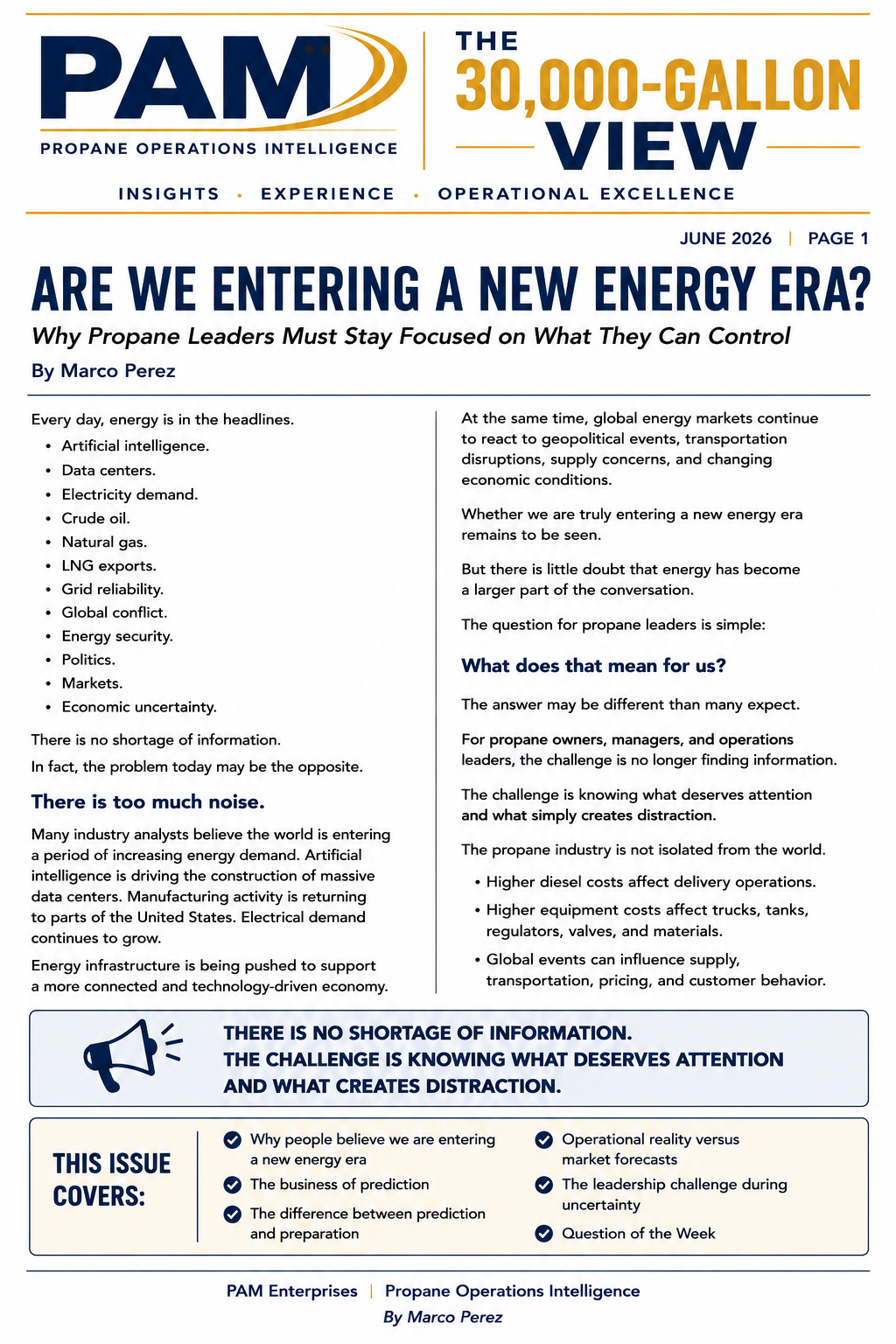
View Designed Edition4 original publication pagesAre We Entering a New Energy Era?
Every day, energy is in the headlines.
- Artificial intelligence
- Data centers
- Electricity demand
- Crude oil
- Natural gas
- LNG exports
- Grid reliability
- Global conflict
- Energy security
- Politics
- Markets
- Economic uncertainty
There is no shortage of information. In fact, the problem today may be the opposite. There is too much noise.
Many industry analysts believe the world is entering a period of increasing energy demand. Artificial intelligence is driving the construction of massive data centers. Manufacturing activity is returning to parts of the United States. Electrical demand continues to grow. Energy infrastructure is being pushed to support a more connected and technology-driven economy.
At the same time, global energy markets continue to react to geopolitical events, transportation disruptions, supply concerns, and changing economic conditions.
Whether we are truly entering a new energy era remains to be seen. But there is little doubt that energy has become a larger part of the conversation.
The question for propane leaders is simple: What does that mean for us?
The answer may be different than many expect.
For propane owners, managers, and operations leaders, the challenge is no longer finding information. The challenge is knowing what deserves attention and what simply creates distraction.
The propane industry is not isolated from the world. Higher diesel costs affect delivery operations. Higher equipment costs affect trucks, tanks, regulators, valves, and materials. Global events can influence supply, transportation, pricing, and customer behavior.
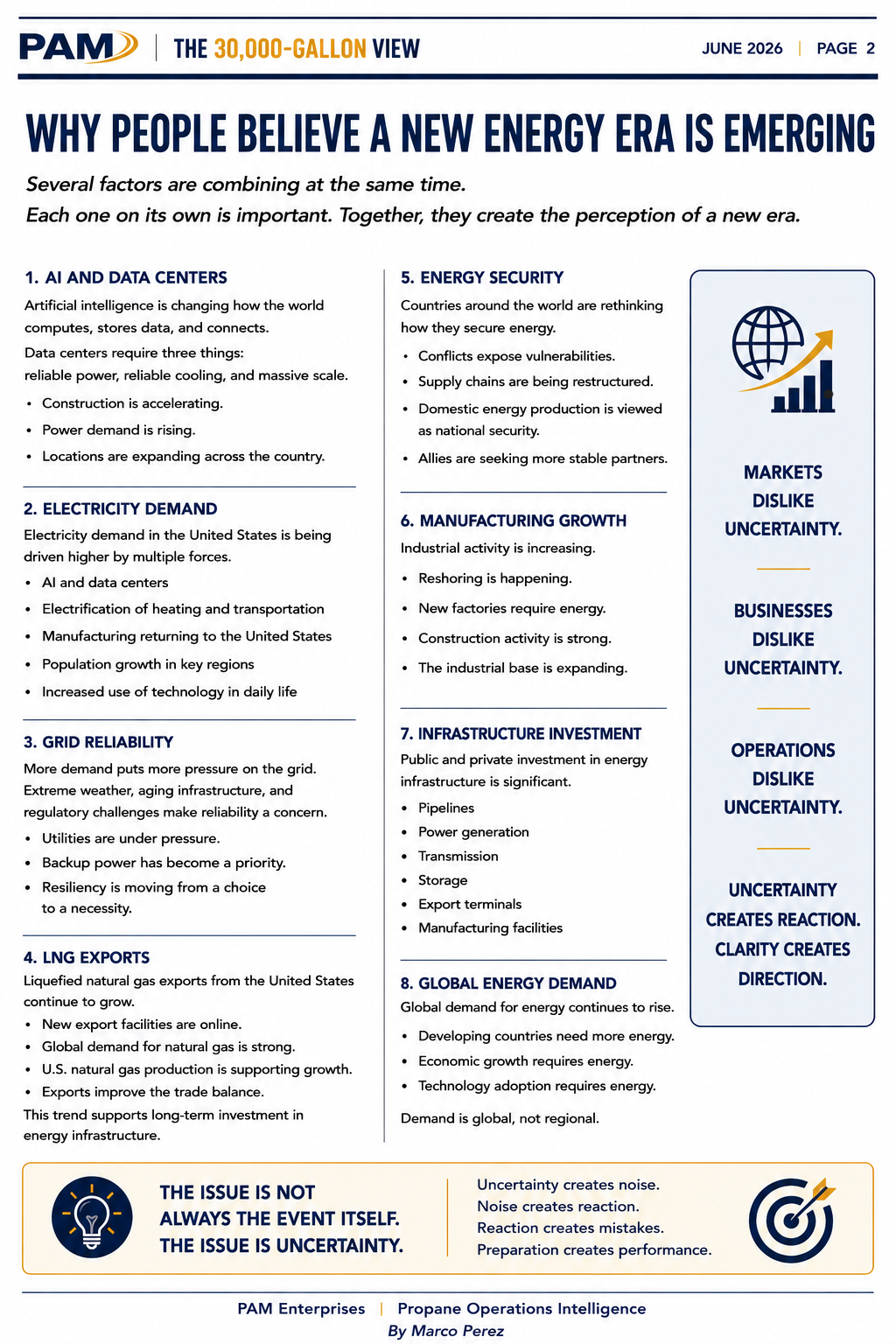
Why People Believe a New Energy Era Is Emerging
Several factors are combining at the same time. Each one on its own is important. Together, they create the perception of a new era.
- AI and data centers. Artificial intelligence is changing how the world computes, stores data, and connects. Data centers require reliable power, reliable cooling, and massive scale. Construction is accelerating, power demand is rising, and locations are expanding across the country.
- Electricity demand. Demand is being driven higher by AI and data centers, electrification of heating and transportation, population growth in key regions, and increased use of technology in daily life.
- Grid reliability. Extreme weather, aging infrastructure, and regulatory challenges make reliability a concern. Utilities are under pressure, backup power has become a priority, and resiliency is moving from a choice to a necessity.
- LNG exports. U.S. liquefied-natural-gas exports continue to grow. New export facilities are online, global demand for natural gas is strong, U.S. natural-gas production is supporting growth, and exports improve the trade balance. This trend supports long-term investment in energy infrastructure.
- Energy security. Countries around the world are rethinking how they secure energy. Conflicts expose vulnerabilities, supply chains are being restructured, domestic energy production is viewed as national security, and allies are seeking more stable partners.
- Manufacturing growth. Reshoring is happening, new factories require energy, construction activity is strong, and the industrial base is expanding.
- Infrastructure investment. Public and private investment in pipelines, power generation, transmission, storage, export terminals, and manufacturing facilities is significant.
- Global energy demand. Developing countries need more energy, economic growth requires energy, technology adoption requires energy, and demand is global, not regional.
Uncertainty creates noise. Noise creates reaction. Reaction creates mistakes.
Clarity creates direction. Preparation creates performance.
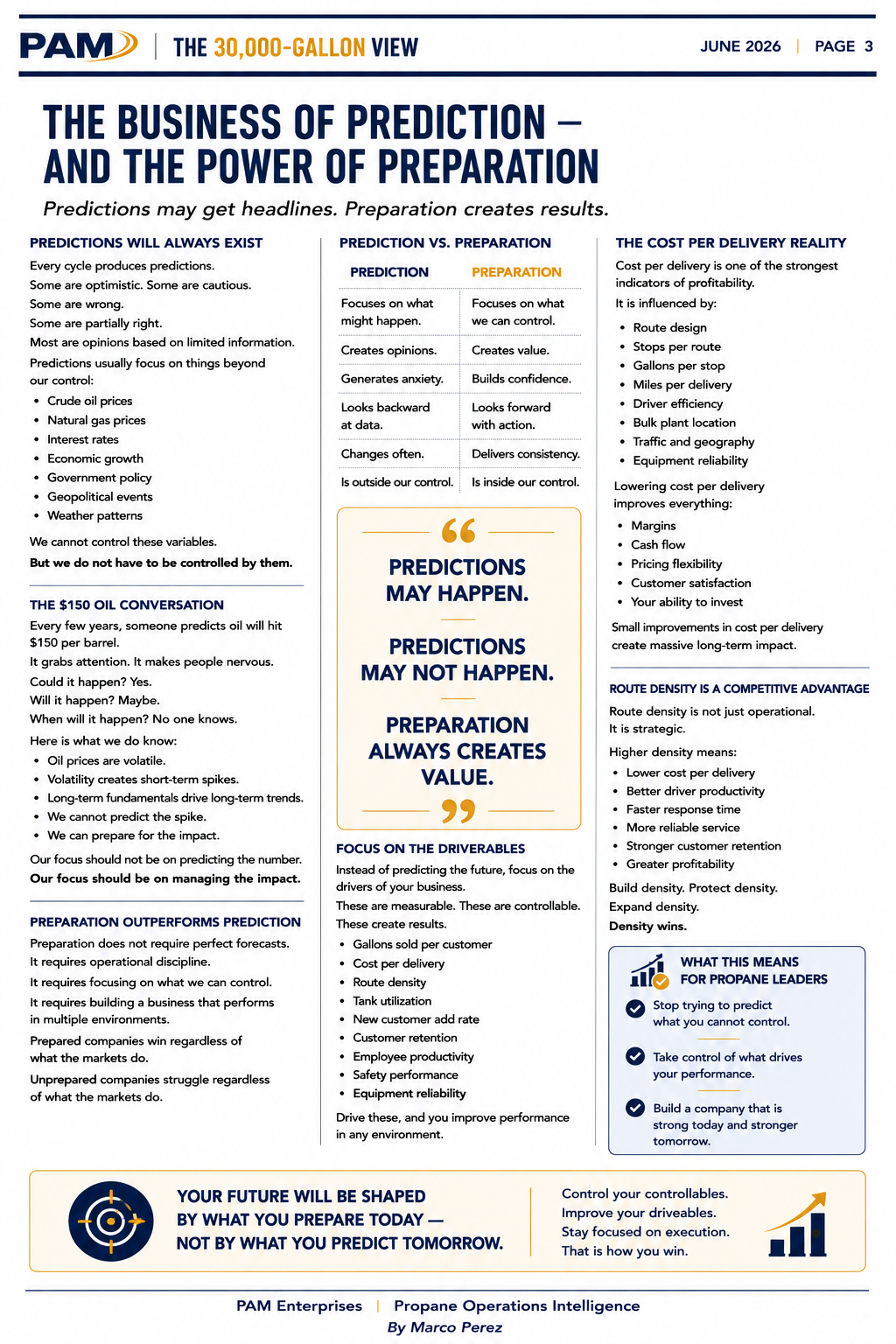
The Business of Prediction—and the Power of Preparation
Predictions may get headlines. Preparation creates results.
Predictions Will Always Exist
Every cycle produces predictions. Some are optimistic. Some are cautious. Some are wrong. Some are partially right. Most are opinions based on limited information.
Predictions usually focus on things beyond our control: crude oil prices, natural gas prices, interest rates, economic growth, government policy, geopolitical events, and weather patterns.
We cannot control these variables. But we do not have to be controlled by them.
The $150 Oil Conversation
Every few years, someone predicts oil will hit $150 per barrel. It grabs attention. It makes people nervous.
Could it happen? Yes. Will it happen? Maybe. When will it happen? No one knows.
Here is what we do know:
- Oil prices are volatile.
- Volatility creates short-term spikes.
- Long-term fundamentals drive long-term trends.
- We cannot predict the spike.
- We can prepare for the impact.
Our focus should not be on predicting the number. Our focus should be on managing the impact.
Prediction versus Preparation
Prediction focuses on what might happen, creates opinions, generates anxiety, looks backward at data, changes often, and is outside our control.
Preparation focuses on what we can control, creates value, builds confidence, looks forward with action, delivers, and is inside our control.
Focus on the Driverables
Instead of predicting the future, focus on the drivers of your business. These are measurable. These are controllable. These create results.
- Gallons sold per customer
- Cost per delivery
- Route density
- Tank utilization
- New-customer add rate
- Employee retention
- Safety performance
- Equipment reliability
Drive these, and you improve performance in any environment.
The Cost per Delivery Reality
Cost per delivery is one of the strongest indicators of profitability. It is influenced by route design, stops per route, gallons per stop, miles per delivery, driver efficiency, bulk-plant location, traffic and geography, and equipment reliability.
Lowering cost per delivery improves margins, cash flow, pricing flexibility, customer satisfaction, and your ability to invest.
Small improvements in cost per delivery create massive long-term impact.
Route Density Is a Competitive Advantage
Route density is not just operational. It is strategic.
Higher density means lower cost per delivery, better driver productivity, faster response time, more reliable service, stronger customer retention, and greater profitability.
Build density. Protect density. Expand density. Density wins.
What This Means for Propane Leaders
Stop trying to predict what you cannot control. Take control of what drives your performance. Build a company that is strong today and stronger tomorrow.
Control your controllables. Improve your driverables. Stay focused on execution. That is how you win.
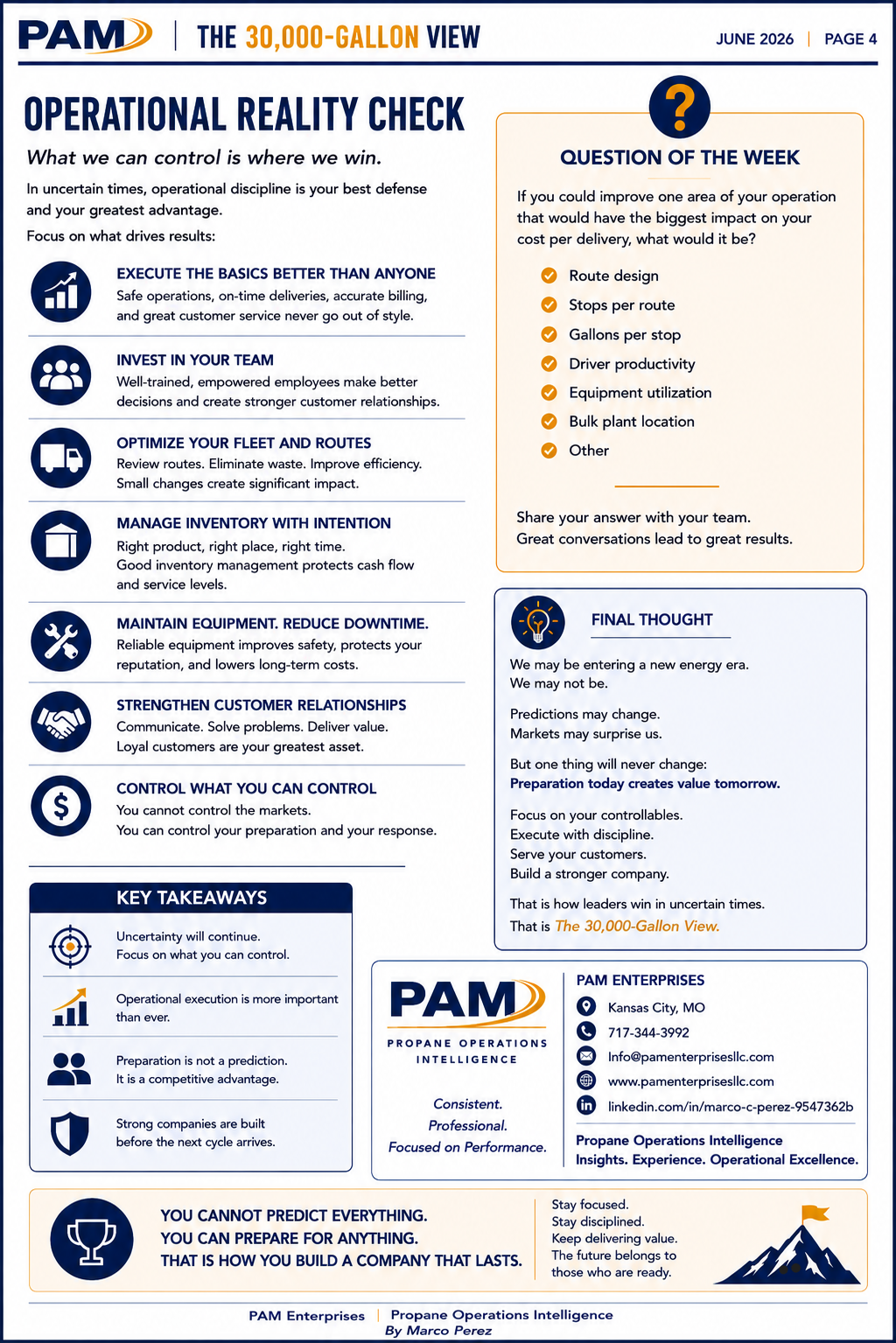
Operational Reality Check
What we can control is where we win.
In uncertain times, operational discipline is your best defense and your greatest advantage.
- Execute the basics better than anyone. Safe operations, on-time deliveries, accurate billing, and great customer service never go out of style.
- Invest in your team. Well-trained, empowered employees make better decisions and create stronger customer relationships.
- Optimize your fleet and routes. Review routes. Eliminate waste. Improve efficiency. Small changes create significant impact.
- Manage inventory with intention. Right product, right place, right time. Good inventory management protects cash flow and service levels.
- Maintain equipment. Reduce downtime. Reliable equipment improves safety, protects your reputation, and lowers long-term costs.
- Strengthen customer relationships. Communicate. Solve problems. Deliver value. Loyal customers are your greatest asset.
- Control what you can control. You cannot control the markets. You can control your preparation and your response.
Final Thought
We may be entering a new energy era. We may not be. Predictions may change. Markets may surprise us.
But one thing will never change: preparation today creates value tomorrow.
Focus on your controllables. Execute with discipline. Serve your customers. Build a stronger company.
That is how leaders win in uncertain times.
Key Takeaways
- Uncertainty will continue.
- Focus on what you can control.
- Operational execution is more important than ever.
- Preparation is not a prediction. It is a competitive advantage.
- Strong companies are built before the next cycle arrives.