Web Edition
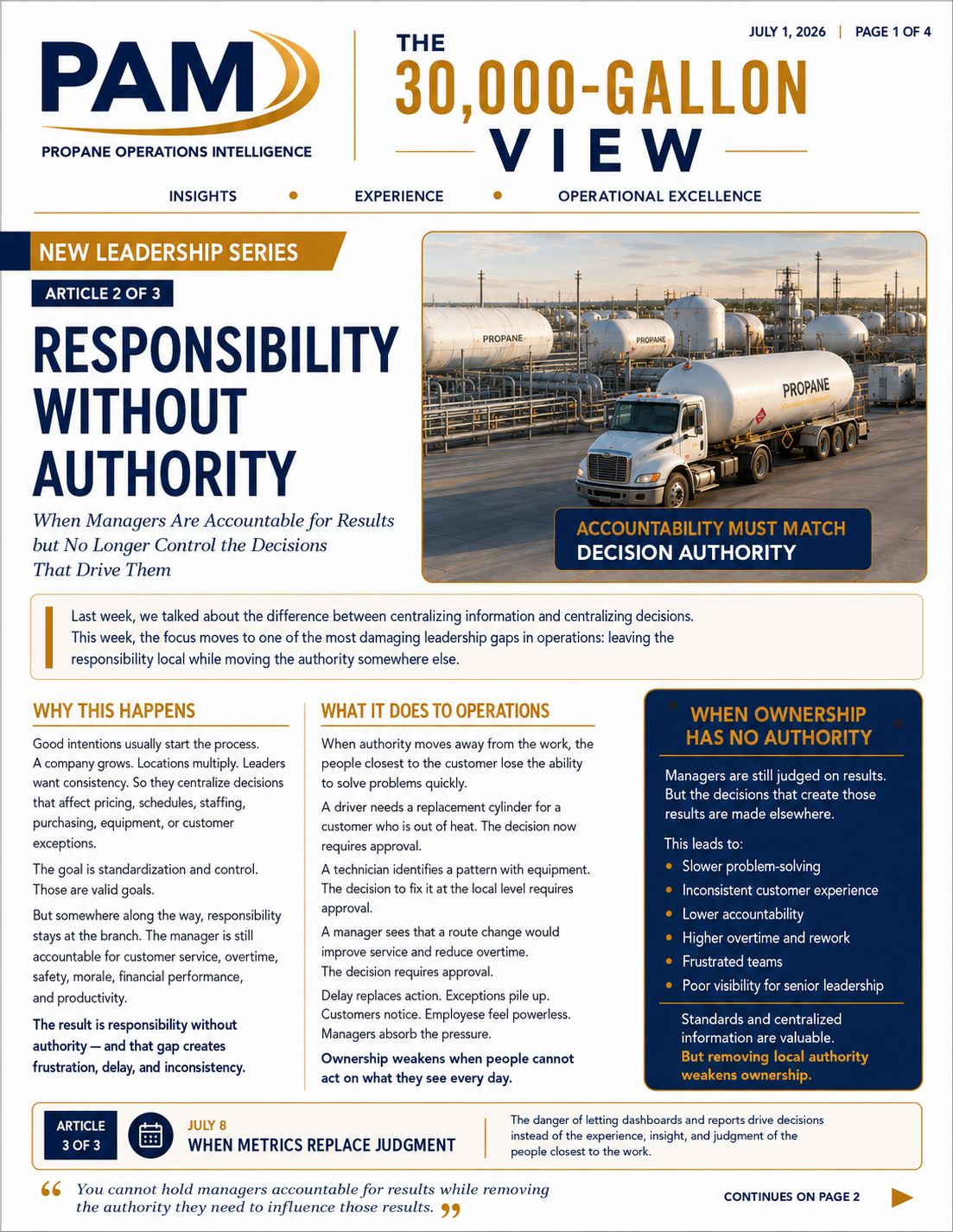
Accountability must match decision authority.
View Designed Edition4 original publication pagesWhy This Happens
Last week, we talked about the difference between centralizing information and centralizing decisions. This week, the focus moves to one of the most damaging leadership gaps in operations: leaving the responsibility local while moving the authority somewhere else.
Good intentions usually start the process. A company grows. Locations multiply. Leaders want consistency. So they centralize decisions that affect pricing, schedules, staffing, purchasing, equipment, or customer exceptions.
The goal is standardization and control. Those are valid goals. But somewhere along the way, responsibility stays at the branch. The manager is still accountable for customer service, overtime, safety, morale, financial performance, and productivity.
The result is responsibility without authority—and that gap creates frustration, delay, and inconsistency.
What It Does to Operations
When authority moves away from the work, the people closest to the customer lose the ability to solve problems quickly. A driver needs a replacement cylinder for a customer who is out of heat. A technician identifies a pattern with equipment. A manager sees that a route change would improve service and reduce overtime. Each decision now requires approval.
Delay replaces action. Exceptions pile up. Customers notice. Employees feel powerless. Managers absorb the pressure. Ownership weakens when people cannot act on what they see every day.
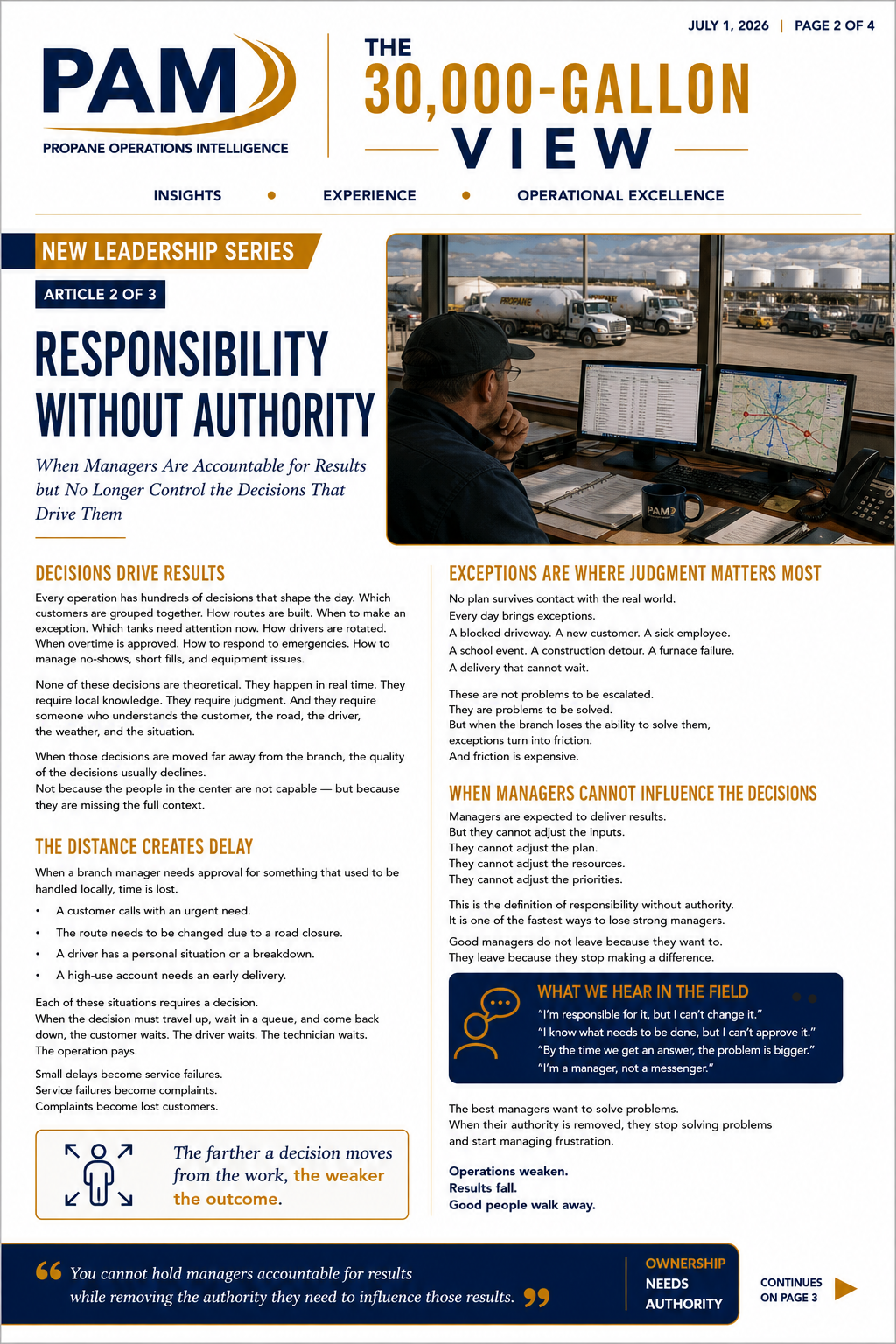
Decisions Drive Results
Every operation has hundreds of decisions that shape the day: which customers are grouped together, how routes are built, when to make an exception, which tanks need attention, how drivers are rotated, when overtime is approved, how to respond to emergencies, and how to manage no-shows, short fills, and equipment issues.
None of these decisions are theoretical. They happen in real time. They require local knowledge, judgment, and someone who understands the customer, road, driver, weather, and situation.
When these decisions are moved far away from the branch, the quality of the decisions usually declines—not because the people in the center are not capable, but because they are missing the full context.
The Distance Creates Delay
When a branch manager needs approval for something that used to be handled locally, time is lost. A customer calls with an urgent need. A route needs to change due to a road closure. A driver has a personal situation or breakdown. A high-use account needs an early delivery.
Each situation requires a decision. When the decision must travel up, wait in a queue, and come back down, the customer, driver, technician, and operation wait. Small delays become service failures. Service failures become complaints. Complaints become lost customers.
Key Takeaway“The farther a decision moves from the work, the weaker the outcome.”
Exceptions Are Where Judgment Matters Most
No plan survives contact with the real world. Every day brings exceptions: a blocked driveway, new customer, sick employee, school event, construction detour, furnace failure, or delivery that cannot wait.
These are not problems to be escalated. They are problems to be solved. But when the branch loses the ability to solve them, exceptions turn into friction. And friction is expensive.
When Managers Cannot Influence the Decisions
Managers are expected to deliver results, but they cannot adjust the inputs, plan, resources, or priorities. This is the definition of responsibility without authority. It is one of the fastest ways to lose strong managers.
Good managers do not leave because they want to. They leave because they stop making a difference.
Why This Creates Frustration, Inconsistency, and Loss of Good People
When responsibility stays at the local level but authority is removed, the operation begins to experience the same pattern over and over. It does not happen because people stop caring. It happens because the system no longer allows them to lead.
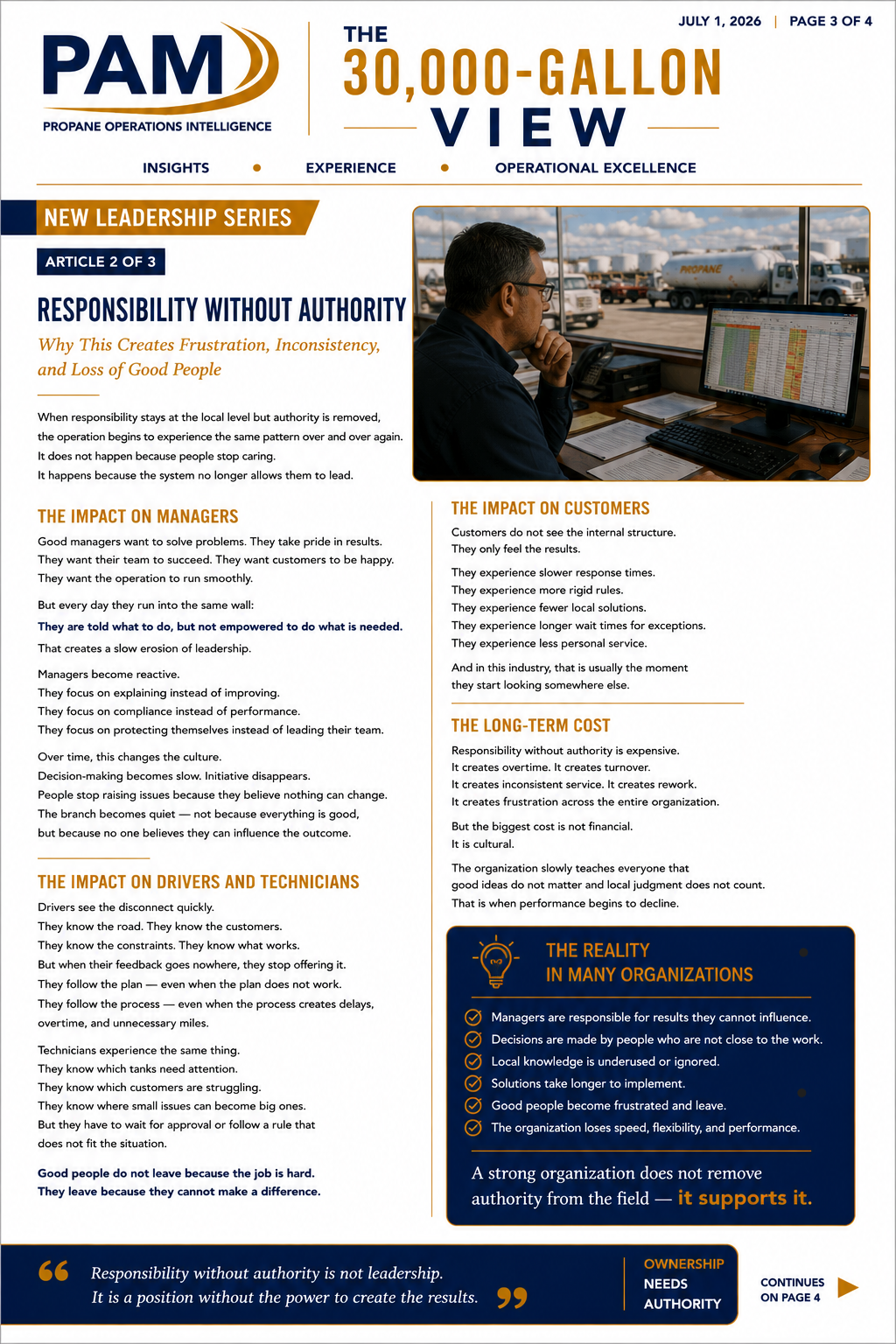
The Impact on Managers
Good managers want to solve problems. They take pride in results, want their team to succeed, want customers to be happy, and want the operation to run smoothly.
But every day they run into the same wall: they are told what to do, but not empowered to do what is needed. Managers become reactive. They focus on explaining instead of improving, compliance instead of performance, and protecting themselves instead of leading their team.
Over time, decision-making becomes slow. Initiative disappears. People stop raising issues because they believe nothing can change.
The Impact on Drivers and Technicians
Drivers know the road, customers, constraints, and what works. But when their feedback goes nowhere, they stop offering it. They follow the plan—even when the plan does not work—and follow the process even when it creates delays, overtime, and unnecessary miles.
Technicians experience the same thing. They know which tanks need attention, which customers are struggling, and where small issues can become big ones. But they must wait for approval or follow a rule that does not fit the situation.
Good people do not leave because the job is hard. They leave because they cannot make a difference.
The Impact on Customers
Customers do not see the internal structure. They only feel the results: slower response times, more rigid rules, fewer local solutions, longer waits for exceptions, and less personal service. That is usually the moment they start looking somewhere else.
The Long-Term Cost
Responsibility without authority creates overtime, turnover, inconsistent service, rework, and frustration. But the biggest cost is cultural. The organization slowly teaches everyone that good ideas do not matter and local judgment does not count. That is when performance begins to decline.
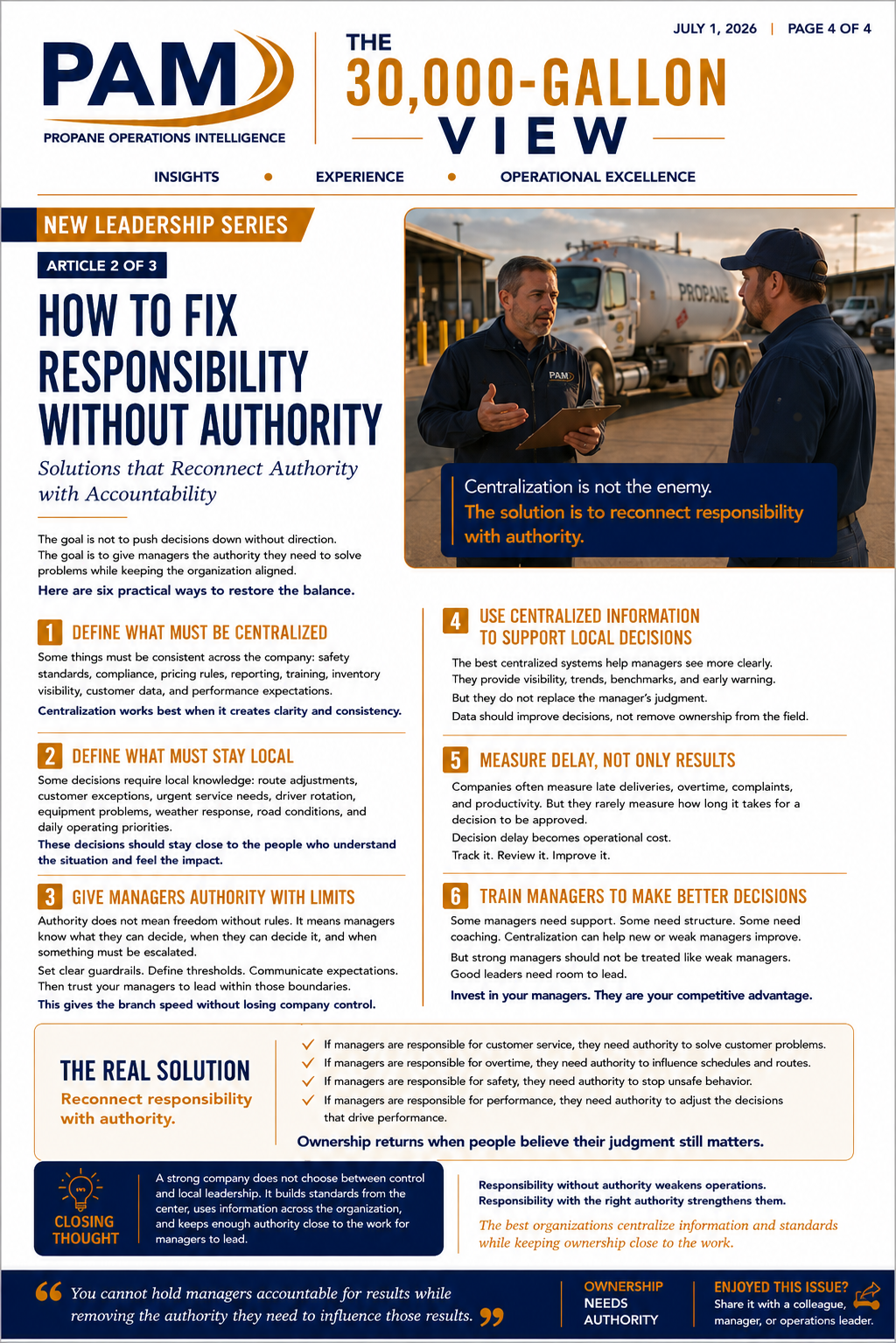
How to Fix Responsibility Without Authority
Solutions that reconnect authority with accountability.
The goal is not to push decisions down without direction. The goal is to give managers the authority they need to solve problems while keeping the organization aligned.
- Define what must be centralized. Safety standards, compliance, pricing rules, reporting, training, inventory visibility, customer data, and performance expectations.
- Define what must stay local. Route adjustments, customer exceptions, urgent service needs, driver rotation, equipment problems, weather response, road conditions, and daily operating priorities.
- Give managers authority with limits. Set clear guardrails, thresholds, and expectations, then trust managers to lead within those boundaries.
- Use centralized information to support local decisions. Provide visibility, trends, benchmarks, and early warning without replacing the manager’s judgment.
- Measure delay, not only results. Track how long decisions take to be approved; review and improve decision delay as an operational cost.
- Train managers to make better decisions. Some need structure or coaching, but strong managers should not be treated like weak managers.