Web Edition
Decision Rights + Local Authority
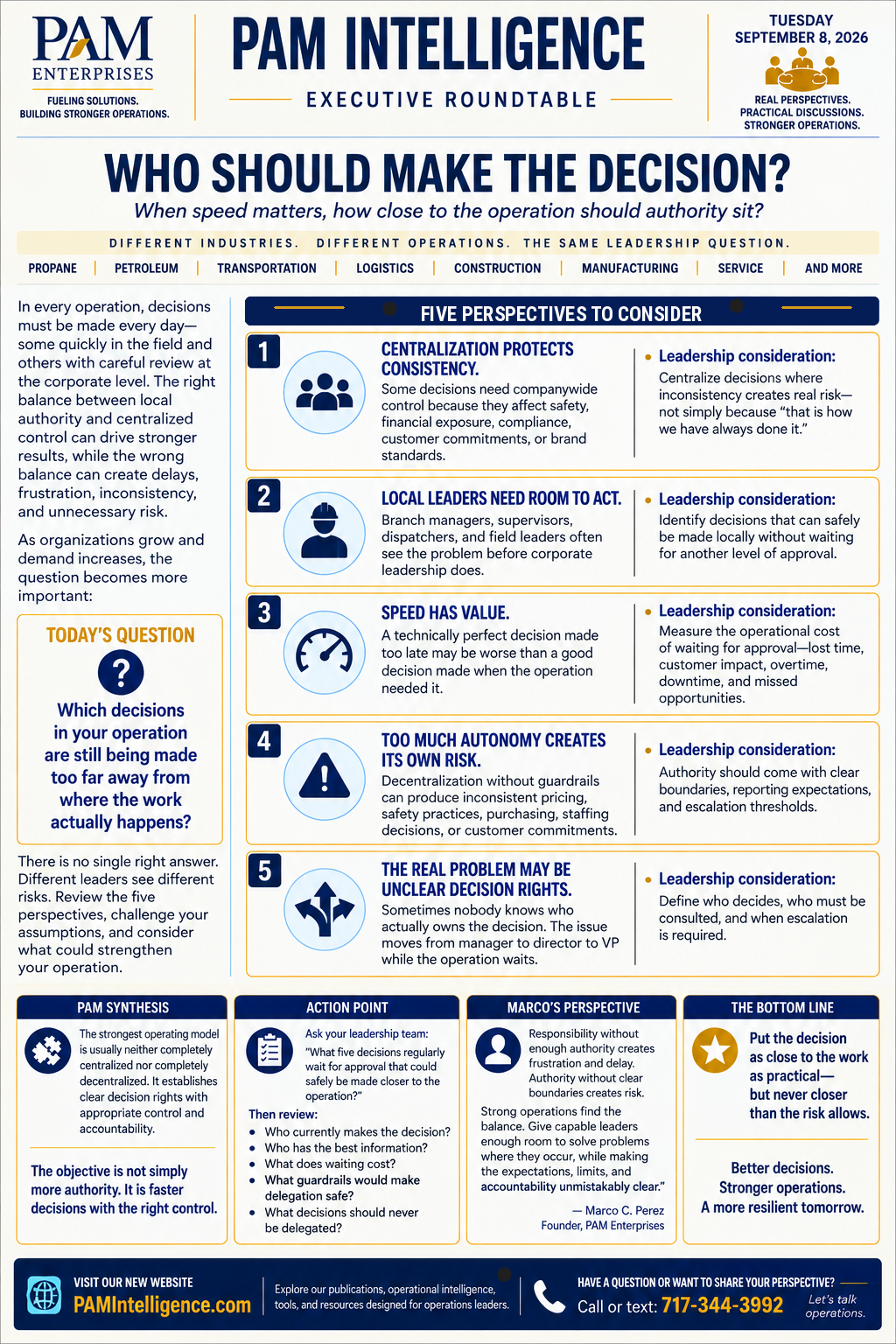
View Designed Edition1 original publication pageToday’s Question
In every operation, decisions must be made every day—some quickly in the field and others with careful review at the corporate level. The right balance between local authority and centralized control can drive stronger results, while the wrong balance can create delays, frustration, inconsistency, and unnecessary risk.
As organizations grow and demand increases, the question becomes more important:
Which decisions in your operation are still being made too far away from where the work actually happens?
There is no single right answer. Different leaders see different risks. Review the five perspectives, challenge your assumptions, and consider what could strengthen your operation.
Five Perspectives From the Executive Roundtable
1. CENTRALIZATION PROTECTS CONSISTENCY.
Some decisions need companywide control because they affect safety, financial exposure, compliance, customer commitments, or brand standards.
Leadership consideration
- Centralize decisions where inconsistency creates real risk—not simply because “that is how we have always done it.”
2. LOCAL LEADERS NEED ROOM TO ACT.
Branch managers, supervisors, dispatchers, and field leaders often see the problem before corporate leadership does.
Leadership consideration
- Identify decisions that can safely be made locally without waiting for another level of approval.
3. SPEED HAS VALUE.
A technically perfect decision made too late may be worse than a good decision made when the operation needed it.
Leadership consideration
- Measure the operational cost of waiting for approval—lost time, customer impact, overtime, downtime, and missed opportunities.
4. TOO MUCH AUTONOMY CREATES ITS OWN RISK.
Decentralization without guardrails can produce inconsistent pricing, safety practices, purchasing, staffing decisions, or customer commitments.
Leadership consideration
- Authority should come with clear boundaries, reporting expectations, and escalation thresholds.
5. THE REAL PROBLEM MAY BE UNCLEAR DECISION RIGHTS.
Sometimes nobody knows who actually owns the decision. The issue moves from manager to director to VP while the operation waits.
Leadership consideration
- Define who decides, who must be consulted, and when escalation is required.