Web Edition
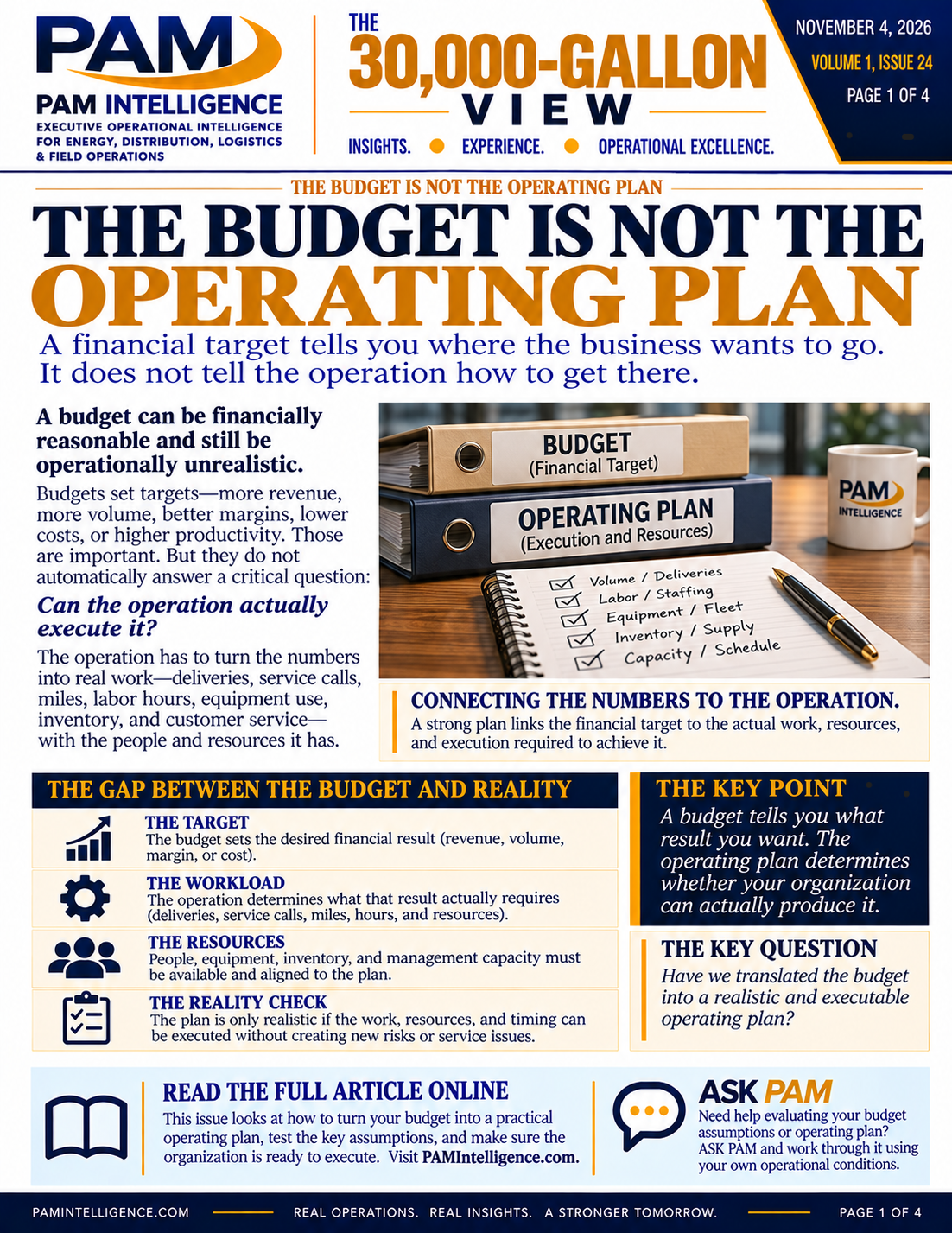
A strong plan connects the financial target to the real work, resources, timing, and execution required to achieve it.
View Designed Edition4 original publication pagesConnect the Numbers to the Operation
A budget can be financially reasonable and still be operationally unrealistic.
Budgets set targets—more revenue, more volume, better margins, lower costs, or higher productivity. Those are important. But they do not automatically answer a critical question: Can the operation actually execute it?
The operation has to turn the numbers into real work—deliveries, service calls, miles, labor hours, equipment use, inventory, and customer service—with the people and resources it has.
The Gap Between the Budget and Reality
- The Target. The budget sets the desired financial result—revenue, volume, margin, or cost.
- The Workload. The operation determines what that result actually requires—deliveries, service calls, miles, hours, and resources.
- The Resources. People, equipment, inventory, and management capacity must be available and aligned to the plan.
- The Reality Check. The plan is only realistic if the work, resources, and timing can be executed without creating new risks or service issues.
The key question: Have we translated the budget into a realistic and executable operating plan?
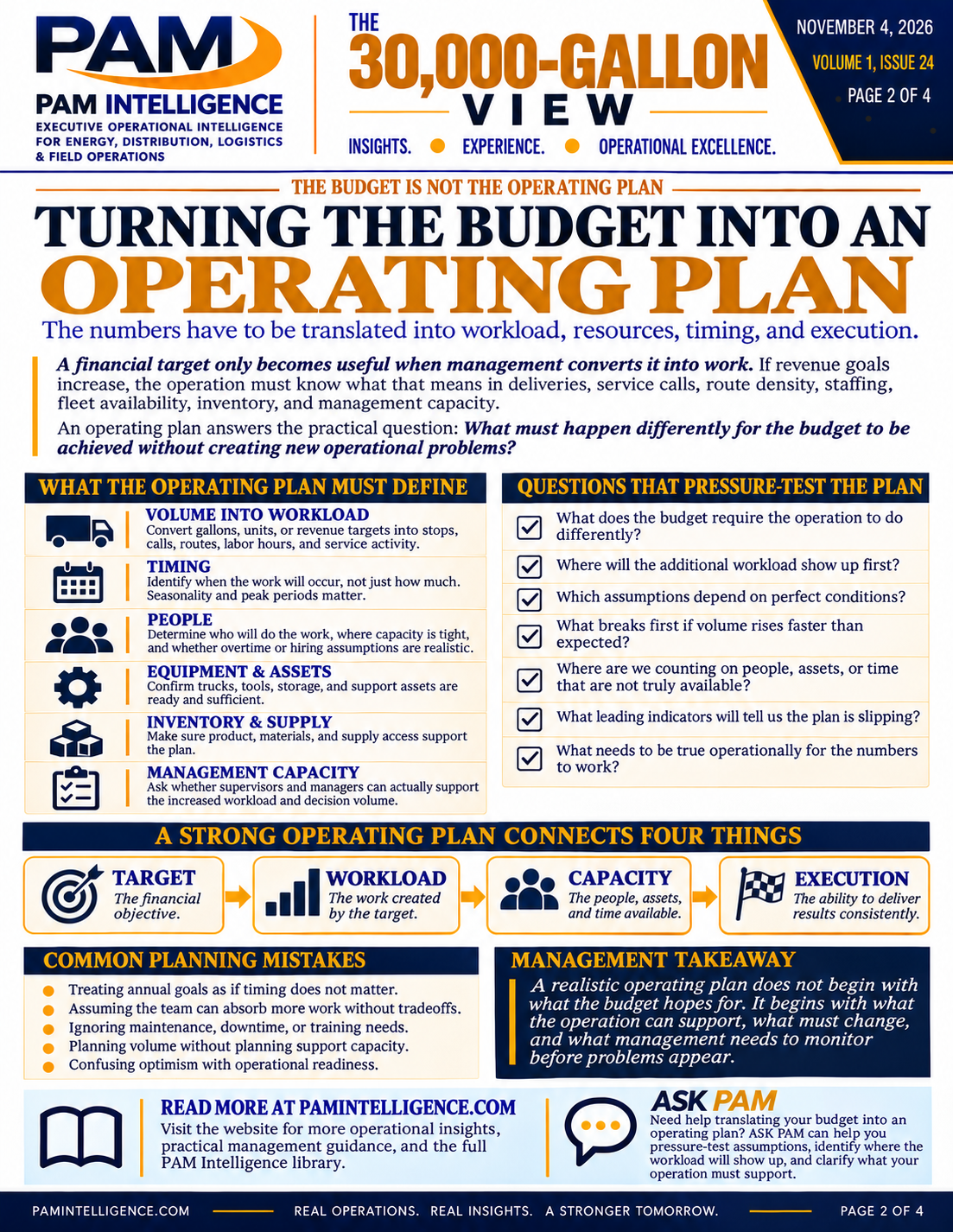
Turning the Budget into an Operating Plan
The numbers have to be translated into workload, resources, timing, and execution.
A financial target only becomes useful when management converts it into work. If revenue goals increase, the operation must know what that means in deliveries, service calls, route density, staffing, fleet availability, inventory, and management capacity.
An operating plan answers the practical question: What must happen differently for the budget to be achieved without creating new operational problems?
What the Operating Plan Must Define
- Volume into Workload. Convert gallons, units, or revenue targets into stops, calls, routes, labor hours, and service activity.
- Timing. Identify when the work will occur, not just how much. Seasonality and peak periods matter.
- People. Determine who will do the work, where capacity is tight, and whether overtime or hiring assumptions are realistic.
- Equipment & Assets. Confirm trucks, tools, storage, and support assets are ready and sufficient.
- Inventory & Supply. Make sure product, materials, and supply access support the plan.
- Management Capacity. Ask whether supervisors and managers can actually support the increased workload and decision volume.
Questions That Pressure-Test the Plan
- What does the budget require the operation to do differently?
- Where will the additional workload show up first?
- Which assumptions depend on perfect conditions?
- What breaks first if volume rises faster than expected?
- Where are we counting on people, assets, or time that are not truly available?
- What leading indicators will tell us the plan is slipping?
- What needs to be true operationally for the numbers to work?
A Strong Operating Plan Connects Four Things
- Target. The financial objective.
- Workload. The work created by the target.
- Capacity. The people, assets, and time available.
- Execution. The ability to deliver results consistently.
Common Planning Mistakes
- Treating annual goals as if timing does not matter.
- Assuming the team can absorb more work without tradeoffs.
- Ignoring maintenance, downtime, or training needs.
- Planning volume without planning support capacity.
- Confusing optimism with operational readiness.
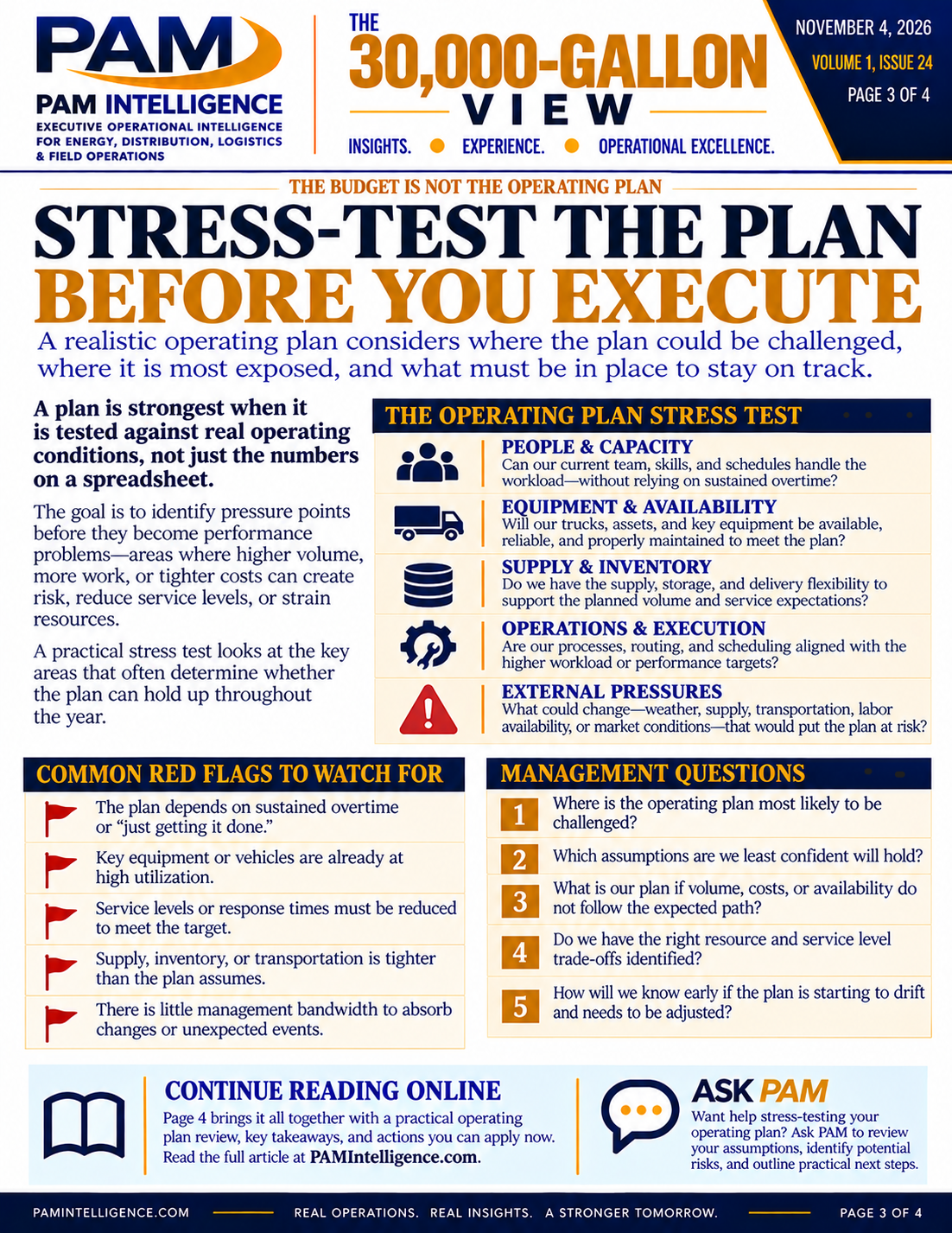
Stress-Test the Plan Before You Execute
A realistic operating plan considers where the plan could be challenged, where it is most exposed, and what must be in place to stay on track.
A plan is strongest when it is tested against real operating conditions, not just the numbers on a spreadsheet.
The goal is to identify pressure points before they become performance problems—areas where higher volume, more work, or tighter costs can create risk, reduce service levels, or strain resources.
A practical stress test looks at the key areas that often determine whether the plan can hold up throughout the year.
The Operating Plan Stress Test
- People & Capacity. Can our current team, skills, and schedules handle the workload—without relying on sustained overtime?
- Equipment & Availability. Will our trucks, assets, and key equipment be available, reliable, and properly maintained to meet the plan?
- Supply & Inventory. Do we have the supply, storage, and delivery flexibility to support the planned volume and service expectations?
- Operations & Execution. Are our processes, routing, and scheduling aligned with the higher workload or performance targets?
- External Pressures. What could change—weather, supply, transportation, labor availability, or market conditions—that would put the plan at risk?
Common Red Flags to Watch For
- The plan depends on sustained overtime or “just getting it done.”
- Key equipment or vehicles are already at high utilization.
- Service levels or response times must be reduced to meet the target.
- Supply, inventory, or transportation is tighter than the plan assumes.
- There is little management bandwidth to absorb changes or unexpected events.
Management Questions
- Where is the operating plan most likely to be challenged?
- Which assumptions are we least confident will hold?
- What is our plan if volume, costs, or availability do not follow the expected path?
- Do we have the right resource and service level trade-offs identified?
- How will we know early if the plan is starting to drift and needs to be adjusted?
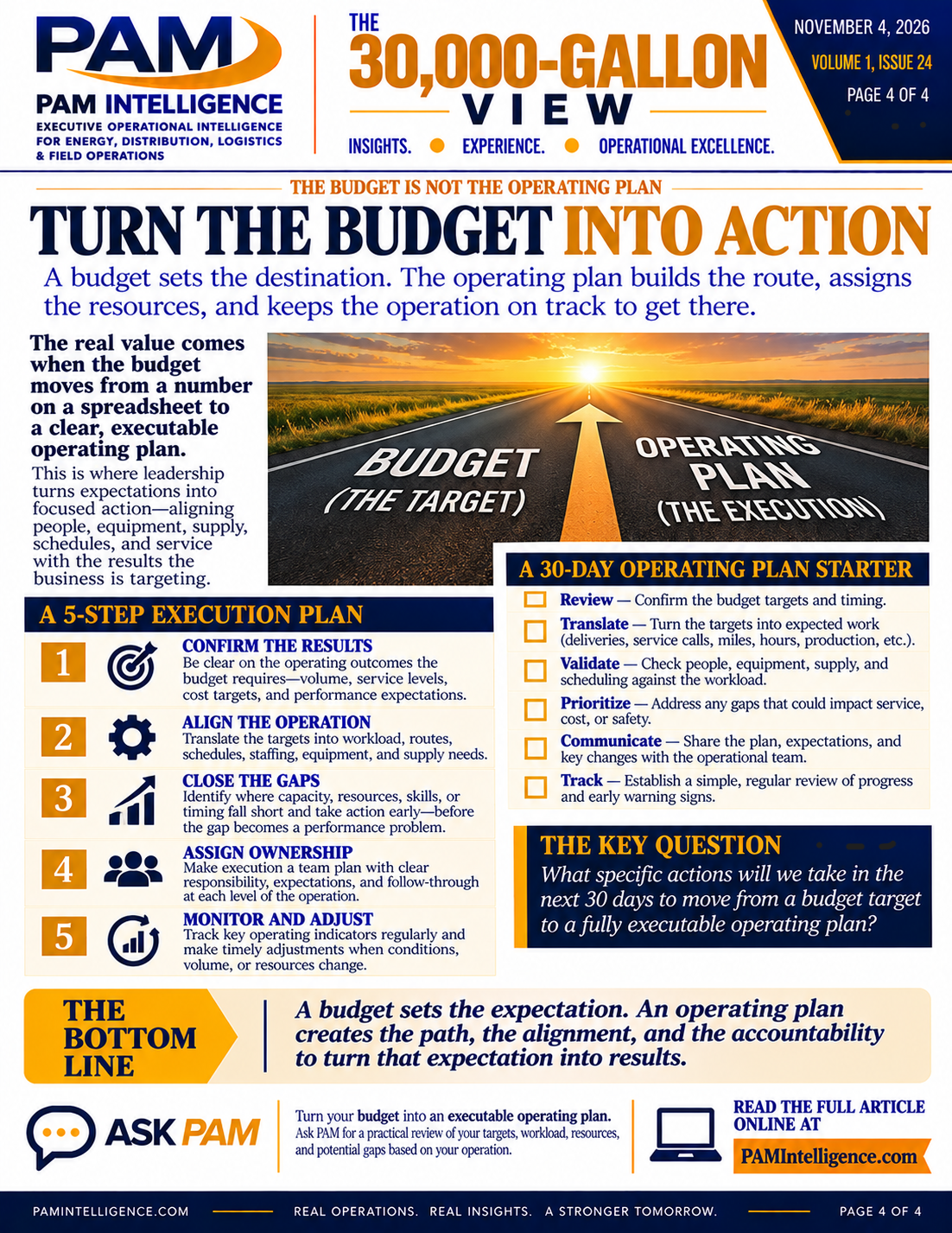
Turn the Budget into Action
A budget sets the destination. The operating plan builds the route, assigns the resources, and keeps the operation on track to get there.
The real value comes when the budget moves from a number on a spreadsheet to a clear, executable operating plan.
This is where leadership turns expectations into focused action—aligning people, equipment, supply, schedules, and service with the results the business is targeting.
A 5-Step Execution Plan
- Confirm the Results. Be clear on the operating outcomes the budget requires—volume, service levels, cost targets, and performance expectations.
- Align the Operation. Translate the targets into workload, routes, schedules, staffing, equipment, and supply needs.
- Close the Gaps. Identify where capacity, resources, skills, or timing fall short and take action early—before the gap becomes a performance problem.
- Assign Ownership. Make execution a team plan with clear responsibility, expectations, and follow-through at each level of the operation.
- Monitor and Adjust. Track key operating indicators regularly and make timely adjustments when conditions, volume, or resources change.
A 30-Day Operating Plan Starter
- Review. Confirm the budget targets and timing.
- Translate. Turn the targets into expected work—deliveries, service calls, miles, hours, production, and other relevant activity.
- Validate. Check people, equipment, supply, and scheduling against the workload.
- Prioritize. Address any gaps that could impact service, cost, or safety.
- Communicate. Share the plan, expectations, and key changes with the operational team.
- Track. Establish a simple, regular review of progress and early warning signs.
The key question: What specific actions will we take in the next 30 days to move from a budget target to a fully executable operating plan?
ASK PAM — Start With a Better Question
Translate a Financial Target into Operating Reality
ASK PAM remains Coming Soon. Use the public reader-education page to prepare a clearer question about workload, capacity, resources, timing, ownership, or execution.