Web Edition
A plan can look efficient on paper and still fail when it meets real operating conditions. Diagnose the gap between planning and execution before choosing a solution.
View Designed Edition4 original publication pagesThe Plan Can Be Right and Still Fail in the Field
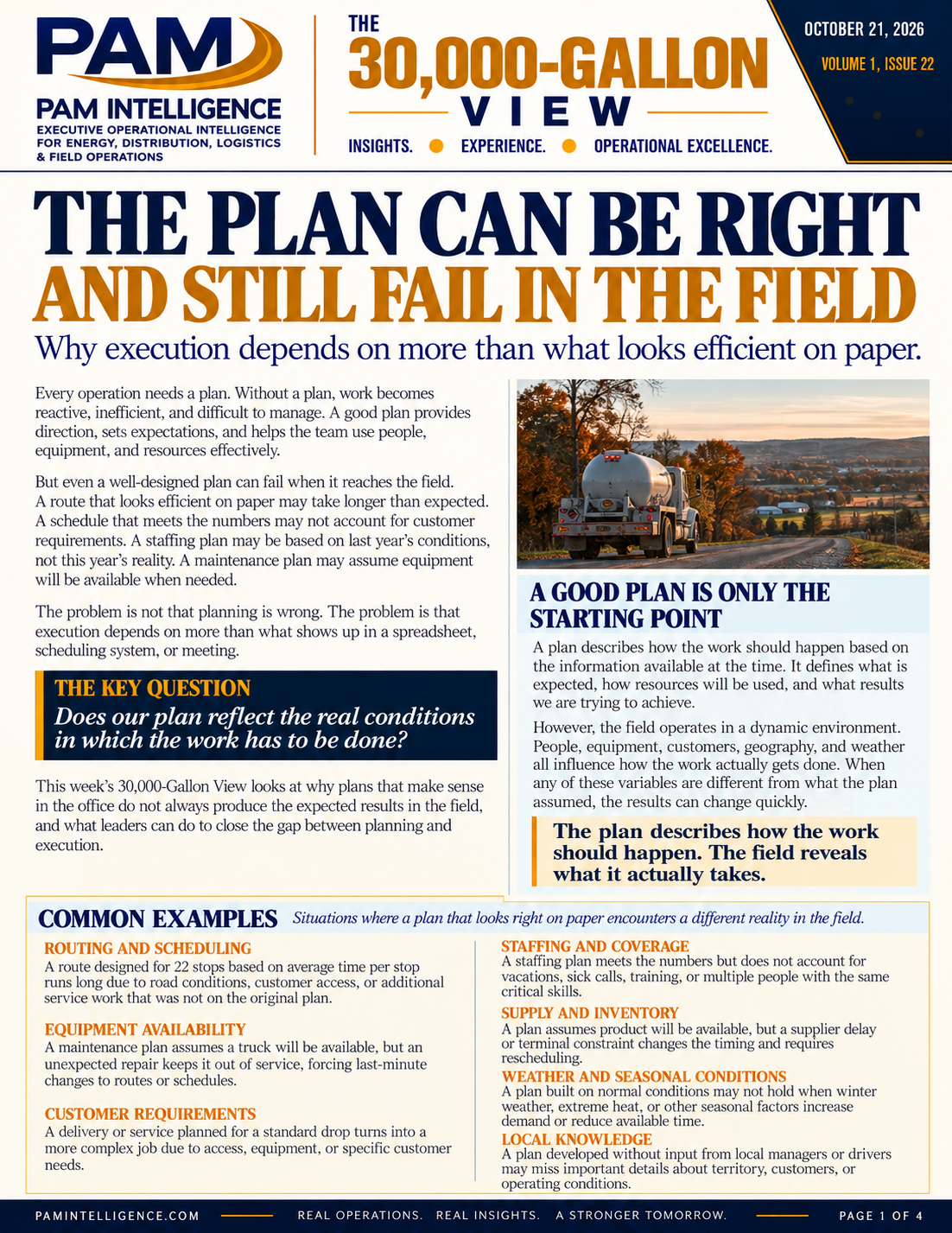
Every operation needs a plan. Without a plan, work becomes reactive, inefficient, and difficult to manage. A good plan provides direction, sets expectations, and helps the team use people, equipment, and resources effectively.
But even a well-designed plan can fail when it reaches the field. A route that looks efficient on paper may take longer than expected. A schedule that meets the numbers may not account for customer requirements. A staffing plan may be based on last year’s conditions, not this year’s reality. A maintenance plan may assume equipment will be available when needed.
The problem is not that planning is wrong. The problem is that execution depends on more than what shows up in a spreadsheet, scheduling system, or meeting.
This issue looks at why plans that make sense in the office do not always produce the expected results in the field, and what leaders can do to close the gap between planning and execution.
A Good Plan Is Only the Starting Point
A plan describes how the work should happen based on the information available at the time. It defines what is expected, how resources will be used, and what results the organization is trying to achieve.
However, the field operates in a dynamic environment. People, equipment, customers, geography, and weather all influence how the work actually gets done. When any of these variables are different from what the plan assumed, the results can change quickly.
The plan describes how the work should happen. The field reveals what it actually takes.
Common Examples
Routing and Scheduling
A route designed for 22 stops based on average time per stop runs long due to road conditions, customer access, or additional service work that was not on the original plan.
Equipment Availability
A maintenance plan assumes a truck will be available, but an unexpected repair keeps it out of service, forcing last-minute changes to routes or schedules.
Customer Requirements
A delivery or service planned for a standard drop turns into a more complex job due to access, equipment, or specific customer needs.
Staffing and Coverage
A staffing plan meets the numbers but does not account for vacations, sick calls, training, or multiple people with the same critical skills.
Supply and Inventory
A plan assumes product will be available, but a supplier delay or terminal constraint changes the timing and requires rescheduling.
Weather and Seasonal Conditions
A plan built on normal conditions may not hold when winter weather, extreme heat, or other seasonal factors increase demand or reduce available time.
Local Knowledge
A plan developed without input from local managers or drivers may miss important details about territory, customers, or operating conditions.
The Pattern May Be Similar. The Solution May Not Be.
Why routing, equipment, staffing, scheduling, and service problems can produce similar symptoms but require different answers.
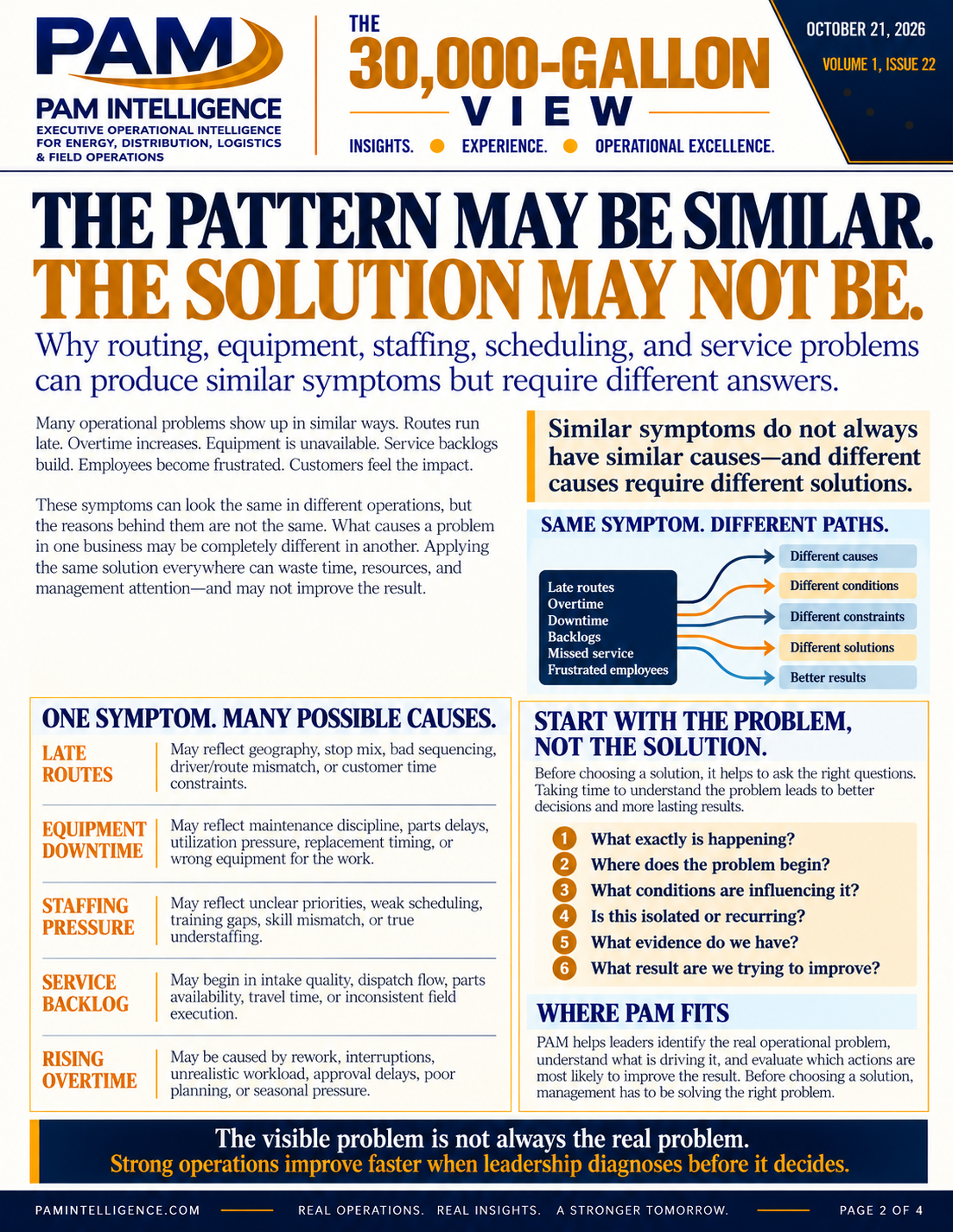
Many operational problems show up in similar ways. Routes run late. Overtime increases. Equipment is unavailable. Service backlogs build. Employees become frustrated. Customers feel the impact.
These symptoms can look the same in different operations, but the reasons behind them are not the same. What causes a problem in one business may be completely different in another. Applying the same solution everywhere can waste time, resources, and management attention—and may not improve the result.
Similar symptoms do not always have similar causes—and different causes require different solutions.
One Symptom. Many Possible Causes.
Late Routes
May reflect geography, stop mix, bad sequencing, driver/route mismatch, or customer time constraints.
Equipment Downtime
May reflect maintenance discipline, parts delays, utilization pressure, replacement timing, or the wrong equipment for the work.
Staffing Pressure
May reflect unclear priorities, weak scheduling, training gaps, skill mismatch, or true understaffing.
Service Backlog
May begin in intake quality, dispatch flow, parts availability, travel time, or inconsistent field execution.
Rising Overtime
May be caused by rework, interruptions, unrealistic workload, approval delays, poor planning, or seasonal pressure.
Start with the Problem, Not the Solution
Before choosing a solution, ask the right questions. Taking time to understand the problem leads to better decisions and more lasting results.
- What exactly is happening?
- Where does the problem begin?
- What conditions are influencing it?
- Is this isolated or recurring?
- What evidence do we have?
- What result are we trying to improve?
Where PAM Fits
PAM helps leaders identify the real operational problem, understand what is driving it, and evaluate which actions are most likely to improve the result. Before choosing a solution, management has to be solving the right problem.
A Complete Diagnostic Process: From the Problem to the Right Action
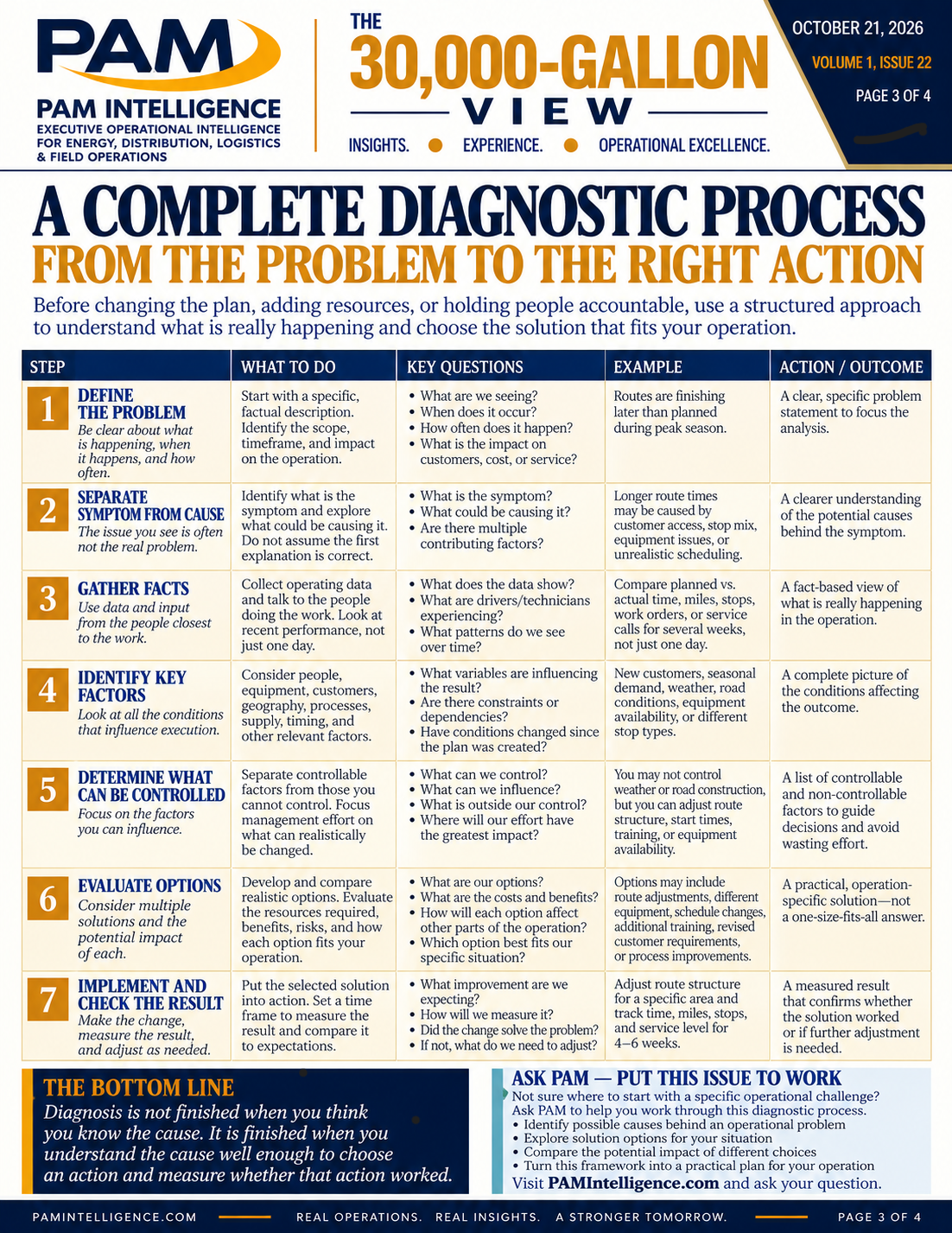
Before changing the plan, adding resources, or holding people accountable, use a structured approach to understand what is really happening and choose the solution that fits your operation.
- Define the Problem. Be clear about what is happening, when it happens, and how often. Start with a specific, factual description. Identify the scope, timeframe, and impact on the operation. Ask: What are we seeing? When does it occur? How often does it happen? What is the impact on customers, cost, or service? Example: routes are finishing later than planned during peak season. Outcome: a clear, specific problem statement to focus the analysis.
- Separate Symptom from Cause. The issue you see is often not the real problem. Identify what is the symptom and explore what could be causing it. Do not assume the first explanation is correct. Ask: What is the symptom? What could be causing it? Are there multiple contributing factors? Example: longer route times may be caused by customer access, stop mix, equipment issues, or unrealistic scheduling. Outcome: a clearer understanding of the potential causes behind the symptom.
- Gather Facts. Use data and input from the people closest to the work. Collect operating data and talk to the people doing the work. Look at recent performance, not just one day. Ask: What does the data show? What are drivers or technicians experiencing? What patterns do we see over time? Example: compare planned versus actual time, miles, stops, work orders, or service calls for several weeks. Outcome: a fact-based view of what is really happening in the operation.
- Identify Key Factors. Look at all the conditions that influence execution. Consider people, equipment, customers, geography, processes, supply, timing, and other relevant factors. Ask: What variables are influencing the result? Are there constraints or dependencies? Have conditions changed since the plan was created? Example: new customers, seasonal demand, weather, road conditions, equipment availability, or different stop types. Outcome: a complete picture of the conditions affecting the outcome.
- Determine What Can Be Controlled. Focus on the factors you can influence. Separate controllable factors from those you cannot control. Focus management effort on what can realistically be changed. Ask: What can we control? What can we influence? What is outside our control? Where will our effort have the greatest impact? Example: you may not control weather or road construction, but you can adjust route structure, start times, training, or equipment availability. Outcome: a list of controllable and non-controllable factors to guide decisions and avoid wasting effort.
- Evaluate Options. Consider multiple solutions and the potential impact of each. Develop and compare realistic options. Evaluate the resources required, benefits, risks, and how each option fits your operation. Ask: What are our options? What are the costs and benefits? How will each option affect other parts of the operation? Which option best fits our specific situation? Example: options may include route adjustments, different equipment, schedule changes, additional training, revised customer requirements, or process improvements. Outcome: a practical, operation-specific solution—not a one-size-fits-all answer.
- Implement and Check the Result. Make the change, measure the result, and adjust as needed. Put the selected solution into action. Set a timeframe to measure the result and compare it to expectations. Ask: What improvement are we expecting? How will we measure it? Did the change solve the problem? If not, what do we need to adjust? Example: adjust route structure for a specific area and track time, miles, stops, and service level for four to six weeks. Outcome: a measured result that confirms whether the solution worked or whether further adjustment is needed.
From Diagnosis to Action: Turning Analysis into Better Results
A practical approach to choosing the right solution, executing it, and measuring the impact.
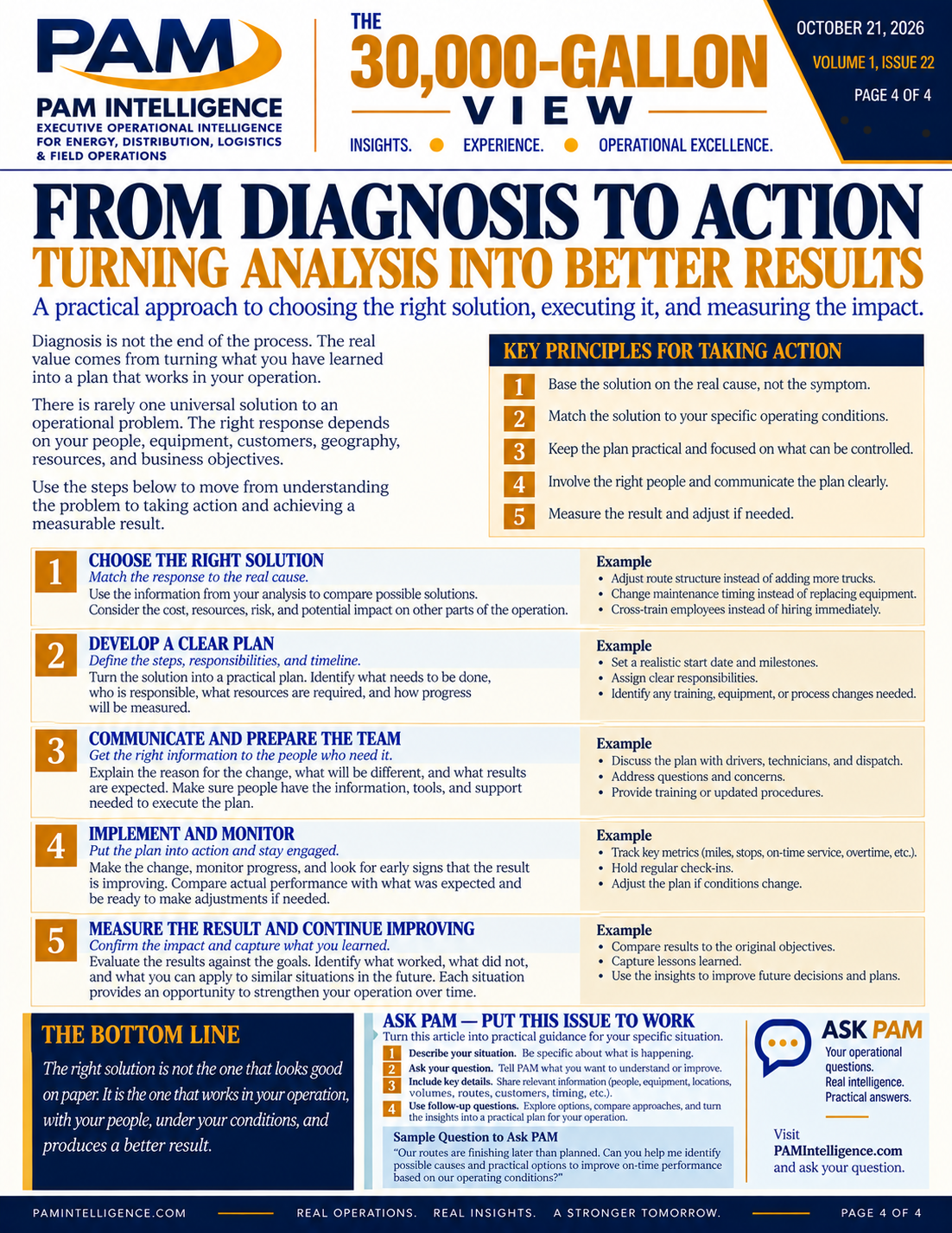
Diagnosis is not the end of the process. The real value comes from turning what you have learned into a plan that works in your operation.
There is rarely one universal solution to an operational problem. The right response depends on your people, equipment, customers, geography, resources, and business objectives.
Use the steps below to move from understanding the problem to taking action and achieving a measurable result.
Five-Step Implementation Sequence
- Choose the Right Solution. Match the response to the real cause. Use the analysis to compare possible solutions and consider cost, resources, risk, and impact on other parts of the operation. Examples: adjust route structure instead of adding trucks; change maintenance timing instead of replacing equipment; cross-train employees instead of hiring immediately.
- Develop a Clear Plan. Define the steps, responsibilities, and timeline. Identify what must be done, who is responsible, what resources are required, and how progress will be measured. Set a realistic start date and milestones, assign clear responsibilities, and identify training, equipment, or process changes.
- Communicate and Prepare the Team. Get the right information to the people who need it. Explain the reason for the change, what will be different, and what results are expected. Make sure people have the information, tools, and support needed to execute the plan.
- Implement and Monitor. Put the plan into action and stay engaged. Monitor progress and look for early signs that the result is improving. Compare actual performance with expectations and be ready to adjust. Track metrics such as miles, stops, on-time service, and overtime; hold regular check-ins; adjust as conditions change.
- Measure the Result and Continue Improving. Confirm the impact and capture what you learned. Evaluate results against the goals. Identify what worked, what did not, and what can be applied to similar situations. Each situation is an opportunity to strengthen the operation over time.
Key Principles for Taking Action
- Base the solution on the real cause, not the symptom.
- Match the solution to your specific operating conditions.
- Keep the plan practical and focused on what can be controlled.
- Involve the right people and communicate the plan clearly.
- Measure the result and adjust if needed.
ASK PAM — Put This Issue to Work
Management Question → PAM Answer → Management Decision
Management Question: “Our routes are finishing later than planned. Can you help me identify possible causes and practical options to improve on-time performance based on our operating conditions?”
PAM Answer: Do not assume the cause is routing software, drivers, staffing, equipment, or management. First define what “later than planned” means and where the variance begins. Compare planned versus actual route time over several weeks, then review miles, stops, gallons or workload per stop, customer access, stop mix, driver hours, overtime, equipment availability, weather, geography, schedule changes, customer requirements, repeat work, and seasonal conditions.
- What is happening? Define which routes finish late, by how much, when the problem occurs, and whether customer service or cost is affected.
- What should we measure? Compare planned and actual route time, miles, stops, workload per stop, driver hours, overtime, service level, and the frequency of exceptions over several weeks.
- What may be causing it? Examine customer access, stop mix, sequencing, geography, weather, equipment availability, schedule changes, repeat work, seasonal conditions, and driver/route fit. Treat these as possibilities to test, not conclusions.
- What can management control? Management can change route structure, sequencing, start times, scheduling assumptions, customer requirements, equipment availability, training, communication, and exception handling.
- What decision may need to be made? Select the option that addresses the verified cause and fits the operation without creating larger problems elsewhere.
- What practical step comes next? Choose a representative group of routes, gather the facts for four to six weeks, identify the strongest contributing factors, test one targeted change, and measure whether on-time performance improves.
Management Decision: Use the seven-step diagnostic framework—define the problem, separate symptom from cause, gather facts, identify key factors, determine what can be controlled, evaluate options, and implement and check the result—before committing resources or assigning blame.
No company-specific facts are assumed. The diagnosis should be built from the operation’s actual data and field input.