Web Edition
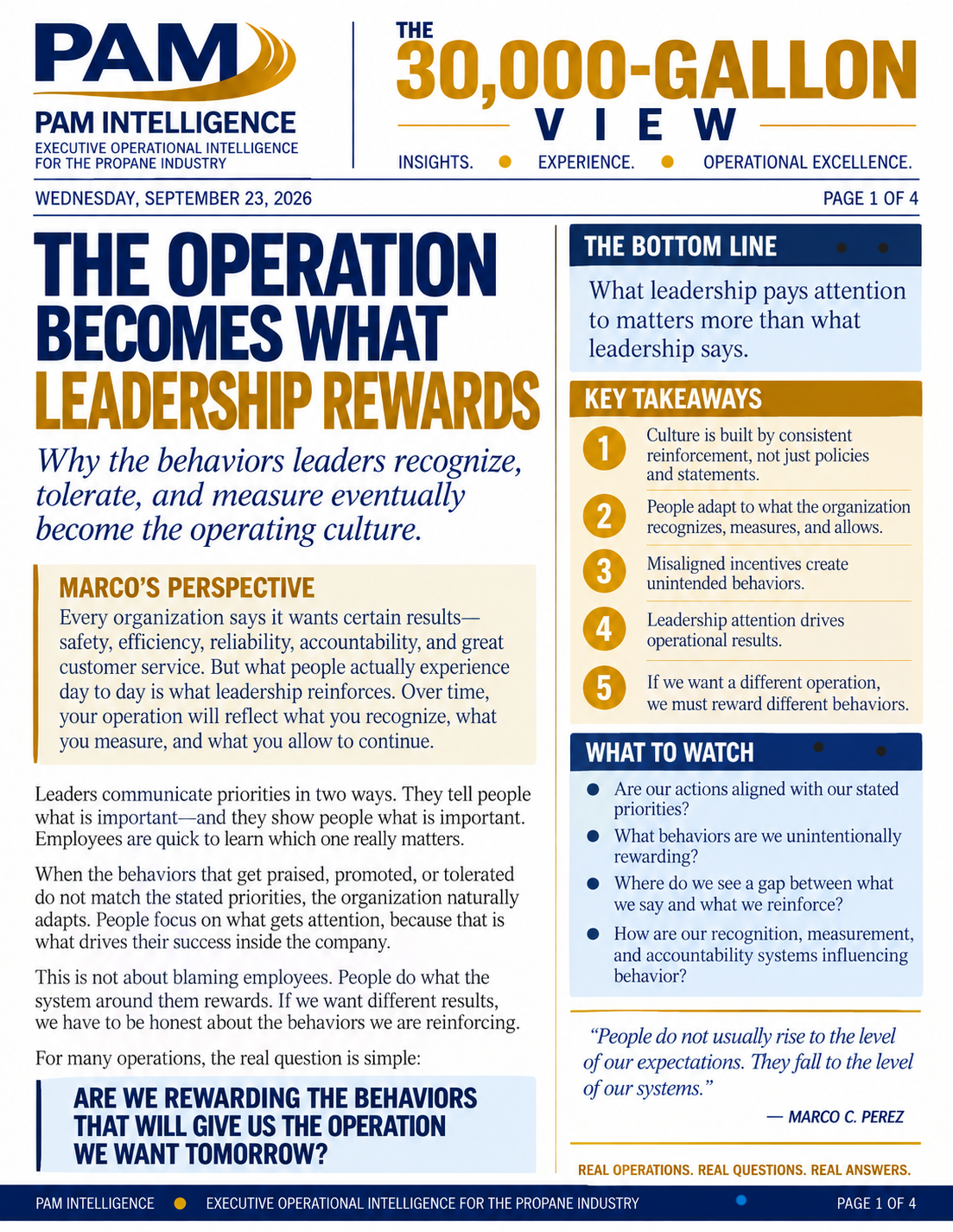
What leadership pays attention to matters more than what leadership says.
View Designed Edition 4 original publication pagesThe Operation Becomes What Leadership Rewards
Why the behaviors leaders recognize, tolerate, and measure eventually become the operating culture.
Leaders communicate priorities in two ways. They tell people what is important—and they show people what is important. Employees are quick to learn which one really matters.
When the behaviors that get praised, promoted, or tolerated do not match the stated priorities, the organization naturally adapts. People focus on what gets attention, because that is what drives their success inside the company.
This is not about blaming employees. People do what the system around them rewards. If we want different results, we have to be honest about the behaviors we are reinforcing.
For many operations, the real question is simple:
ARE WE REWARDING THE BEHAVIORS THAT WILL GIVE US THE OPERATION WE WANT TOMORROW?
Key Takeaways
- Culture is built by consistent reinforcement, not just policies and statements.
- People adapt to what the organization recognizes, measures, and allows.
- Misaligned incentives create unintended behaviors.
- Leadership attention drives operational results.
- If we want a different operation, we must reward different behaviors.
What to Watch
- Are our actions aligned with our stated priorities?
- What behaviors are we unintentionally rewarding?
- Where do we see a gap between what we say and what we reinforce?
- How are our recognition, measurement, and accountability systems influencing behavior?
“People do not usually rise to the level of our expectations. They fall to the level of our systems.”
— Marco C. Perez
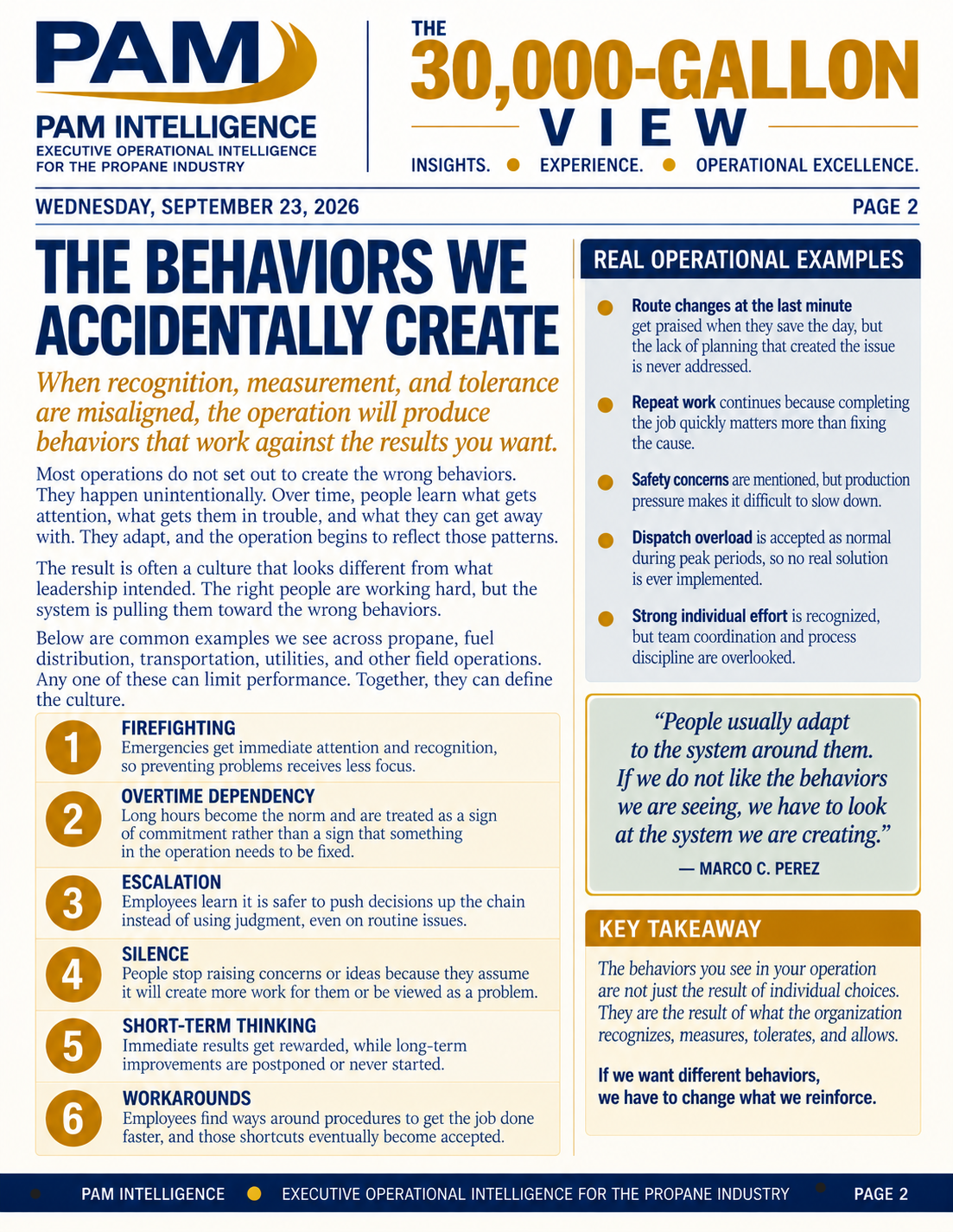
The Behaviors We Accidentally Create
When recognition, measurement, and tolerance are misaligned, the operation will produce behaviors that work against the results you want.
Most operations do not set out to create the wrong behaviors. They happen unintentionally. Over time, people learn what gets attention, what gets them in trouble, and what they can get away with. They adapt, and the operation begins to reflect those patterns.
The result is often a culture that looks different from what leadership intended. The right people are working hard, but the system is pulling them toward the wrong behaviors.
Below are common examples we see across propane, fuel distribution, transportation, utilities, and other field operations. Any one of these can limit performance. Together, they can define the culture.
- Firefighting. Emergencies get immediate attention and recognition, so preventing problems receives less focus.
- Overtime Dependency. Long hours become the norm and are treated as a sign of commitment rather than a sign that something in the operation needs to be fixed.
- Escalation. Employees learn it is safer to push decisions up the chain instead of using judgment, even on routine issues.
- Silence. People stop raising concerns or ideas because they assume it will create more work for them or be viewed as a problem.
- Short-Term Thinking. Immediate results get rewarded, while long-term improvements are postponed or never started.
- Workarounds. Employees find ways around procedures to get the job done faster, and those shortcuts eventually become accepted.
Real Operational Examples
- Route changes at the last minute get praised when they save the day, but the lack of planning that created the issue is never addressed.
- Repeat work continues because completing the job quickly matters more than fixing the cause.
- Safety concerns are mentioned, but production pressure makes it difficult to slow down.
- Dispatch overload is accepted as normal during peak periods, so no real solution is ever implemented.
- Strong individual effort is recognized, but team coordination and process discipline are overlooked.
“People usually adapt to the system around them. If we do not like the behaviors we are seeing, we have to look at the system we are creating.”
— Marco C. Perez
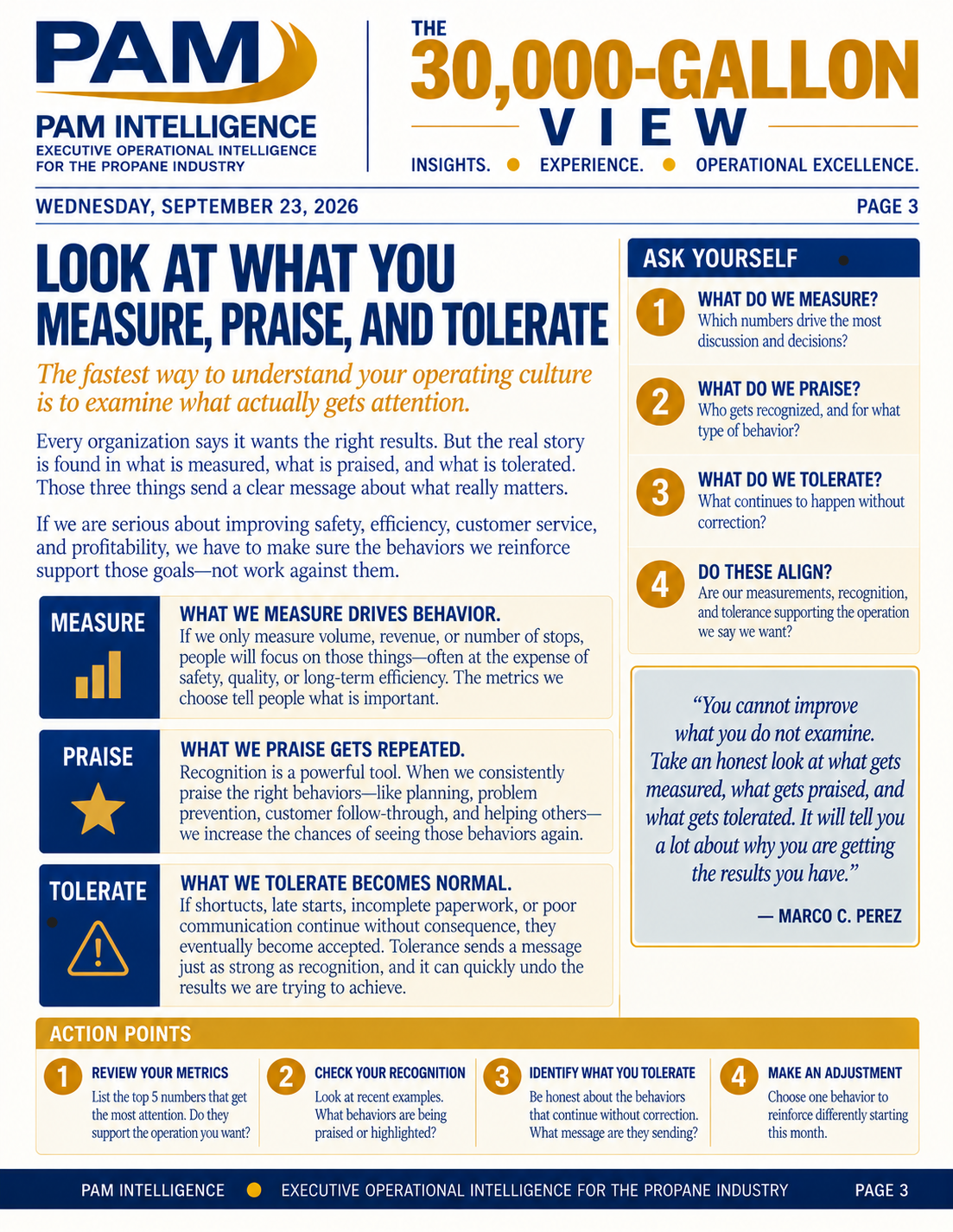
Look at What You Measure, Praise, and Tolerate
The fastest way to understand your operating culture is to examine what actually gets attention.
Every organization says it wants the right results. But the real story is found in what is measured, what is praised, and what is tolerated. Those three things send a clear message about what really matters.
If we are serious about improving safety, efficiency, customer service, and profitability, we have to make sure the behaviors we reinforce support those goals—not work against them.
Measure — What We Measure Drives Behavior
If we only measure volume, revenue, or number of stops, people will focus on those things—often at the expense of safety, quality, or long-term efficiency. The metrics we choose tell people what is important.
Praise — What We Praise Gets Repeated
Recognition is a powerful tool. When we consistently praise the right behaviors—like planning, problem prevention, customer follow-through, and helping others—we increase the chances of seeing those behaviors again.
Tolerate — What We Tolerate Becomes Normal
If shortcuts, late starts, incomplete paperwork, or poor communication continue without consequence, they eventually become accepted. Tolerance sends a message just as strong as recognition, and it can quickly undo the results we are trying to achieve.
Ask Yourself
- What do we measure? Which numbers drive the most discussion and decisions?
- What do we praise? Who gets recognized, and for what type of behavior?
- What do we tolerate? What continues to happen without correction?
- Do these align? Are our measurements, recognition, and tolerance supporting the operation we say we want?
“You cannot improve what you do not examine. Take an honest look at what gets measured, what gets praised, and what gets tolerated. It will tell you a lot about why you are getting the results you have.”
— Marco C. Perez
Action Points
- Review Your Metrics. List the top 5 numbers that get the most attention. Do they support the operation you want?
- Check Your Recognition. Look at recent examples. What behaviors are being praised or highlighted?
- Identify What You Tolerate. Be honest about the behaviors that continue without correction. What message are they sending?
- Make an Adjustment. Choose one behavior to reinforce differently starting this month.
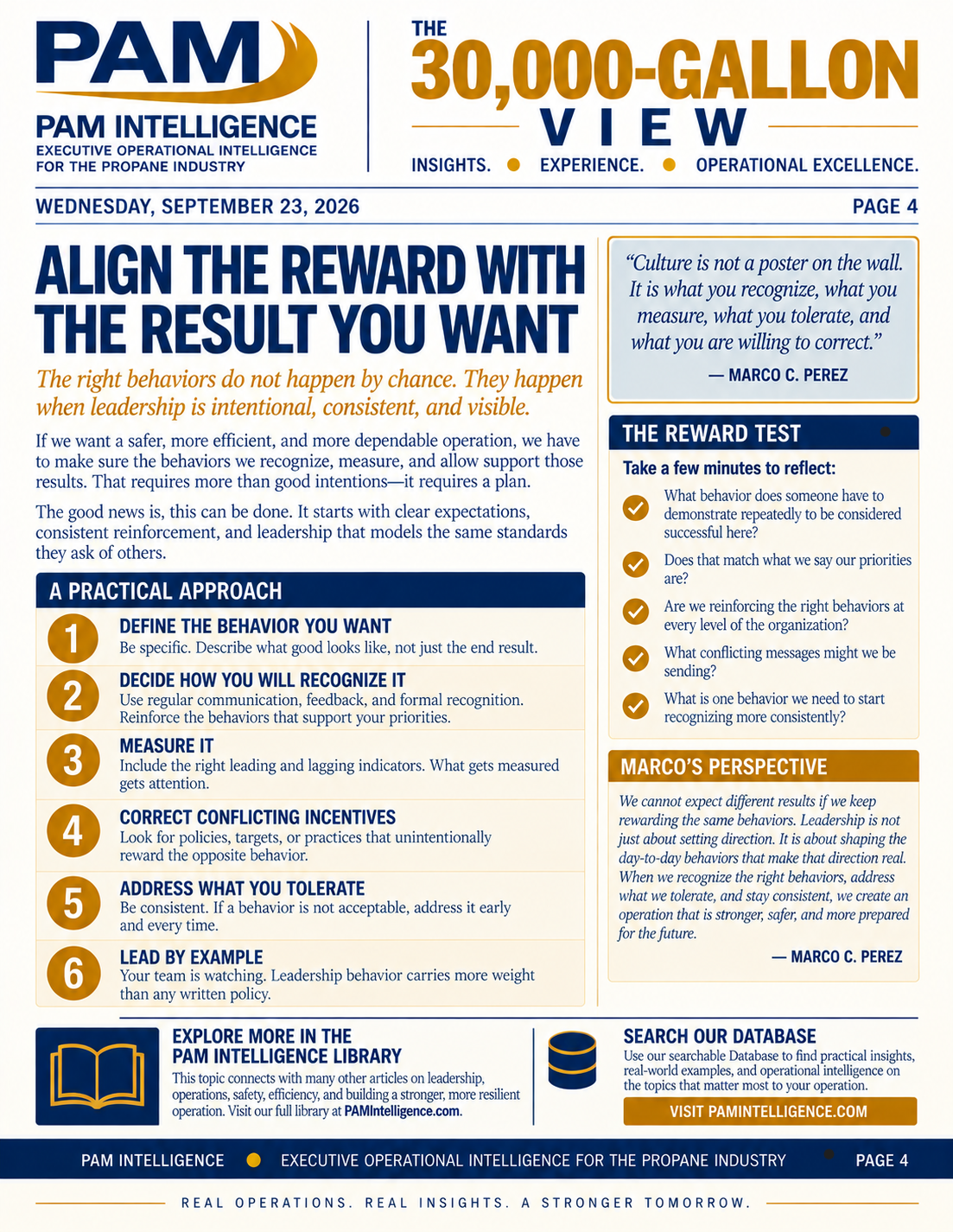
Align the Reward With the Result You Want
The right behaviors do not happen by chance. They happen when leadership is intentional, consistent, and visible.
If we want a safer, more efficient, and more dependable operation, we have to make sure the behaviors we recognize, measure, and allow support those results. That requires more than good intentions—it requires a plan.
The good news is, this can be done. It starts with clear expectations, consistent reinforcement, and leadership that models the same standards they ask of others.
A Practical Approach
- Define the Behavior You Want. Be specific. Describe what good looks like, not just the end result.
- Decide How You Will Recognize It. Use regular communication, feedback, and formal recognition. Reinforce the behaviors that support your priorities.
- Measure It. Include the right leading and lagging indicators. What gets measured gets attention.
- Correct Conflicting Incentives. Look for policies, targets, or practices that unintentionally reward the opposite behavior.
- Address What You Tolerate. Be consistent. If a behavior is not acceptable, address it early and every time.
- Lead by Example. Your team is watching. Leadership behavior carries more weight than any written policy.
“Culture is not a poster on the wall. It is what you recognize, what you measure, what you tolerate, and what you are willing to correct.”
— Marco C. Perez
The Reward Test
Take a few minutes to reflect:
- What behavior does someone have to demonstrate repeatedly to be considered successful here?
- Does that match what we say our priorities are?
- Are we reinforcing the right behaviors at every level of the organization?
- What conflicting messages might we be sending?
- What is one behavior we need to start recognizing more consistently?