Web Edition
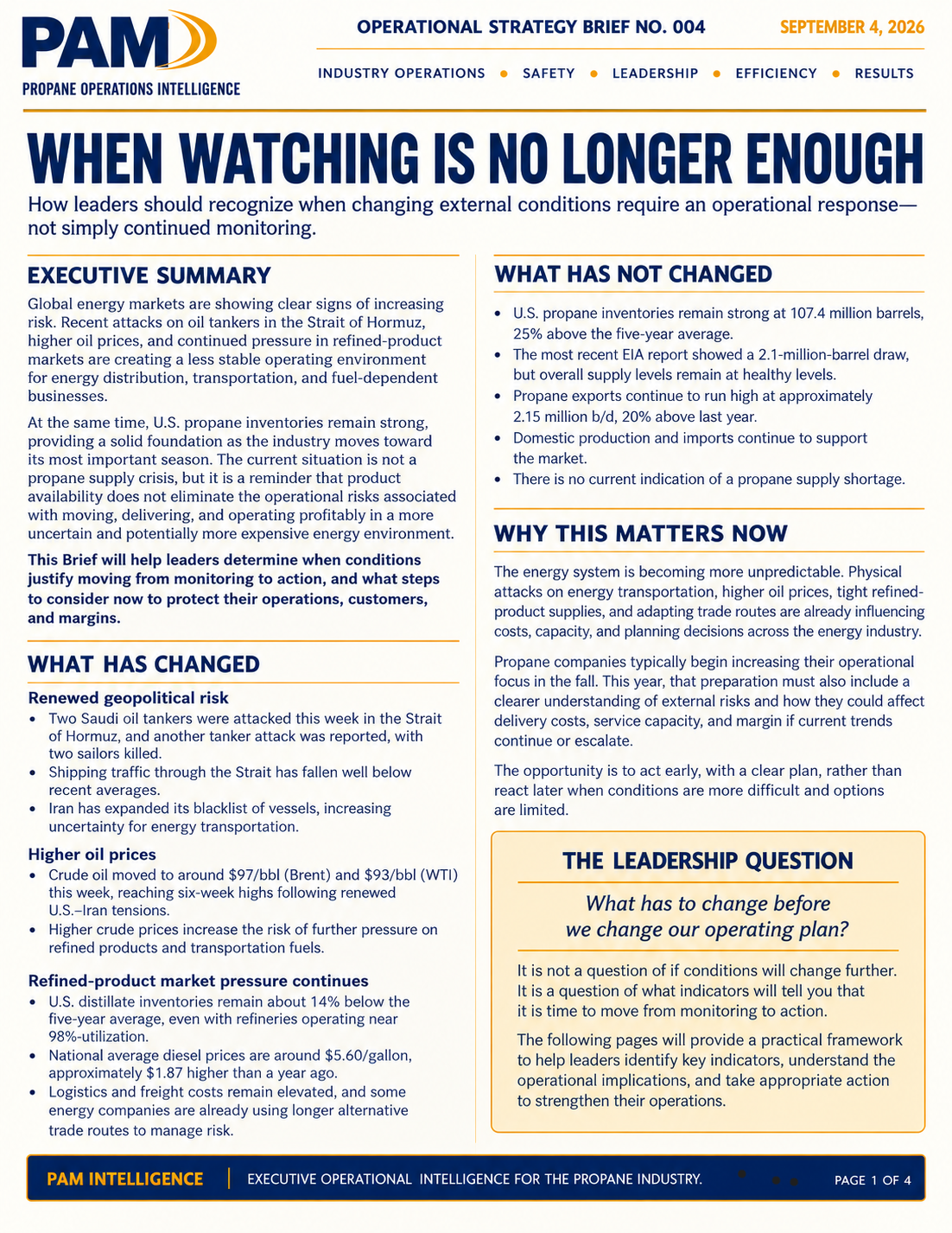
How leaders should recognize when changing external conditions require an operational response—not simply continued monitoring.
Executive Summary
Global energy markets are showing clear signs of increasing risk. Recent attacks on oil tankers in the Strait of Hormuz, higher oil prices, and continued pressure in refined-product markets are creating a less stable operating environment for energy distribution, transportation, and fuel-dependent businesses.
At the same time, U.S. propane inventories remain strong, providing a solid foundation as the industry moves toward its most important season. The current situation is not a propane supply crisis, but it is a reminder that product availability does not eliminate the operational risks associated with moving, delivering, and operating profitably in a more uncertain and potentially more expensive energy environment.
This Brief will help leaders determine when conditions justify moving from monitoring to action, and what steps to consider now to protect their operations, customers, and margins.
What Has Changed
Renewed geopolitical risk
- Two Saudi oil tankers were attacked this week in the Strait of Hormuz, and another tanker attack was reported, with two sailors killed.
- Shipping traffic through the Strait has fallen well below recent averages.
- Iran has expanded its blacklist of vessels, increasing uncertainty for energy transportation.
Higher oil prices
- Crude oil moved to around $97/bbl (Brent) and $93/bbl (WTI) this week, reaching six-week highs following renewed U.S.-Iran tensions.
- Higher crude prices increase the risk of further pressure on refined products and transportation fuels.
Refined-product market pressure continues
- U.S. distillate inventories remain about 14% below the five-year average, even with refineries operating near 98%-utilization.
- National average diesel prices are around $5.60/gallon, approximately $1.87 higher than a year ago.
- Logistics and freight costs remain elevated, and some energy companies are already using longer alternative trade routes to manage risk.
What Has Not Changed
- U.S. propane inventories remain strong at 107.4 million barrels, 25% above the five-year average.
- The most recent EIA report showed a 2.1-million-barrel draw, but overall supply levels remain at healthy levels.
- Propane exports continue to run high at approximately 2.15 million b/d, 20% above last year.
- Domestic production and imports continue to support the market.
- There is no current indication of a propane supply shortage.
Why This Matters Now
The energy system is becoming more unpredictable. Physical attacks on energy transportation, higher oil prices, tight refined-product supplies, and adapting trade routes are already influencing costs, capacity, and planning decisions across the energy industry.
Propane companies typically begin increasing their operational focus in the fall. This year, that preparation must also include a clearer understanding of external risks and how they could affect delivery costs, service capacity, and margin if current trends continue or escalate.
The opportunity is to act early, with a clear plan, rather than react later when conditions are more difficult and options are limited.
From Awareness to Action: Separate Signals From Noise
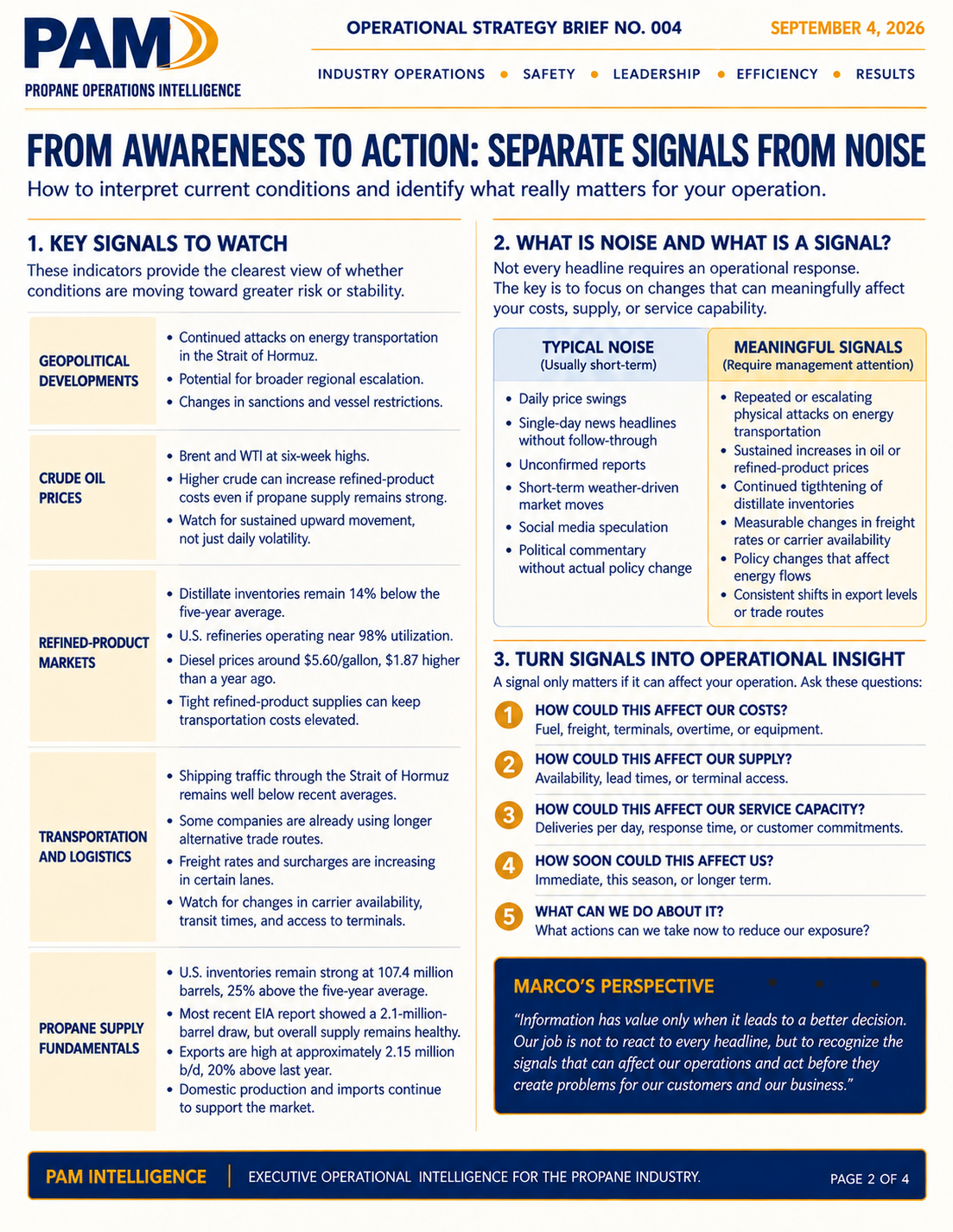
How to interpret current conditions and identify what really matters for your operation.
1. Key Signals to Watch
These indicators provide the clearest view of whether conditions are moving toward greater risk or stability.
Geopolitical Developments
- Continued attacks on energy transportation in the Strait of Hormuz.
- Potential for broader regional escalation.
- Changes in sanctions and vessel restrictions.
Crude Oil Prices
- Brent and WTI at six-week highs.
- Higher crude can increase refined-product costs even if propane supply remains strong.
- Watch for sustained upward movement, not just daily volatility.
Refined-Product Markets
- Distillate inventories remain 14% below the five-year average.
- U.S. refineries operating near 98% utilization.
- Diesel prices around $5.60/gallon, $1.87 higher than a year ago.
- Tight refined-product supplies can keep transportation costs elevated.
Transportation and Logistics
- Shipping traffic through the Strait of Hormuz remains well below recent averages.
- Some companies are already using longer alternative trade routes.
- Freight rates and surcharges are increasing in certain lanes.
- Watch for changes in carrier availability, transit times, and access to terminals.
Propane Supply Fundamentals
- U.S. inventories remain strong at 107.4 million barrels, 25% above the five-year average.
- Most recent EIA report showed a 2.1-million-barrel draw, but overall supply remains healthy.
- Exports are high at approximately 2.15 million b/d, 20% above last year.
- Domestic production and imports continue to support the market.
2. What Is Noise and What Is a Signal?
Not every headline requires an operational response.
The key is to focus on changes that can meaningfully affect your costs, supply, or service capability.
Typical Noise (Usually short-term)
- Daily price swings
- Single-day news headlines without follow-through
- Unconfirmed reports
- Short-term weather-driven market moves
- Social media speculation
- Political commentary without actual policy change
Meaningful Signals (Require management attention)
- Repeated or escalating physical attacks on energy transportation
- Sustained increases in oil or refined-product prices
- Continued tightening of distillate inventories
- Measurable changes in freight rates or carrier availability
- Policy changes that affect energy flows
- Consistent shifts in export levels or trade routes
3. Turn Signals Into Operational Insight
A signal only matters if it can affect your operation. Ask these questions:
- How could this affect our costs?
Fuel, freight, terminals, overtime, or equipment. - How could this affect our supply?
Availability, lead times, or terminal access. - How could this affect our service capacity?
Deliveries per day, response time, or customer commitments. - How soon could this affect us?
Immediate, this season, or longer term. - What can we do about it?
What actions can we take now to reduce our exposure?
Marco’s Perspective“Information has value only when it leads to a better decision.
Our job is not to react to every headline, but to recognize the signals that can affect our operations and act before they create problems for our customers and our business.”
From Information to Action: Operational Trigger Points
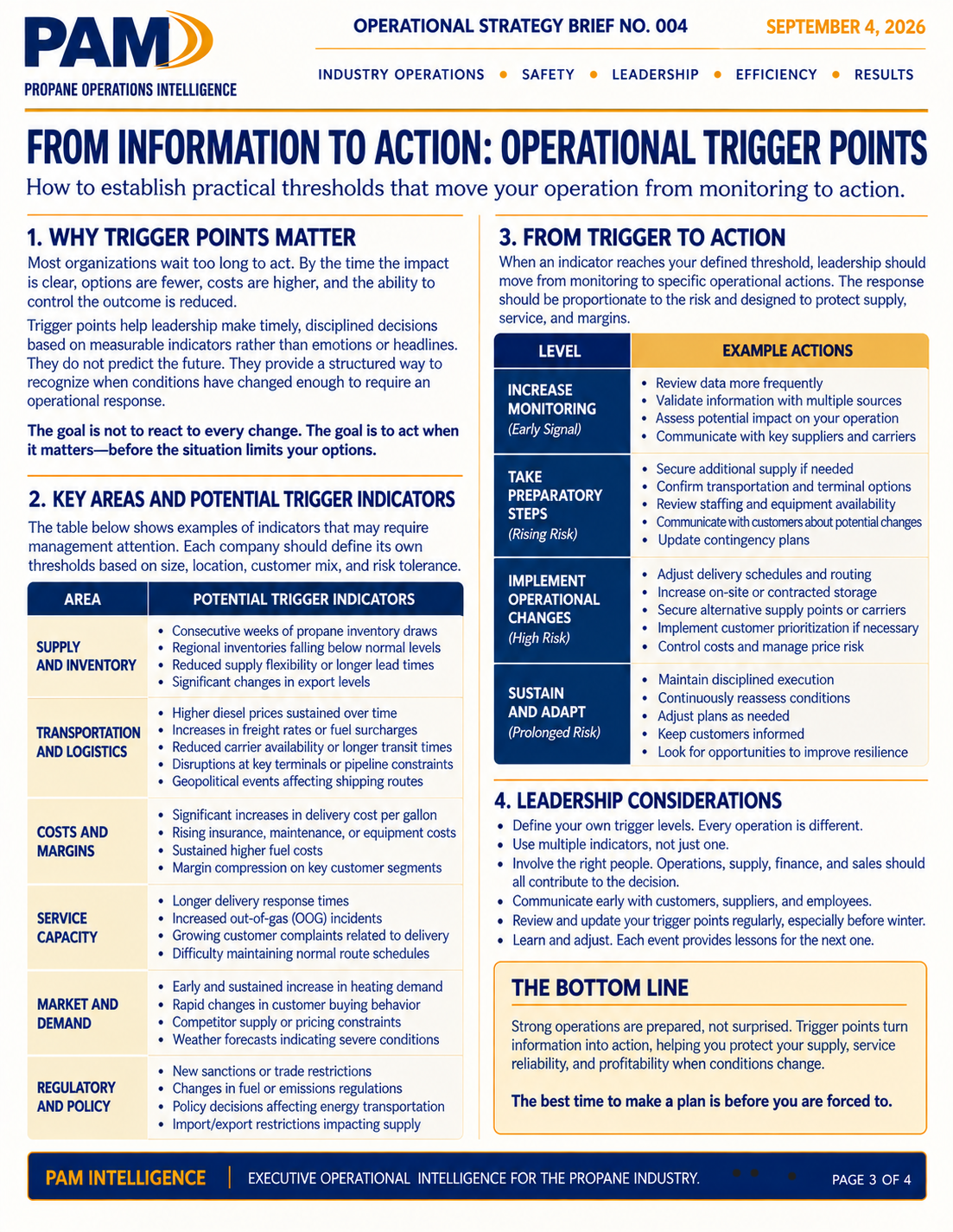
How to establish practical thresholds that move your operation from monitoring to action.
1. Why Trigger Points Matter
Most organizations wait too long to act. By the time the impact is clear, options are fewer, costs are higher, and the ability to control the outcome is reduced.
Trigger points help leadership make timely, disciplined decisions based on measurable indicators rather than emotions or headlines.
They do not predict the future. They provide a structured way to recognize when conditions have changed enough to require an operational response.
The goal is not to react to every change. The goal is to act when it matters—before the situation limits your options.
2. Key Areas and Potential Trigger Indicators
The table below shows examples of indicators that may require management attention.
Each company should define its own thresholds based on size, location, customer mix, and risk tolerance.
Supply and Inventory
- Consecutive weeks of propane inventory draws
- Regional inventories falling below normal levels
- Reduced supply flexibility or longer lead times
- Significant changes in export levels
Transportation and Logistics
- Higher diesel prices sustained over time
- Increases in freight rates or fuel surcharges
- Reduced carrier availability or longer transit times
- Disruptions at key terminals or pipeline constraints
- Geopolitical events affecting shipping routes
Costs and Margins
- Significant increases in delivery cost per gallon
- Rising insurance, maintenance, or equipment costs
- Sustained higher fuel costs
- Margin compression on key customer segments
Service Capacity
- Longer delivery response times
- Increased out-of-gas (OOG) incidents
- Growing customer complaints related to delivery
- Difficulty maintaining normal route schedules
Market and Demand
- Early and sustained increase in heating demand
- Rapid changes in customer buying behavior
- Competitor supply or pricing constraints
- Weather forecasts indicating severe conditions
Regulatory and Policy
- New sanctions or trade restrictions
- Changes in fuel or emissions regulations
- Policy decisions affecting energy transportation
- Import/export restrictions impacting supply
3. From Trigger to Action
When an indicator reaches your defined threshold, leadership should move from monitoring to specific operational actions.
The response should be proportionate to the risk and designed to protect supply, service, and margins.
Level: Increase Monitoring (Early Signal)
- Review data more frequently
- Validate information with multiple sources
- Assess potential impact on your operation
- Communicate with key suppliers and carriers
Level: Take Preparatory Steps (Rising Risk)
- Secure additional supply if needed
- Confirm transportation and terminal options
- Review staffing and equipment availability
- Communicate with customers about potential changes
- Update contingency plans
Level: Implement Operational Changes (High Risk)
- Adjust delivery schedules and routing
- Increase on-site or contracted storage
- Secure alternative supply points or carriers
- Implement customer prioritization if necessary
- Control costs and manage price risk
Level: Sustain and Adapt (Prolonged Risk)
- Maintain disciplined execution
- Continuously reassess conditions
- Adjust plans as needed
- Keep customers informed
- Look for opportunities to improve resilience
4. Leadership Considerations
- Define your own trigger levels. Every operation is different.
- Use multiple indicators, not just one.
- Involve the right people. Operations, supply, finance, and sales should all contribute to the decision.
- Communicate early with customers, suppliers, and employees.
- Review and update your trigger points regularly, especially before winter.
- Learn and adjust. Each event provides lessons for the next one.
Leadership Action Plan: Be Prepared, Not Reactive
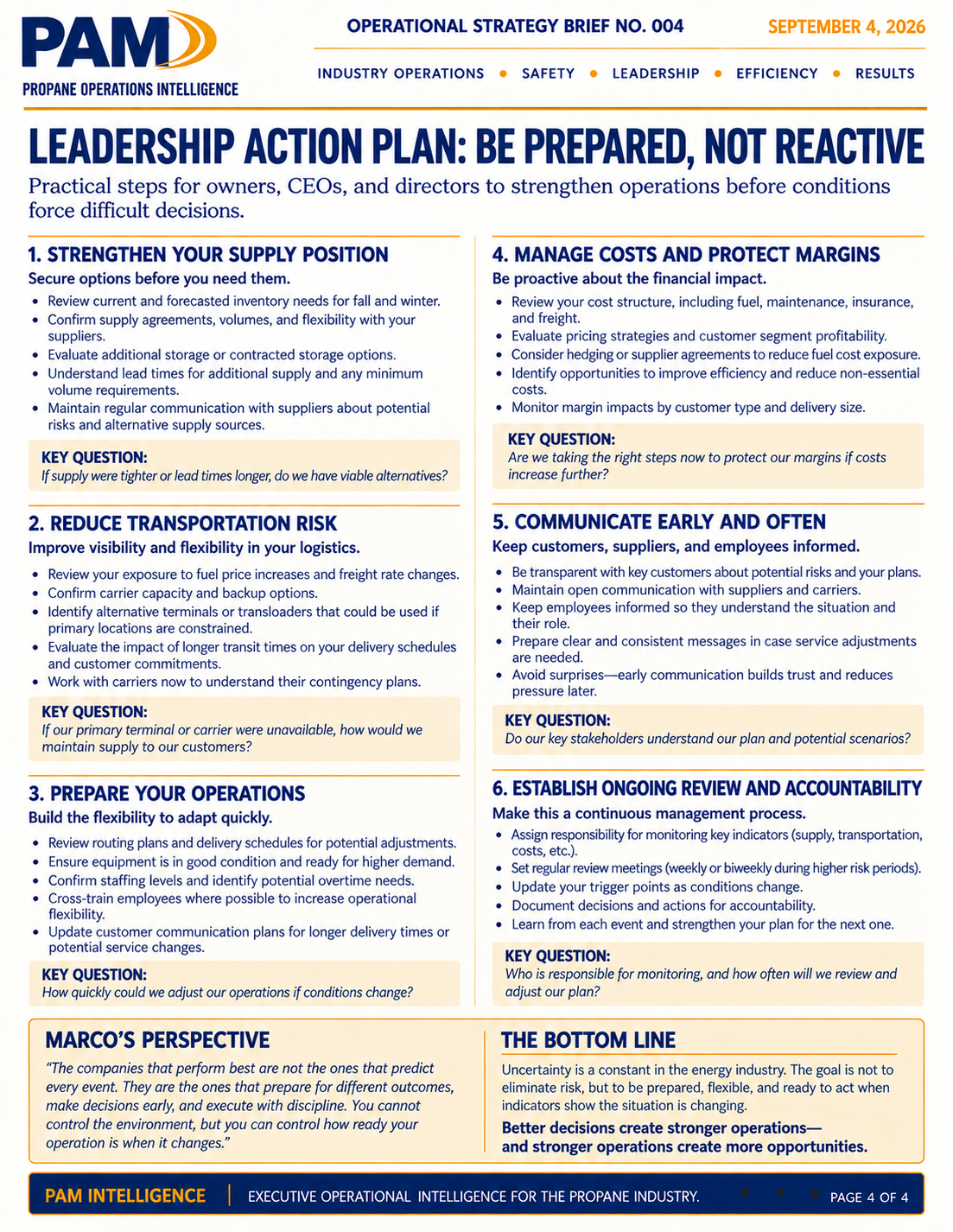
Practical steps for owners, CEOs, and directors to strengthen operations before conditions force difficult decisions.
1. Strengthen Your Supply Position
Secure options before you need them.
- Review current and forecasted inventory needs for fall and winter.
- Confirm supply agreements, volumes, and flexibility with your suppliers.
- Evaluate additional storage or contracted storage options.
- Understand lead times for additional supply and any minimum volume requirements.
- Maintain regular communication with suppliers about potential risks and alternative supply sources.
Key Question: If supply were tighter or lead times longer, do we have viable alternatives?
2. Reduce Transportation Risk
Improve visibility and flexibility in your logistics.
- Review your exposure to fuel price increases and freight rate changes.
- Confirm carrier capacity and backup options.
- Identify alternative terminals or transloaders that could be used if primary locations are constrained.
- Evaluate the impact of longer transit times on your delivery schedules and customer commitments.
- Work with carriers now to understand their contingency plans.
Key Question: If our primary terminal or carrier were unavailable, how would we maintain supply to our customers?
3. Prepare Your Operations
Build the flexibility to adapt quickly.
- Review routing plans and delivery schedules for potential adjustments.
- Ensure equipment is in good condition and ready for higher demand.
- Confirm staffing levels and identify potential overtime needs.
- Cross-train employees where possible to increase operational flexibility.
- Update customer communication plans for longer delivery times or potential service changes.
Key Question: How quickly could we adjust our operations if conditions change?
4. Manage Costs and Protect Margins
Be proactive about the financial impact.
- Review your cost structure, including fuel, maintenance, insurance, and freight.
- Evaluate pricing strategies and customer segment profitability.
- Consider hedging or supplier agreements to reduce fuel cost exposure.
- Identify opportunities to improve efficiency and reduce non-essential costs.
- Monitor margin impacts by customer type and delivery size.
Key Question: Are we taking the right steps now to protect our margins if costs increase further?
5. Communicate Early and Often
Keep customers, suppliers, and employees informed.
- Be transparent with key customers about potential risks and your plans.
- Maintain open communication with suppliers and carriers.
- Keep employees informed so they understand the situation and their role.
- Prepare clear and consistent messages in case service adjustments are needed.
- Avoid surprises—early communication builds trust and reduces pressure later.
Key Question: Do our key stakeholders understand our plan and potential scenarios?
6. Establish Ongoing Review and Accountability
Make this a continuous management process.
- Assign responsibility for monitoring key indicators (supply, transportation, costs, etc.).
- Set regular review meetings (weekly or biweekly during higher risk periods).
- Update your trigger points as conditions change.
- Document decisions and actions for accountability.
- Learn from each event and strengthen your plan for the next one.
Key Question: Who is responsible for monitoring, and how often will we review and adjust our plan?
Marco’s Perspective“The companies that perform best are not the ones that predict every event. They are the ones that prepare for different outcomes, make decisions early, and execute with discipline. You cannot control the environment, but you can control how ready your operation is when it changes.”