Web Edition
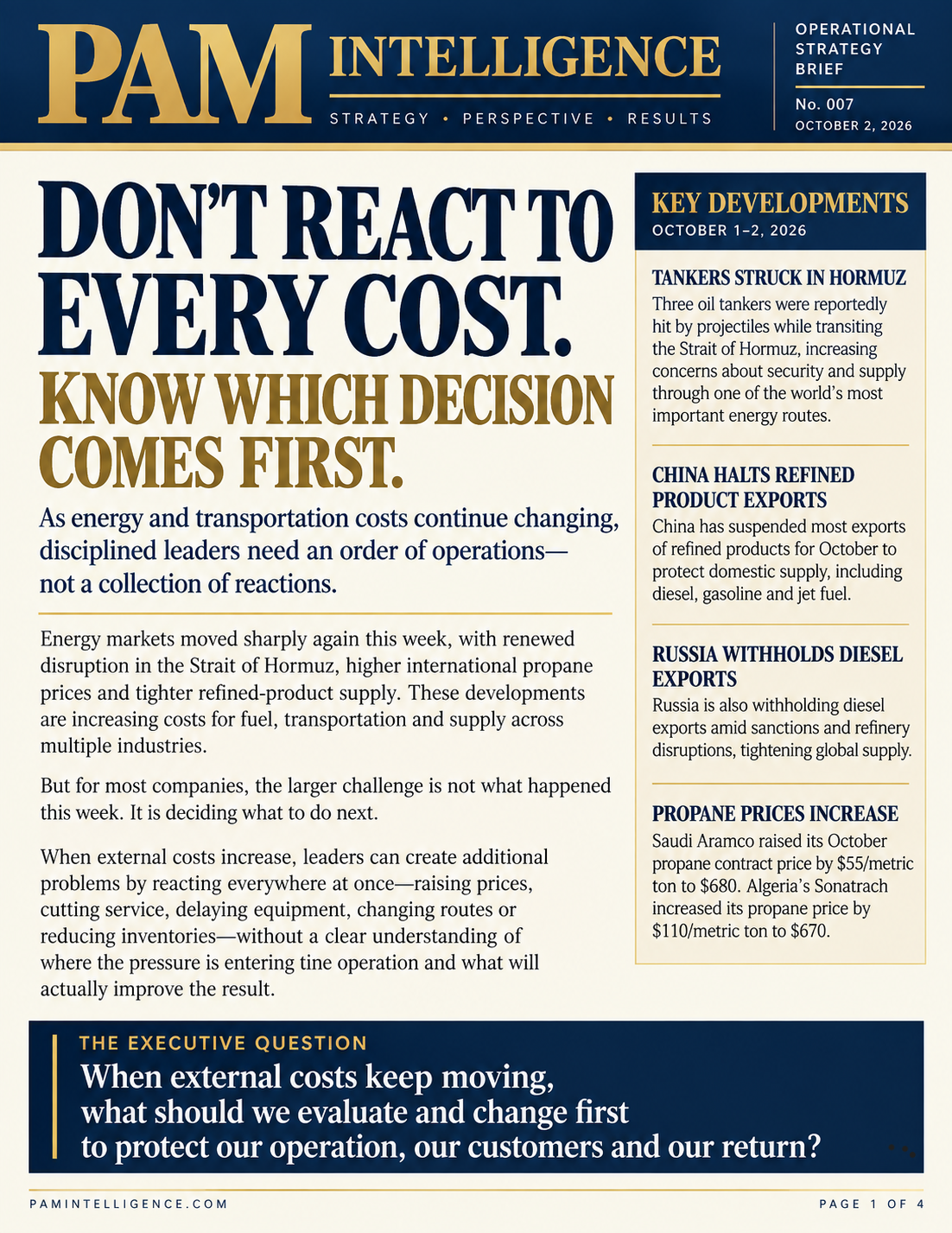
When external costs keep moving, what should we evaluate and change first to protect our operation, our customers, and our return?
View Designed Edition4 original publication pagesDon’t React to Every Cost
Energy markets moved sharply again this week, with renewed disruption in the Strait of Hormuz, higher international propane prices, and tighter refined-product supply. These developments were increasing costs for fuel, transportation, and supply across multiple industries.
But for most companies, the larger challenge was not what happened that week. It was deciding what to do next.
When external costs increase, leaders can create additional problems by reacting everywhere at once—raising prices, cutting service, delaying equipment, changing routes, or reducing inventories—without a clear understanding of where the pressure is entering the operation and what will actually improve the result.
Key Developments — October 1–2, 2026
Historical trigger/events: These events explain the context in which the brief was published. They must not be read as present-day conditions.
Tankers Struck in Hormuz
Three oil tankers were reportedly hit by projectiles while transiting the Strait of Hormuz, increasing concerns about security and supply through one of the world’s most important energy routes.
China Halts Refined Product Exports
China suspended most exports of refined products for October to protect domestic supply, including diesel, gasoline, and jet fuel.
Russia Withholds Diesel Exports
Russia was also withholding diesel exports amid sanctions and refinery disruptions, tightening global supply.
Propane Prices Increase
Saudi Aramco raised its October propane contract price by $55 per metric ton to $680. Algeria’s Sonatrach increased its propane price by $110 per metric ton to $670.
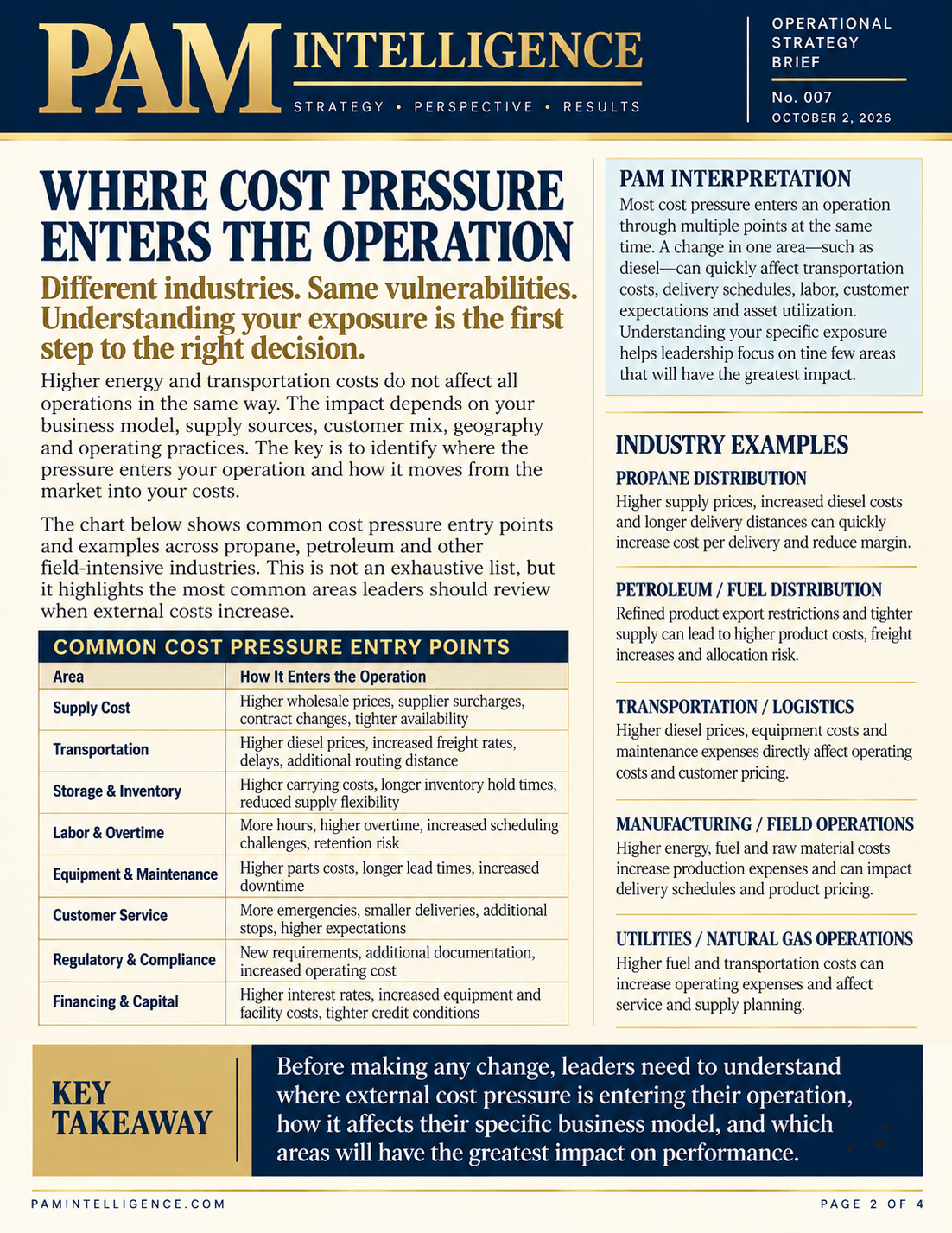
Where Cost Pressure Enters the Operation
Different industries. Same vulnerabilities. Understanding your exposure is the first step to the right decision.
Higher energy and transportation costs do not affect all operations in the same way. The impact depends on your business model, supply sources, customer mix, geography, and operating practices. The key is to identify where the pressure enters your operation and how it moves from the market into your costs.
The common entry points below are examples across propane, petroleum, and other field-intensive industries. They are not exhaustive, but they highlight the areas leaders should review when external costs increase.
Common Cost Pressure Entry Points
| Area | How it enters the operation |
|---|---|
| Supply Cost | Higher wholesale prices, supplier surcharges, contract changes, and tighter availability. |
| Transportation | Higher diesel prices, increased freight rates, delays, and additional routing distance. |
| Storage & Inventory | Higher carrying costs, longer inventory hold times, and reduced supply flexibility. |
| Labor & Overtime | More hours, higher overtime, increased scheduling challenges, and retention risk. |
| Equipment & Maintenance | Higher parts costs, longer lead times, and increased downtime. |
| Customer Service | More emergencies, smaller deliveries, additional stops, and higher expectations. |
| Regulatory & Compliance | New requirements, additional documentation, and increased operating cost. |
| Financing & Capital | Higher interest rates, increased equipment and facility costs, and tighter credit conditions. |
Industry Examples
Propane Distribution
Higher supply prices, increased diesel costs, and longer delivery distances can quickly increase cost per delivery and reduce margin.
Petroleum / Fuel Distribution
Refined-product export restrictions and tighter supply can lead to higher product costs, freight increases, and allocation risk.
Transportation / Logistics
Higher diesel prices, equipment costs, and maintenance expenses directly affect operating costs and customer pricing.
Manufacturing / Field Operations
Higher energy, fuel, and raw-material costs increase production expenses and can impact delivery schedules and product pricing.
Utilities / Natural Gas Operations
Higher fuel and transportation costs can increase operating expenses and affect service and supply planning.
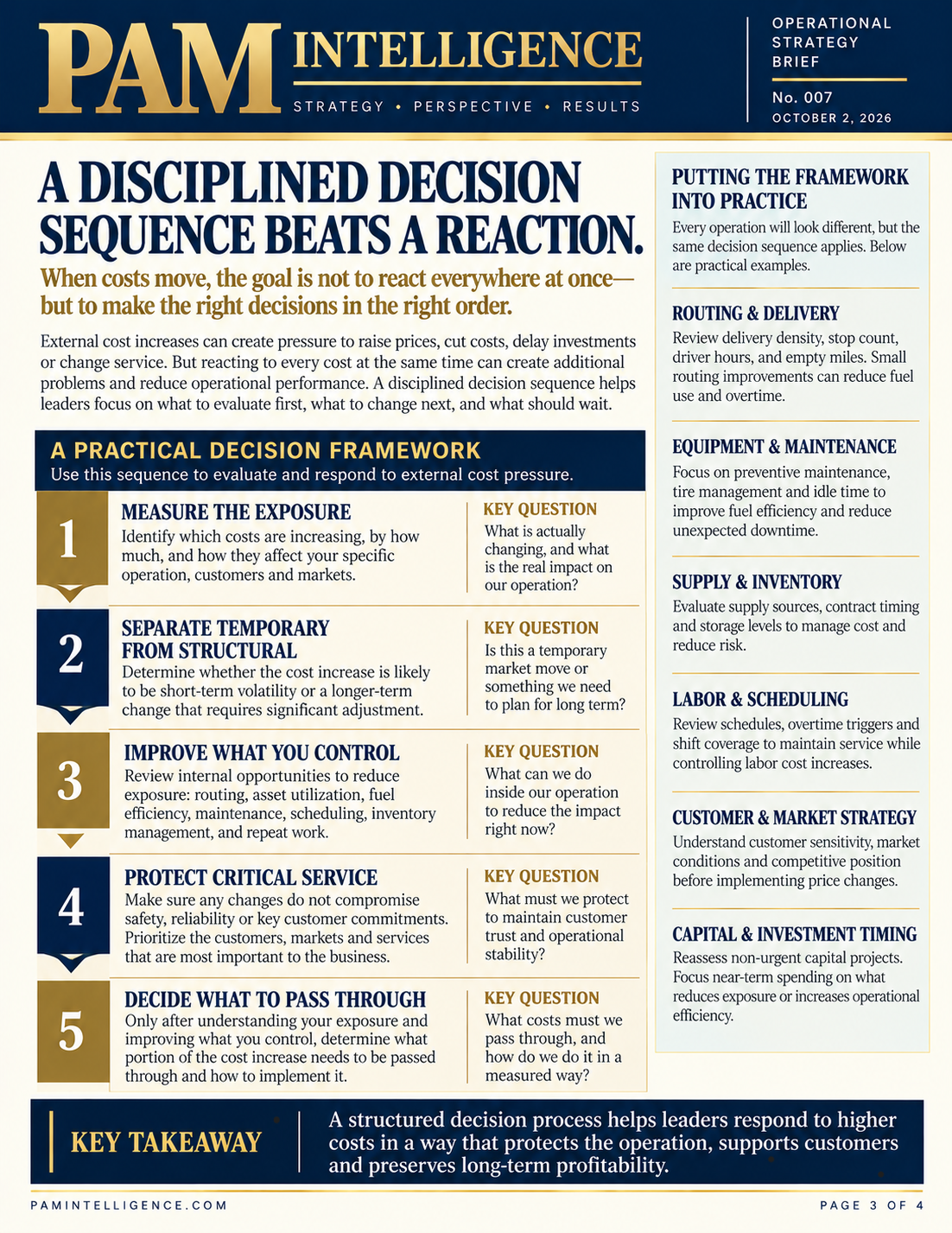
A Disciplined Decision Sequence Beats a Reaction
When costs move, the goal is not to react everywhere at once—but to make the right decisions in the right order.
External cost increases can create pressure to raise prices, cut costs, delay investments, or change service. But reacting to every cost at the same time can create additional problems and reduce operating performance. A disciplined decision sequence helps leaders focus on what to evaluate first, what to change next, and what should wait.
A Practical Decision Framework
- Measure the Exposure. Identify which costs are increasing, by how much, and how they affect your specific operation, customers, and markets. Ask: What is actually changing, and what is the real impact on our operation?
- Separate Temporary from Structural. Determine whether the cost increase is likely to be short-term volatility or a longer-term change that requires significant adjustment. Ask: Is this a temporary market move or something we need to plan for long term?
- Improve What You Control. Review internal opportunities to reduce exposure: routing, asset utilization, fuel efficiency, maintenance, scheduling, inventory management, and repeat work. Ask: What can we do inside our operation to reduce the impact right now?
- Protect Critical Service. Make sure any changes do not compromise safety, reliability, or key customer commitments. Prioritize the customers, markets, and services that are most important to the business. Ask: What must we protect to maintain customer trust and operational stability?
- Decide What to Pass Through. Only after understanding your exposure and improving what you control, determine what portion of the cost increase needs to be passed through and how to implement it. Ask: What costs must we pass through, and how do we do it in a measured way?
Putting the Framework into Practice
Routing & Delivery
Review delivery density, stop count, driver hours, and empty miles. Small routing improvements can reduce fuel use and overtime.
Equipment & Maintenance
Focus on preventive maintenance, tire management, and idle time to improve fuel efficiency and reduce unexpected downtime.
Supply & Inventory
Evaluate supply sources, contract timing, and storage levels to manage cost and reduce risk.
Labor & Scheduling
Review schedules, overtime triggers, and shift coverage to maintain service while controlling labor cost increases.
Customer & Market Strategy
Understand customer sensitivity, market conditions, and competitive position before implementing price changes.
Capital & Investment Timing
Reassess non-urgent capital projects. Focus near-term spending on what reduces exposure or increases operational efficiency.
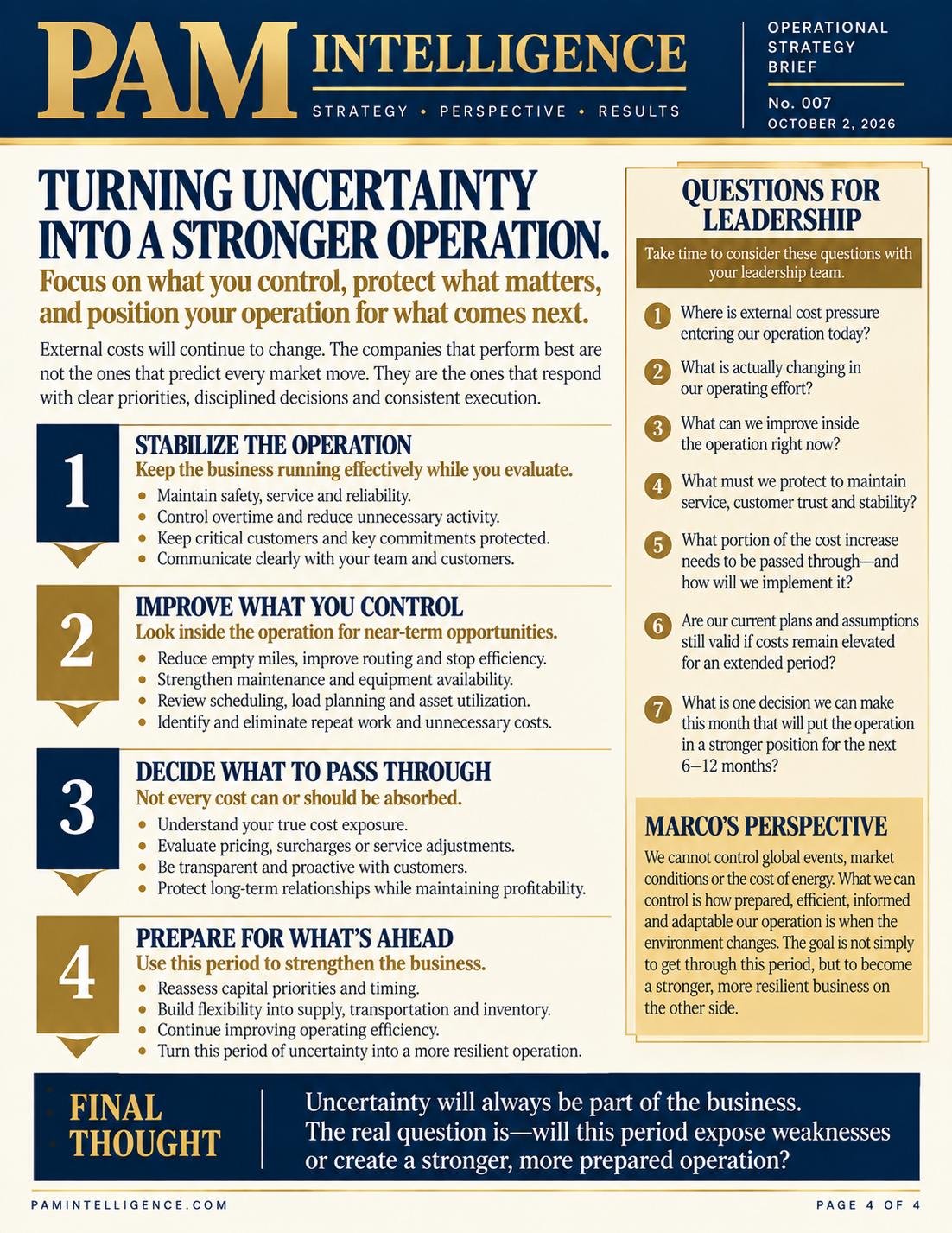
Turning Uncertainty into a Stronger Operation
Focus on what you control, protect what matters, and position your operation for what comes next.
External costs will continue to change. The companies that perform best are not the ones that predict every market move. They are the ones that respond with clear priorities, disciplined decisions, and consistent execution.
- Stabilize the Operation. Keep the business running effectively while you evaluate. Maintain safety, service, and reliability; control overtime and reduce unnecessary activity; keep critical customers and key commitments protected; and communicate clearly with your team and customers.
- Improve What You Control. Look inside the operation for near-term opportunities. Reduce empty miles, improve routing and stop efficiency, strengthen maintenance and equipment availability, review scheduling, load planning, and asset utilization, and eliminate repeat work and unnecessary costs.
- Decide What to Pass Through. Not every cost can or should be absorbed. Understand your true cost exposure, evaluate pricing, surcharges, or service adjustments, be transparent and proactive with customers, and protect long-term relationships while maintaining profitability.
- Prepare for What’s Ahead. Use this period to strengthen the business. Reassess capital priorities and timing, build flexibility into supply, transportation, and inventory, continue improving operating efficiency, and turn uncertainty into a more resilient operation.
Questions for Leadership
- Where is external cost pressure entering our operation today?
- What is actually changing in our operating effort?
- What can we improve inside the operation right now?
- What must we protect to maintain service, customer trust, and stability?
- What portion of the cost increase needs to be passed through—and how will we implement it?
- Are our current plans and assumptions still valid if costs remain elevated for an extended period?
- What is one decision we can make this month that will put the operation in a stronger position for the next 6–12 months?
ASK PAM
Management Question → PAM Answer → Management Decision
Management Question: “Costs are increasing in several parts of my operation. What should I change first?”
PAM Answer: Do not begin by reacting to every cost increase. First identify where the pressure is entering the operation and how material the impact is. Separate temporary market movement from structural change. Then improve controllable operating factors before deciding what must be passed through to customers.
- What is happening? External cost pressure may be entering through supply, transportation, inventory, labor, equipment, customer service, compliance, or capital.
- What should we measure? Measure the size of each cost change and its effect on routes, labor, equipment, service, customers, and margin.
- What may be causing it? Determine whether the pressure is temporary market volatility, a structural change, or internal inefficiency that magnifies the external increase.
- What can management control? Improve routing, asset utilization, fuel efficiency, maintenance, scheduling, inventory management, and repeat work while protecting safety, reliability, and critical service.
- What decision may need to be made? After controllable exposure is addressed, decide whether pricing, surcharges, service, sourcing, or investment timing must change.
- What practical step comes next? Build a prioritized exposure review covering supply, transportation, labor, equipment, service, inventory, and capital. Address the largest controllable sources first, protect critical service, and only then determine what must be passed through.
Management Decision: Use the five-step framework—measure exposure, separate temporary from structural, improve what you control, protect critical service, and decide what to pass through—to establish the order of action.