Web Edition
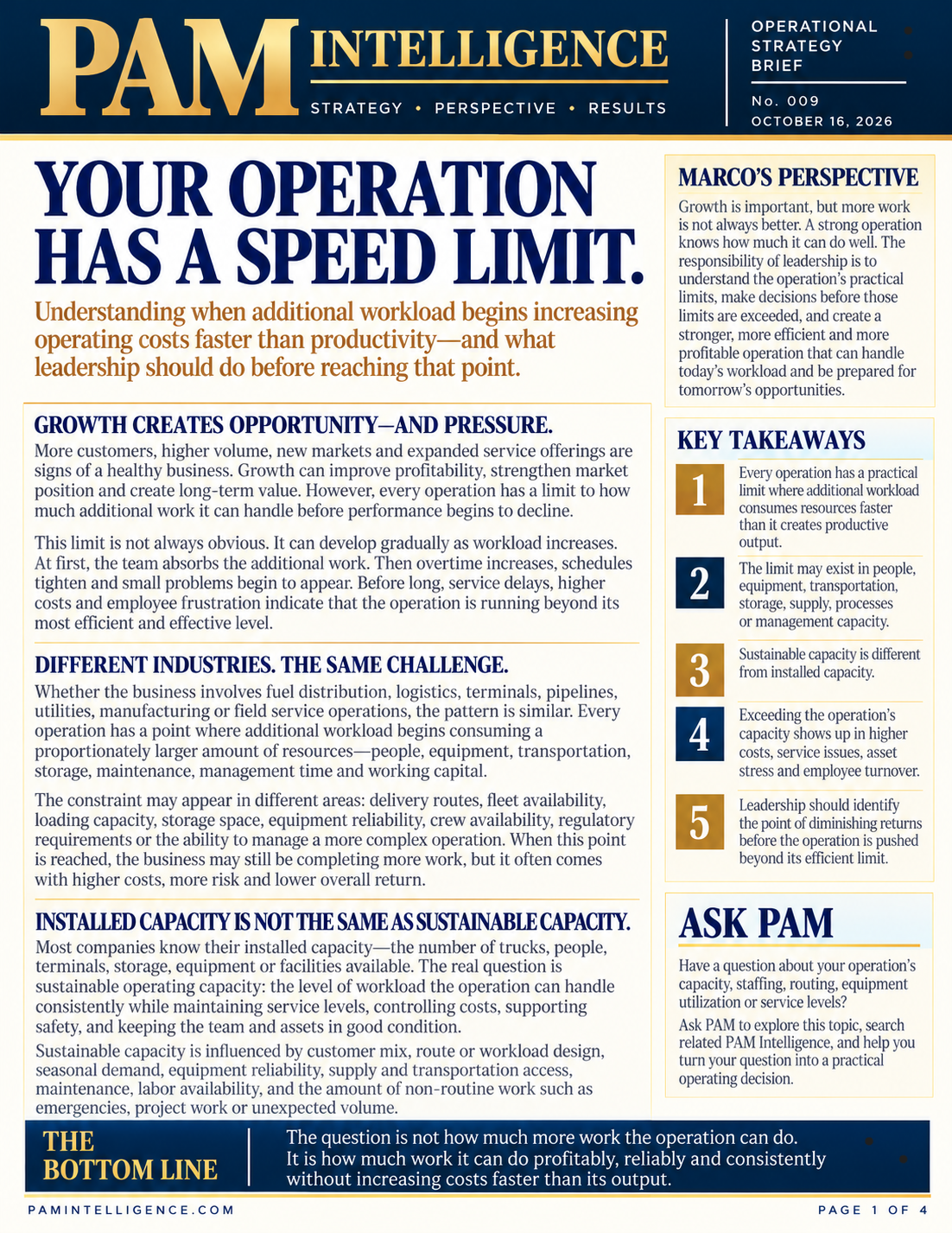
The question is not how much more work the operation can do. It is how much work it can do profitably, reliably, and consistently without increasing costs faster than its output.
View Designed Edition4 original publication pagesYour Operation Has a Speed Limit
Growth Creates Opportunity—and Pressure
More customers, higher volume, new markets, and expanded service offerings are signs of a healthy business. Growth can improve profitability, strengthen market position, and create long-term value. However, every operation has a practical limit to how much additional work it can handle before performance begins to decline.
This limit may develop gradually. The team initially absorbs the work. Then overtime increases, schedules tighten, and small problems appear. Service delays, higher costs, employee frustration, and stress on assets can show that the operation is running beyond its efficient and effective level.
Different Industries. The Same Challenge.
The pattern applies across fuel distribution, logistics, terminals, pipelines, utilities, manufacturing, and field service. The limiting point may appear in delivery routes, fleet availability, loading capacity, storage, equipment reliability, crew availability, regulatory requirements, or management’s ability to handle complexity.
Installed Capacity Is Not Sustainable Capacity
Installed capacity is the trucks, people, terminals, storage, equipment, or facilities available. Usable capacity is the portion that can actually be deployed under present operating conditions. Sustainable capacity is the workload the operation can handle consistently while maintaining service levels, controlling costs, supporting safety, and keeping people and assets in good condition.
Sustainable capacity depends on customer mix, route and workload design, seasonal demand, equipment reliability, supply and transportation access, maintenance, labor availability, and non-routine work.
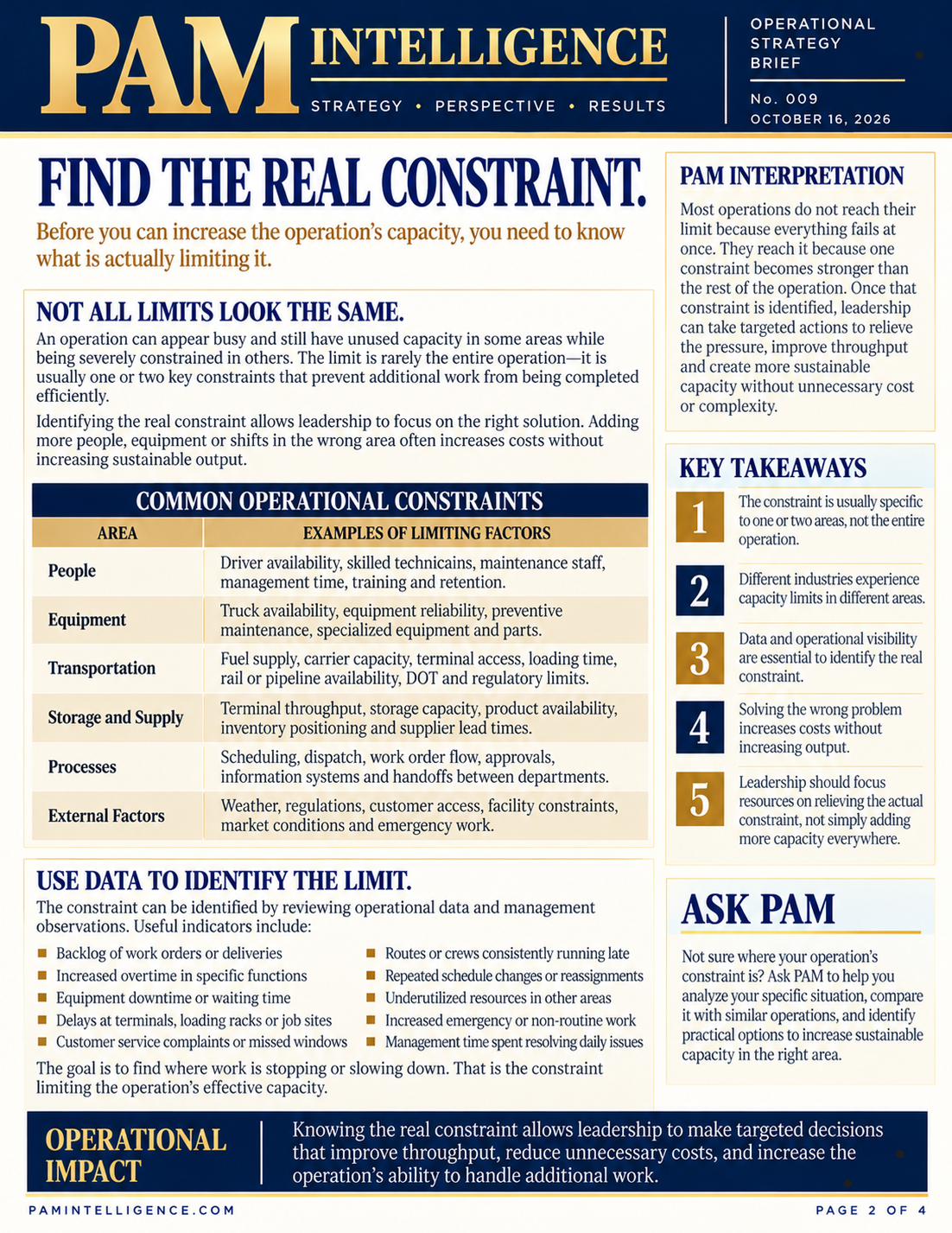
Find the Real Constraint
Before increasing capacity, identify what is actually limiting it.
An operation can appear busy while unused capacity exists in some areas and severe constraints exist in others. The limit is rarely the entire operation. One or two key constraints usually prevent additional work from being completed efficiently. Adding people, equipment, or shifts in the wrong area can increase cost without increasing sustainable output.
Six Common Operational Constraints
- People. Driver availability, skilled technicians, maintenance staff, management time, training, and retention.
- Equipment. Truck availability, reliability, preventive maintenance, specialized equipment, and parts.
- Transportation. Fuel supply, carrier capacity, terminal access, loading time, rail or pipeline availability, and regulatory limits.
- Storage and Supply. Terminal throughput, storage capacity, product availability, inventory positioning, and supplier lead times.
- Processes. Scheduling, dispatch, work-order flow, approvals, information systems, and departmental handoffs.
- External Factors. Weather, regulations, customer access, facility constraints, market conditions, and emergency work.
Use Data to Identify the Limit
Look for backlog; rising overtime in specific functions; equipment downtime or waiting; terminal, loading-rack, or job-site delays; customer complaints or missed windows; late routes or crews; repeated schedule changes and reassignments; underutilized resources elsewhere; emergency or non-routine work; and management time spent resolving daily issues.
The goal is to find where work is actually stopping or slowing. Do not assume the entire operation lacks capacity when a localized constraint limits throughput.
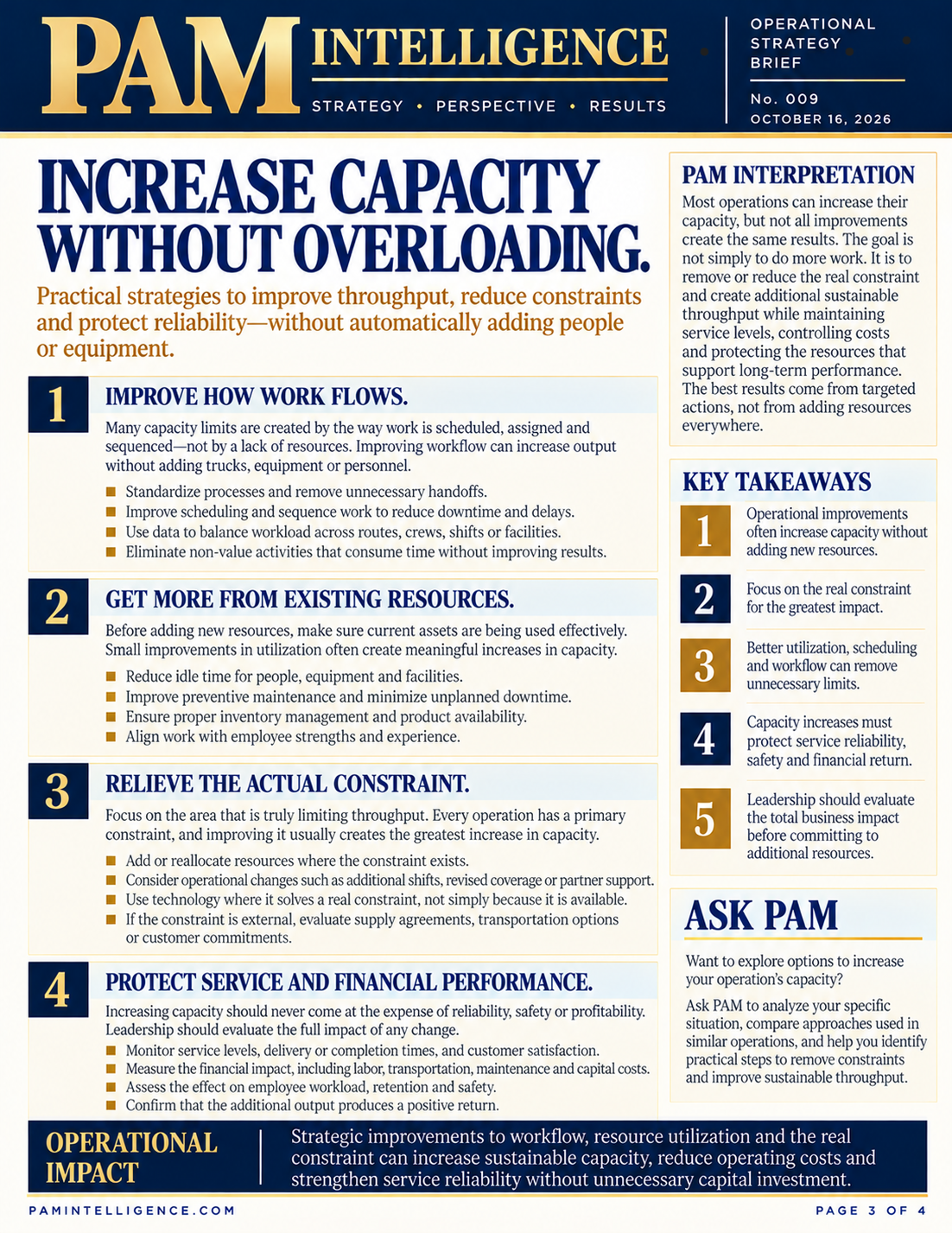
Increase Capacity Without Overloading
Improve throughput, reduce constraints, and protect reliability—without automatically adding people or equipment.
Improve How Work Flows
Standardize processes and remove unnecessary handoffs. Improve scheduling and work sequencing. Balance workload across routes, crews, shifts, or facilities. Eliminate non-value activity.
Get More From Existing Resources
Reduce idle time for people, equipment, and facilities. Improve preventive maintenance. Maintain inventory and product availability. Align work with employee strengths and experience.
Relieve the Actual Constraint
Add or reallocate resources where the constraint exists. Consider shifts, coverage, partner support, appropriate technology, supply agreements, transportation options, or customer commitments.
Protect Service and Financial Performance
Monitor service levels, delivery or completion times, and customer satisfaction. Measure labor, transportation, maintenance, capital cost, employee workload, retention, and safety. Confirm that added output produces a positive return.
Leadership should reason in sequence: installed capacity → usable capacity → sustainable capacity → actual constraint → required investment. High workload alone does not justify adding people, trucks, equipment, facilities, shifts, storage, or technology.
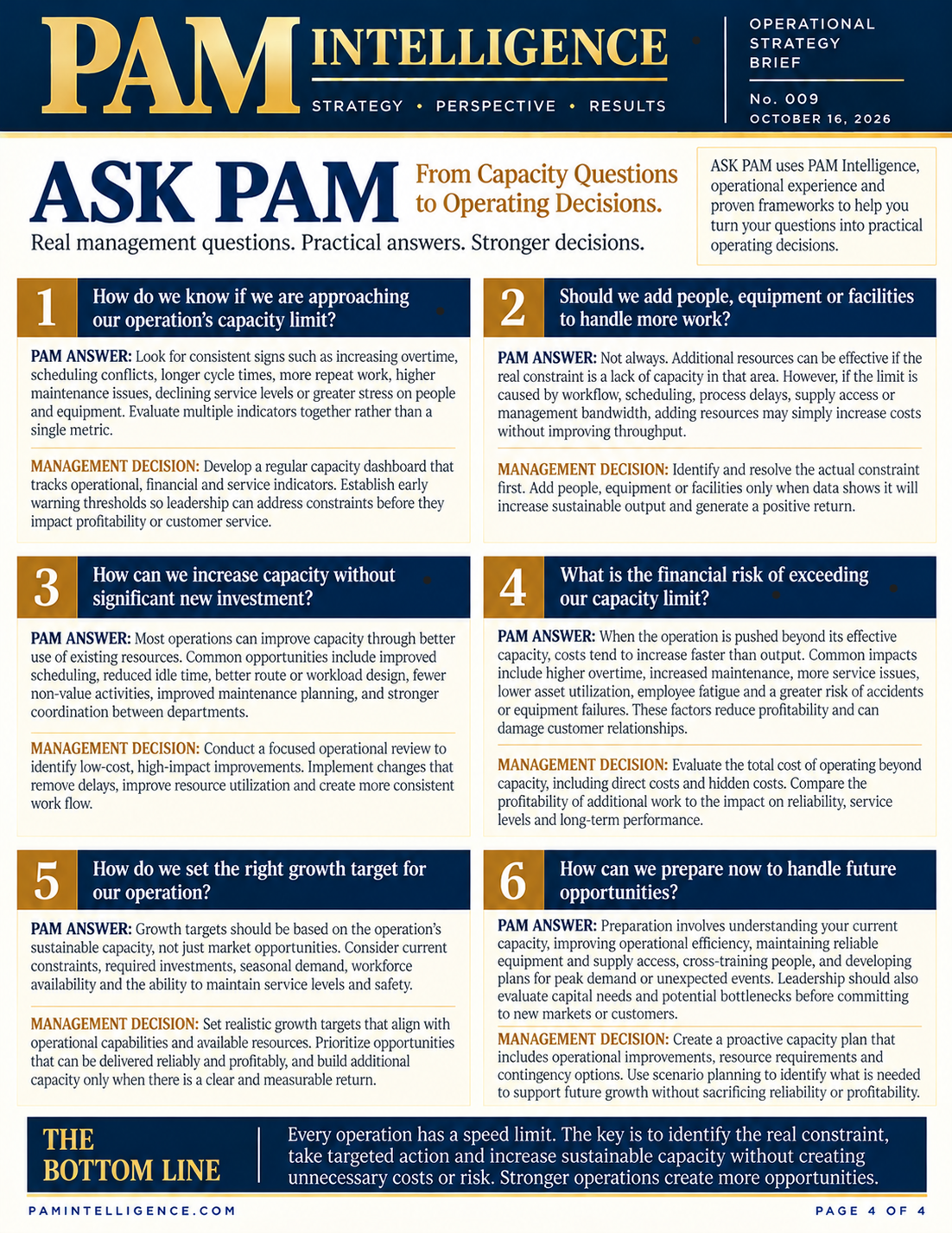
ASK PAM: From Capacity Questions to Operating Decisions
How do we know if we are approaching our operation’s capacity limit?
PAM Answer: Look for consistent signs such as increasing overtime, scheduling conflicts, longer cycle times, repeat work, maintenance issues, declining service levels, or stress on people and equipment. Evaluate several indicators together rather than one metric.
Management Decision: Develop a regular capacity dashboard that tracks operational, financial, and service indicators. Establish early-warning thresholds.
Should we add people, equipment, or facilities to handle more work?
PAM Answer: Not always. Add resources only if the real constraint is a lack of capacity in that area. If the limit is workflow, scheduling, process delay, supply access, or management bandwidth, more resources may increase cost without improving throughput.
Management Decision: Identify and resolve the actual constraint first. Add resources only when data shows they will increase sustainable output and produce a positive return.
How can we increase capacity without significant new investment?
PAM Answer: Improve use of existing resources through scheduling, less idle time, route or workload design, fewer non-value activities, stronger maintenance planning, and better coordination.
Management Decision: Conduct a focused operational review, identify low-cost high-impact improvements, and implement changes that remove delays and improve utilization.
What is the financial risk of exceeding our capacity limit?
PAM Answer: Costs can rise faster than output through overtime, maintenance, service problems, lower utilization, employee fatigue, accidents, equipment failures, lost customers, and reduced profitability.
Management Decision: Evaluate direct and hidden costs of operating beyond capacity. Compare the profitability of added work with effects on reliability, service, and long-term performance.
How do we set the right growth target for our operation?
PAM Answer: Base growth targets on sustainable capacity, current constraints, required investments, seasonal demand, workforce availability, and the ability to maintain service and safety.
Management Decision: Set realistic targets aligned with operational capability and available resources. Build capacity only when there is a clear, measurable return.
How can we prepare now to handle future opportunities?
PAM Answer: Understand current capacity, improve efficiency, maintain reliable equipment and supply access, cross-train people, and plan for peak demand and unexpected events. Evaluate capital needs and bottlenecks before committing.
Management Decision: Create a proactive capacity plan containing operational improvements, resource requirements, and contingency options.
ASK PAM
Diagnose Capacity Before Adding Resources
Reason through: What is happening? → What should we measure? → Where is work slowing or stopping? → What may be causing it? → What can management control? → Can existing capacity be improved? → What decision is justified?
Useful inputs include backlog, stops, routes, jobs, volume, miles, driver or technician hours, overtime, equipment availability, downtime, utilization, loading or terminal delays, storage utilization, service levels, missed windows, repeat work, seasonal workload, emergency work, staffing coverage, and management workload.
If operation-specific data is missing, ASK PAM should request it instead of inventing values. It must distinguish a true capacity shortage from a workflow or localized-constraint problem and should not automatically recommend adding resources.